Canada


A specification-first buyer’s guide for signs and identification
Choose Workplace Safety Products With a Site Audit
Short answer. Do not start with a catalogue. Start with a site audit that names the hazard or information need, audience, jurisdiction, viewing conditions, environment and control owner. Then specify the message, symbol, language, size, substrate, attachment and inspection plan. A workplace safety sign or label can support a safety system, but it cannot replace hazard elimination, engineering controls, procedures, training or required protective equipment.

Specify visual safety products from the hazard, viewing conditions, jurisdiction, substrate and maintenance plan—not from a generic catalogue category.
Audit the site before buying workplace safety products
Walk the work in operating conditions with a competent person and worker input. Photograph or map each decision point: entrances, equipment approaches, pipe runs, transfer containers, restricted areas, emergency equipment, traffic intersections and statutory posting locations. For every point, record what a person must notice and what action must follow.
Classify the problem before specifying a sign:
- What hazard, instruction, identity or legal posting need exists?
- Which workers, contractors, visitors or emergency responders need the information?
- From what approach, distance and angle must it be noticed?
- What lighting, dirt, moisture, UV, abrasion, heat or chemical exposure occurs?
- What language, literacy, colour-vision or accessibility needs matter?
- Which law, code, standard, procedure or site rule defines the message?
- Who installs, inspects, updates and removes the product?
If the hazard can be eliminated or better controlled, address that first. A warning sign beside an unguarded hazard does not turn an inadequate control into an adequate one.
Separate the product classes before comparing options
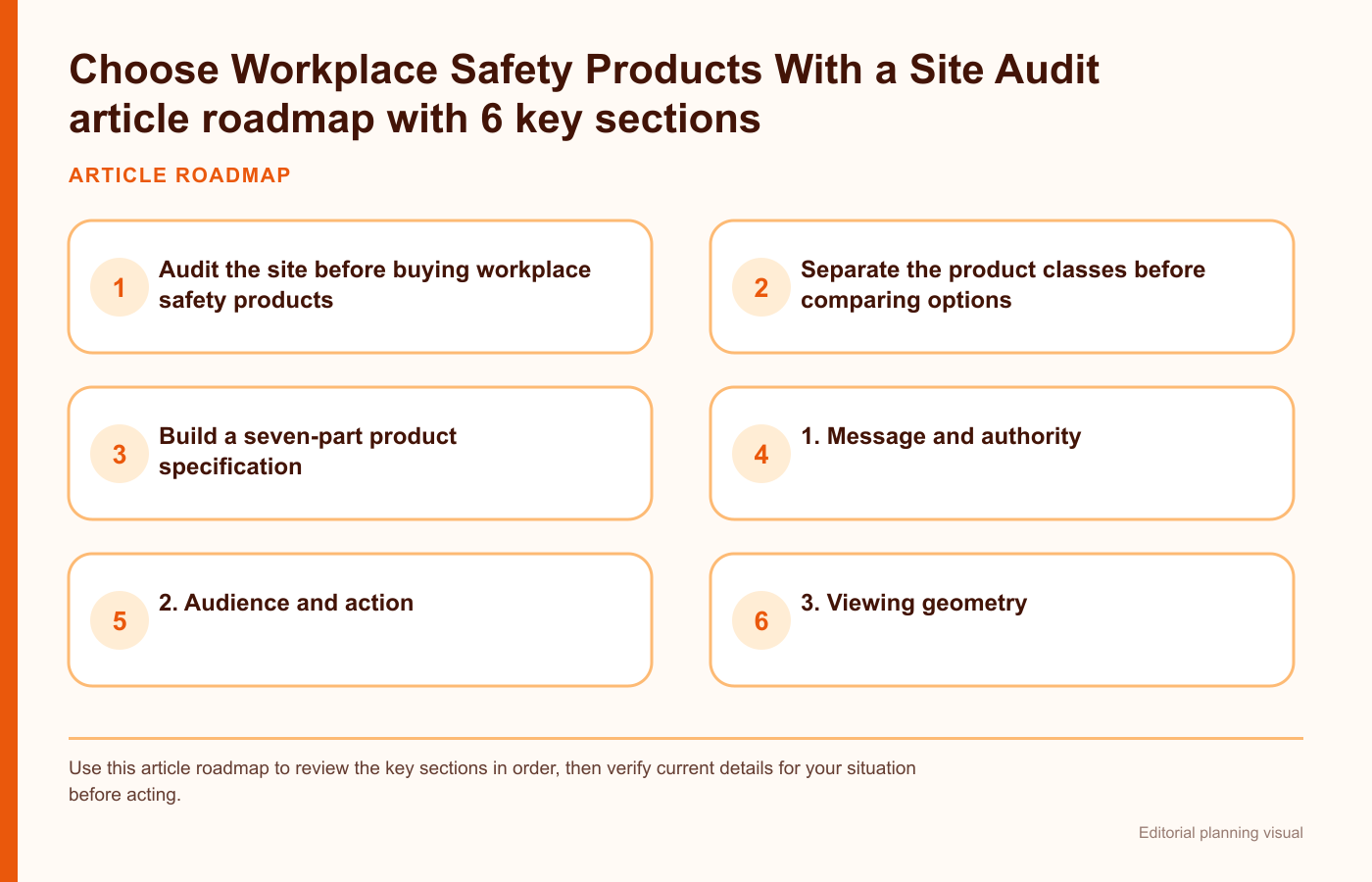
Use this article roadmap to review the key sections in order, then verify current details for your situation before acting.
| Product class | Primary job | Evidence needed | Common mismatch |
|---|---|---|---|
| Hazard or instruction sign | Warn, prohibit or direct an action at a location | Applicable message rules, audience, visibility and location | Generic wording that does not match the actual hazard or procedure |
| WHMIS workplace label | Identify a hazardous product and communicate required handling information | Product identifier, safe-handling information, SDS reference and jurisdiction | Decorative “chemical” sticker used instead of required label content |
| Pipe or process identification | Identify contents, direction or system consistently | Facility standard, system inventory, line conditions and placement logic | Marker material fails in the pipe temperature or cleaning environment |
| Emergency equipment identification | Help people find equipment or routes promptly | Applicable code, sight lines, obstructions and lighting | Sign is hidden when doors, pallets or vehicles are in normal positions |
| Traffic and floor marking | Define lanes, crossings, storage or exclusion zones | Traffic study, surface condition, vehicle type and maintenance method | Colour alone carries meaning that workers have not been trained to use |
| Statutory poster | Provide required rights, policy or contact information | Current jurisdiction, workplace coverage and official version | Old poster remains displayed after the official content changes |
VisionMarker’s Canadian homepage currently publishes categories including pipe markers, posters and signs, fire-protection identification, labels and stickers. Use those categories to structure a request, then require item-specific evidence rather than assuming every product under a category fits the site.
Build a seven-part product specification
1. Message and authority
Write the exact required message and identify its source. Distinguish legal or code language from a site reminder. Confirm the current rule with the applicable authority or safety professional.
2. Audience and action
Name who reads it and the action expected. “Danger” without a specific hazard and response may create recognition without useful action.
3. Viewing geometry
Record approach direction, minimum and maximum viewing distance, mounting height, obstructions and lighting. Confirm the size and layout against those conditions rather than a desk proof.
4. Environment
List indoor or outdoor exposure, temperature range, UV, water, washdown, oils, cleaners, solvents, abrasion, dust and surface texture. Ask for evidence relevant to the exact substrate, ink and adhesive.
5. Attachment
Specify the mounting surface, preparation, fastener or adhesive, removability and whether penetration is allowed. Consider condensation, paint condition and vibration.
6. Language and accessibility
Confirm jurisdictional language requirements and worker comprehension. Symbols can reinforce meaning, but training and clear text may still be required.
7. Lifecycle record
Assign an asset ID, installation date, inspection owner, replacement trigger and source artwork revision. A safety product becomes unreliable when no one knows whether its message is still current.
Match substrate ink and adhesive to actual exposure
Words such as “industrial,” “outdoor” or “chemical-resistant” are too broad for purchasing. Ask which chemicals, concentrations, contact duration, cleaning method, temperature, surface and expected exposure were tested. A material that tolerates occasional splash may not tolerate immersion or daily washdown.
Request a sample for difficult conditions. Prepare the surface exactly as instructed, install it in a representative location and document adhesion, legibility, colour, edge lift and cleaning response. A trial does not certify compliance, but it can reveal obvious material mismatch before a large order.
For pipe markers, include line diameter, insulation or cladding surface, operating temperature, outdoor exposure and flow-direction needs. For floor products, include pedestrian or vehicle traffic, surface coating, turning forces and cleaning equipment. For signs, include wind, impact and fastening constraints.
Design the information for the person who must act
A sign competes with equipment, noise, movement, other signs and routine familiarity. Reduce unnecessary words, establish a clear visual hierarchy and keep the action close to the hazard description. Avoid decorative type, low contrast and unexplained abbreviations.
CCOHS explains that WHMIS supplier and workplace labels have defined functions and that employers must confirm workplace-label requirements with their jurisdiction. A general safety sticker is not automatically a WHMIS label. Match the product identifier to the safety data sheet and preserve required information.
Test comprehension with people who perform the work. Ask what they think the sign means and what they would do next. If answers vary, revise the system, training or placement. Do not “solve” a comprehension problem by simply adding more signs.
Ask the supplier for item-level evidence
Before issuing a purchase order, request:
- product code, revision and current artwork proof;
- finished dimensions and readable copy;
- substrate, printing method, coating and adhesive or fastener details;
- documented environmental limitations;
- the exact standard, edition and clause claimed, if any;
- test report or declaration tied to the item—not a general logo;
- installation and surface-preparation instructions;
- lead time, proof approval, minimum quantity and change terms; and
- replacement, defect and artwork-error terms.
VisionMarker’s site names several standards and uses broad durability or certification language. That may prompt useful questions, but it is not enough to establish that a chosen product meets the latest applicable edition and workplace use. Ask VisionMarker to bind every claim to the exact SKU and documentation.
Plan installation inspection and change control
Install only after the message, location and authority are approved. Use a map or asset list so the installer can confirm the correct item at the correct point. Photograph the completed installation from the expected approach—not only close up.
Inspect for obstruction, fading, damage, edge lift, dirt, outdated information and changed processes. The interval should follow the hazard, environment, product instructions, site system and applicable rules. Add an immediate review trigger after equipment moves, incidents, new chemicals, route changes or procedural revisions.
CCOHS notes that posting obligations vary by jurisdiction and can change. Ontario also publishes a current list of posters required in covered workplaces. Maintain official postings separately from customized hazard and wayfinding products so an old custom print is not mistaken for the official current version.
Workplace safety product buying red flags
- “Compliant” without the item, standard edition, clause and evidence
- One material recommended for every chemical, surface and temperature
- Artwork approved without a site viewing-distance check
- A symbol copied from the internet without rights or applicability review
- No distinction between statutory posters, WHMIS labels and site reminders
- No installation instructions or surface requirements
- No inspection owner or replacement trigger
- Claims based on testimonials rather than item-specific documentation
Workplace safety product mistakes to avoid
- Buying signs before completing the hazard assessment
- Using signs as a substitute for stronger controls
- Overloading a location with competing messages
- Assuming a catalogue colour or signal word fits every jurisdiction
- Ignoring normal obstructions and lighting
- Specifying an adhesive without identifying the surface and cleaning method
- Failing to train workers on the identification system
- Leaving outdated signs in place after the process changes
Frequently asked questions
Does a safety sign make a workplace compliant?
No. Compliance depends on the applicable duties and the whole control system. A sign may be one required or supporting element, but it does not replace other controls.
Can a supplier certify that a sign is right for my site?
A supplier can provide product evidence. The employer and competent advisors must determine the applicable requirements, hazard, placement and system fit.
Are WHMIS labels the same as general warning signs?
No. WHMIS labels communicate information about hazardous products and have defined content responsibilities. Confirm the exact rules for the workplace jurisdiction.
How often should workplace signs be replaced?
There is no single interval for every product. Replace when the message is outdated, the sign is damaged or illegible, adhesion fails, exposure limits are reached or the applicable system requires it.
Prepare a decision-ready specification request
Send VisionMarker a schedule listing each location, product class, exact message source, dimensions, language, surface, exposure, attachment and quantity. Use the current contact route to request artwork proofs and item-level evidence for every material or standards claim. Have the final selection reviewed by the person responsible for the workplace’s legal and safety requirements before ordering.