Canada


Occupational safety program how-to guide
How to Build an Occupational Safety Program That Works
Short answer: Build an occupational safety program by first identifying the jurisdiction and duties that apply to each workplace, then involving workers in a documented hazard assessment. Prioritize elimination and engineering controls, assign accountable roles, train and supervise people, plan inspections and incident response, keep required records, and review the program when work or evidence changes. Signs and labels support communication; they do not replace hazard control.
Occupational safety is not a poster, binder or one-time orientation. It is an operating system for finding hazards, choosing controls, confirming that work is understood and learning when conditions change. The exact legal duties vary by jurisdiction, industry, employer size, hazard and work arrangement.
This how-to guide supplies a practical build sequence and clear stop conditions. It does not certify compliance or prescribe a sign, colour, label, size or placement for a specific site.

Step one identifies jurisdiction and program scope
List every physical site, mobile crew, remote arrangement, employer and worker group. Identify the federal, provincial, territorial, state or local authority that governs each. Record sector-specific rules, collective agreements, client requirements and overlapping environmental, fire, building or transportation duties for competent review.
Canada publishes an overview of federal workplace health and safety. A federally regulated source should not be applied automatically to a provincially regulated workplace.
Step two maps tasks and hazards with workers
Break work into routine, non-routine, startup, shutdown, maintenance, cleaning and emergency tasks. Consider energy, machinery, vehicles, falls, chemicals, noise, ergonomics, violence, harassment, fatigue, temperature and public interaction. Include new, young, temporary, contract and lone workers.
Use observations, worker input, inspections, safety data, near misses, incident records and change plans. A generic template is only a prompt. Stop and obtain competent help when the team cannot identify the hazard, exposure, governing rule or safe interim control.
Step three chooses controls in a hierarchy
| Control level | Planning question | Verification |
|---|---|---|
| Eliminate | Can the hazard be removed? | Confirm it is no longer present |
| Substitute | Can a less hazardous process be used? | Assess new hazards |
| Engineering | Can people be separated from exposure? | Inspect function and maintenance |
| Administrative | What procedures, scheduling and supervision are needed? | Observe actual work |
| PPE | What residual exposure remains? | Fit, use, care and replacement |
The Canadian Centre for Occupational Health and Safety hierarchy explains why controls should not default to warnings or personal protective equipment.
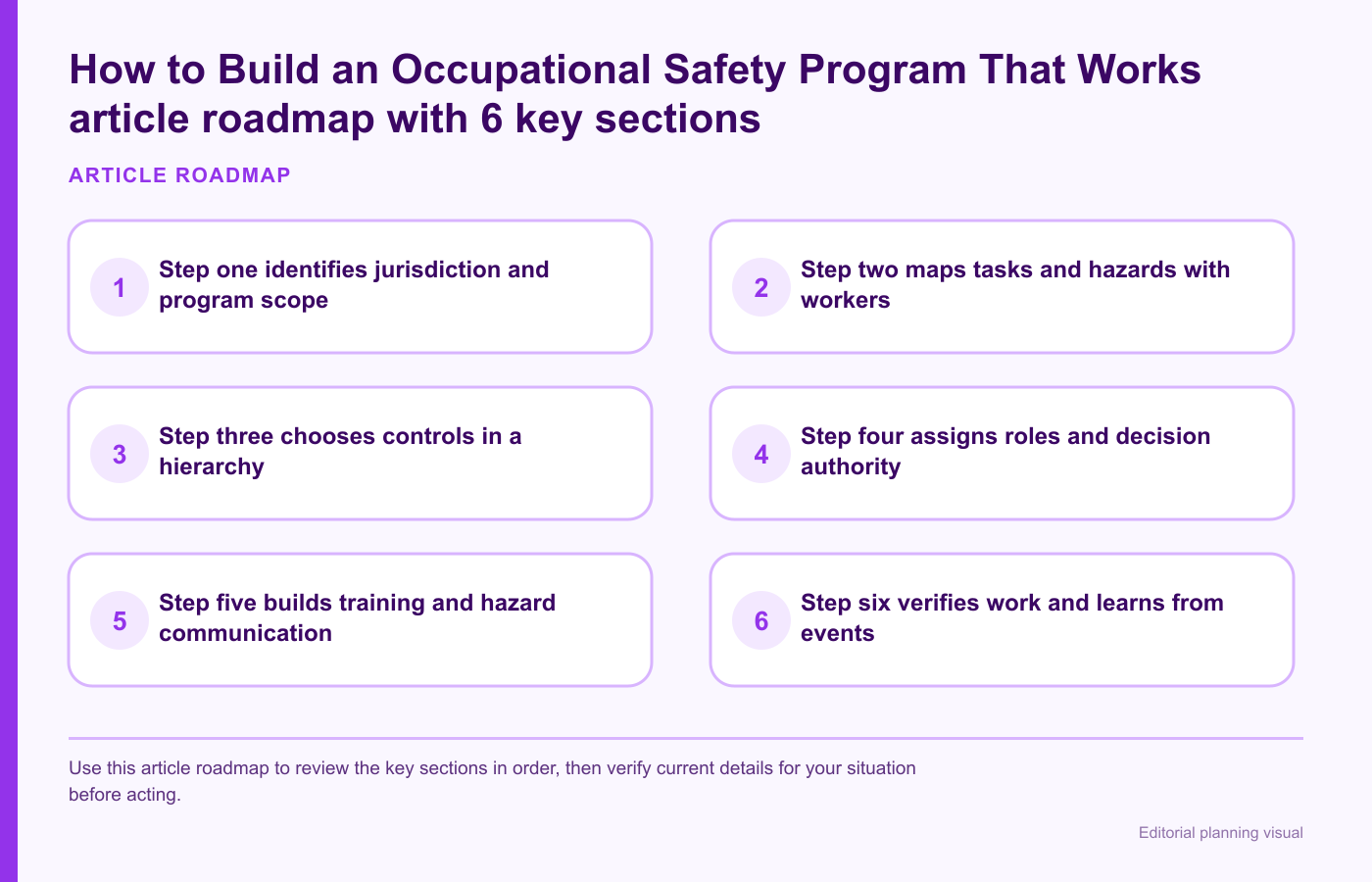
Step four assigns roles and decision authority
Name the program owner, supervisors, competent technical resources, workers, committees or representatives, contractors and emergency contacts. Define who can stop work, approve changes, close corrective actions and communicate with regulators. Give each action an owner and due date.
Consultation must be meaningful. Workers need a safe route to report hazards, refuse unsafe work where law provides, ask questions and receive follow-up. Do not punish or discourage reporting.
Step five builds training and hazard communication
Train people on actual tasks, controls, emergency actions, reporting and stop conditions. Verify understanding through demonstration or observation, not attendance alone. Refresh training when equipment, material, process, role, law or evidence changes.
Use signs, labels and pipe identification only after a competent review defines the message and placement. VisionMarker publishes piping identification and product navigation, but those pages do not establish a workplace’s requirement or compliance.
Step six verifies work and learns from events
- Schedule inspections based on risk and legal duties.
- Check whether controls exist, function and are used.
- Record hazards and assign corrective actions.
- Investigate incidents and near misses without stopping at blame.
- Track overdue actions and recurring patterns.
- Review emergency plans and drills.
- Escalate unresolved high-risk conditions.
Measure leading information such as completed critical checks and closed actions as well as injury outcomes. A low incident count does not prove hazards are controlled.
Step seven manages change and program review
Trigger review when equipment, material, staffing, layout, production, contractors, legislation or incident evidence changes. Reassess hazards before startup rather than after an event. Keep current versions accessible and archive superseded ones according to legal and organizational requirements.
Use VisionMarker’s contact route only after the competent reviewer defines required communication details. Confirm product specifications and suitability in writing for the actual environment.
Keep a verification and decision record
Create a dated record before acting on occupational safety. For each material point, write the question, the exact fact observed, its source, the date checked, who confirmed it and what remains uncertain. Separate a business page’s general description from a written answer about your specific product, service, transaction or appointment. Save the version you relied on because inventory, availability, terms, rules and web pages can change.
Use a simple evidence ladder. Start with current first-party information from VisionMarker, then check the relevant regulator, government, manufacturer or other authoritative source for claims it controls. Use an independent qualified professional when a physical condition, legal right, financial commitment, safety issue or individual need cannot be settled from documents alone. Do not turn a useful general source into proof of a business-specific fact.
- Mark every time-sensitive statement with a review date.
- Keep quotes, approvals and important changes in writing.
- Record the exact item, model, property, trip, document or service scope involved.
- List exclusions and assumptions beside the chosen option.
- Name the person responsible for the next check.
- Pause when identity, authority, safety, scope or total commitment is unclear.
This record is useful after the decision too. Compare what was promised with what was delivered, document questions promptly and retain relevant receipts or correspondence. It will not guarantee an outcome, but it reduces memory disputes and makes follow-up more precise.
Common mistakes to avoid
- Starting with signs or PPE before assessing higher-order controls
- Using one jurisdiction’s checklist at every site
- Treating orientation attendance as demonstrated competence
- Ignoring non-routine work, contractors and change
- Closing incidents with blame rather than control improvement
- Measuring safety only by injury counts
- Buying labels before the governing requirement and environment are defined
Frequently asked questions
What is an occupational safety program?
It is a documented system for identifying duties and hazards, controlling risk, assigning roles, training people, monitoring work, responding to events and improving when conditions change.
Do signs make a workplace compliant?
No. Signs can communicate residual hazards or required actions, but they do not replace elimination, engineering, procedures, supervision, training or PPE.
How often should the program be reviewed?
Follow applicable legal duties and review triggers. Changes in work, hazards, incidents, evidence or law can require review sooner than a calendar date.
When should a competent specialist be involved?
Stop and seek qualified help when hazards, exposure, engineering, legal duties, emergency planning or control performance cannot be assessed reliably in-house.
Take the next step with VisionMarker
Use VisionMarker’s product navigation and contact route after a competent workplace review identifies the required message, format, material and environment. Request current specifications; do not treat a product order as a compliance determination.
This article provides general educational information. Confirm current business details, product or service scope, laws, professional advice and individual needs before publication or action.