Canada

Workplace safety planning guide
How to Map Workplace Health and Safety Requirements
Short answer: there is no dependable universal checklist. First identify the legal jurisdiction and industry rules that govern each worksite. Then map the people, tasks, equipment, materials and hazards; connect every applicable duty to a responsible role, control, training need, inspection, record and review trigger. Treat signs, labels and pipe identification as supporting communication controls only after a competent person has determined the requirement.
Start with jurisdiction before choosing a checklist
The same organization can have workplaces governed by different authorities. A national checklist can therefore omit a local duty, apply the wrong threshold or combine rules that never operate together.
Health Canada explains that every Canadian workplace falls under federal or provincial occupational health and safety jurisdiction. The federal regime applies to federally regulated industries and workplaces; it is not the default for every employer. The Government of Canada’s federal workplace-safety overview is the correct starting point only after federal jurisdiction is confirmed.
For an Ontario-regulated workplace, begin with the current Occupational Health and Safety Act and applicable regulations. Ontario’s OHSA overview describes the Act, its regulations and the internal responsibility system, while noting that a guide is not a replacement for the law. Other provinces and territories have their own statutes, regulations, regulators and guidance.
In the United States, federal OSHA rules may apply, but an OSHA-approved State Plan can govern private-sector or public-sector workplaces within a state. Start with OSHA’s employer responsibilities, then verify state-plan status, sector standards and local fire, building, environmental and public-health requirements.
| Mapping question | Evidence to record | Why it matters |
|---|---|---|
| Where is the work physically performed? | Country, province/state, municipality and worksite address | Identifies potential regulators and local rules |
| Is the operation federally regulated? | Industry and legal-jurisdiction determination | Prevents use of the wrong Canadian or U.S. framework |
| What sector and work are involved? | Industry, project, equipment and task descriptions | Surfaces sector- and hazard-specific regulations |
| Who is at the site? | Employer, owner, constructor, contractor, supervisor, worker and visitor roles | Duties can differ by role and control |
| Which other regimes interact? | Fire, electrical, environmental, transport, accessibility and building authorities | Occupational safety law may be only one layer |
Build a workplace inventory around real work
A requirements map should describe how work happens, not just how the organization chart looks. Walk the site, observe normal and non-routine tasks, review equipment and material inventories, and consult the people who perform and supervise the work. Include startup, shutdown, clearing jams, maintenance, cleaning, deliveries, contractor work and emergency conditions. These are often missed when a map focuses only on steady production.
Capture at least:
- Locations, work areas, access routes and restricted spaces.
- Jobs, tasks, shifts, lone work and interactions between teams.
- Machines, energy sources, vehicles, tools and temporary equipment.
- Hazardous products, waste, stored energy and process substances.
- Workers who may need accommodation and people who are new, temporary or unfamiliar with the site.
- Contractors, visitors, delivery drivers and shared-workplace responsibilities.
- Existing engineered safeguards, procedures, permits, training and protective equipment.
- Incidents, near misses, inspection findings, worker concerns and change history.
- Emergency scenarios, evacuation needs, first aid and communication methods.
The inventory is not the risk assessment. It supplies the facts needed for competent hazard identification and assessment. Assign an owner to resolve unknowns rather than silently treating missing information as “not applicable.”
Create one traceable requirements register
Convert the inventory into a working register. Each row should begin with a specific workplace fact and point to a current primary source. “OSHA,” “OHSA” or “WHMIS” alone is not a usable citation; record the exact section, regulation, incorporated standard or official interpretation that the qualified reviewer relied on.
Use this eight-step sequence:
- Define scope. Name the legal entity, worksite, jurisdiction, sector, work activity and review date.
- Identify hazards. Connect each task, material or condition to a documented assessment.
- Locate primary requirements. Start with current legislation and regulations, then identify legally incorporated codes or standards.
- Define the duty. State what must be done, by whom, for whom and under what trigger or threshold.
- Select controls. Record the control decision and why it is appropriate for the assessed risk.
- Assign responsibility. Name the accountable role, supporting roles and due date.
- Define evidence. Specify the procedure, inspection, training record, maintenance record, design file or other proof.
- Set review triggers. Include changes in law, equipment, process, material, staffing, incident history or official direction.
A useful row might include jurisdiction, source, section, applicability rationale, hazard, required action, control, responsible role, deadline, evidence, status and next review. Add a confidence field so uncertain interpretations are escalated rather than buried.
Connect each duty to an effective control system
A legal register is not a safety program until requirements become operating controls. Wherever practical, start by asking whether the hazard can be eliminated or the work changed. Then evaluate engineering and administrative measures, training, supervision and personal protective equipment in the applicable context. The exact selection and order must follow the jurisdiction, risk assessment and professional advice relevant to the work.
The Canadian Centre for Occupational Health and Safety recommends developing a program for the particular workplace and consulting the applicable jurisdiction. Its health and safety program guidance covers core elements such as responsibility, hazard control, inspections, training, incident investigation and review without claiming one template fits all workplaces.
For every control, document:
- The hazard and people it is intended to protect.
- The operating condition in which it must work.
- Who installs, uses, inspects, maintains and authorizes changes to it.
- What training or competency is required.
- What failure looks like and how work is stopped or escalated.
- How effectiveness is checked in the field.
- What temporary measure applies while a permanent control is unavailable.
A policy copied from another facility can look complete while failing to match actual machinery, chemicals, staffing or emergency arrangements. Field verification is essential.
Use signs, labels and pipe identification as supporting controls
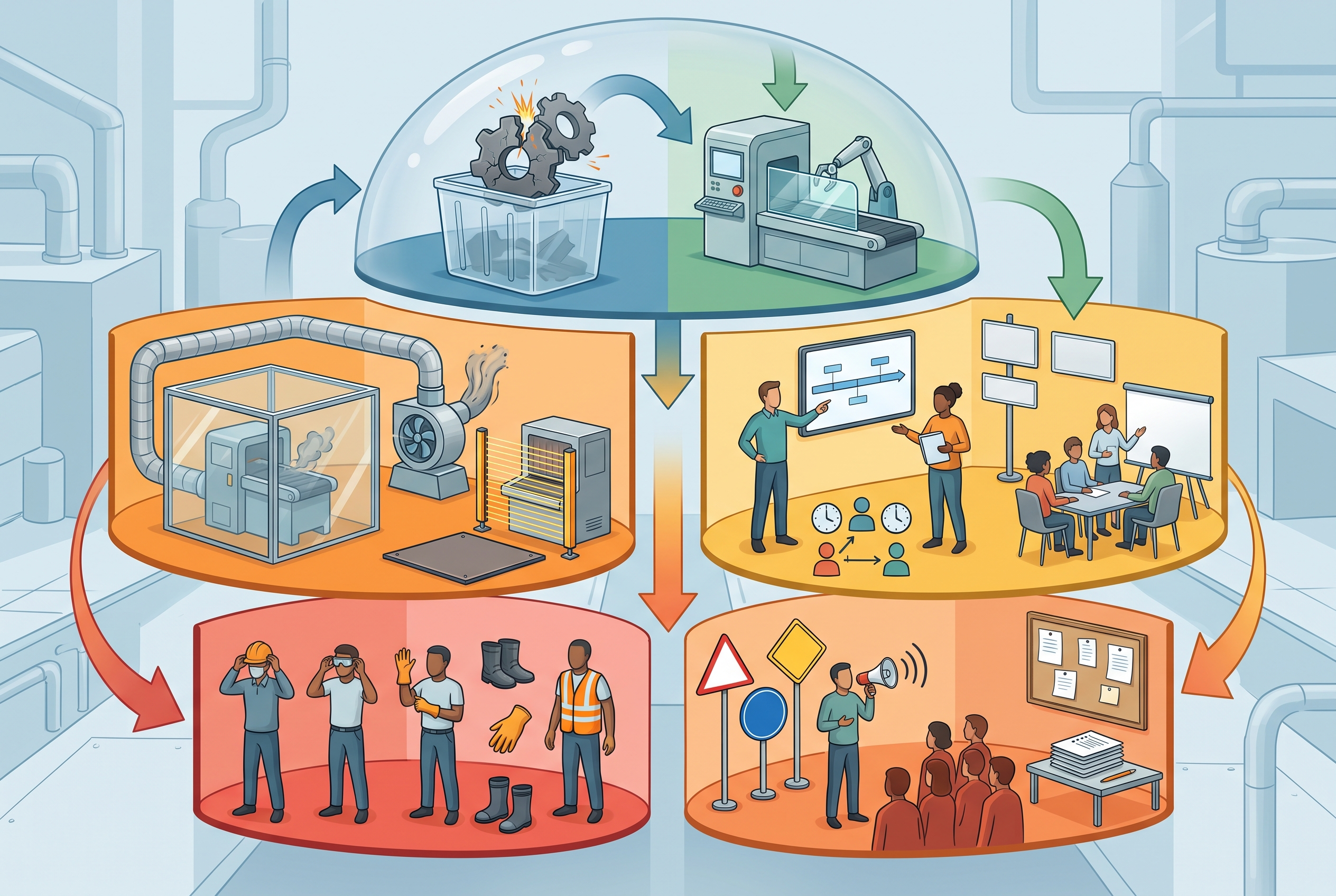
Safety communication should be derived from the requirements map, not selected from a catalog first. A sign can identify a hazard, restriction, instruction, emergency resource or required protective measure. A label can identify a product, container or equipment condition. Pipe markers can support identification. None of these removes the underlying hazard or proves that the broader control system is adequate.
For hazardous products in an Ontario workplace, the current WHMIS employer guide describes supplier labels, workplace labels and worker education. It also addresses identification for piping systems and vessels. Those are specific duties within a hazardous-products regime; they do not create a universal wording or placement rule for every safety message.
Before specifying any communication item, have the competent reviewer answer:
- Which current law, risk assessment, procedure or emergency plan creates the need?
- Who must receive the message, in what language or accessible format?
- What exact hazard, action or restriction must be understood?
- Where and when must the message be visible?
- Can lighting, distance, obstruction, contamination or wear reduce readability?
- Who checks that the message remains current, legible and correctly placed?
- What stronger controls must operate even if the sign or label is missed?
VisionMarker’s website includes navigation for piping identification, labels and stickers, and other product categories. These pages can help a buyer discuss a physical communication need after the governing requirement is confirmed. The presence of a category or product page is not evidence that an item fits a particular hazard, standard or worksite.
Plan training, inspection, records and review
Requirements change when work changes. Build a review process rather than treating the register as a one-time project. Schedule inspections at frequencies supported by the applicable law and risk, and give workers a clear way to report hazards and stop or escalate unsafe work within their legal rights and workplace process.
Track leading evidence such as completed inspections, overdue corrective actions, control testing, training competency checks, preventive maintenance and worker participation. Incident counts alone cannot show whether a control is effective; a quiet month may reflect luck or under-reporting.
Set automatic review triggers for new equipment, materials, layouts, contractors, production rates, shifts, legal updates, official orders, incidents, near misses and repeated inspection findings. Archive superseded versions so the organization can explain what changed and why. Restrict sensitive health, incident and worker information according to privacy, employment and legal requirements.
Before closing a register item, verify the control in the workplace. A purchase order, installed sign or completed training roster does not alone demonstrate that people understand the system or that the control works.
Common health and safety mapping mistakes
- Starting with a downloadable checklist before establishing legal jurisdiction.
- Applying federal guidance to a provincially or state-regulated workplace without checking applicability.
- Listing legislation without recording the section, trigger, owner or evidence.
- Ignoring maintenance, cleaning, shutdown, contractor and emergency tasks.
- Treating “not applicable” as a conclusion without an applicability rationale.
- Copying another facility’s policy without validating real equipment and work.
- Buying a sign or label before defining the hazard, message, audience and governing rule.
- Using signs or PPE in place of feasible higher-level controls.
- Assuming a standard named on a website is legally required or current for the worksite.
- Keeping training attendance without checking competence and field behaviour.
- Closing corrective actions when an item is purchased rather than when effectiveness is verified.
- Failing to update the map after a process, material, staffing or legal change.
Frequently asked questions
Is there one workplace health and safety checklist for Canada and the United States?
No. Jurisdiction, sector, location, task and hazard determine the applicable framework. Canada divides workplaces between federal and provincial or territorial regimes. In the United States, federal OSHA or an approved State Plan may apply, alongside other authorities.
Do safety signs make a workplace compliant?
No. A sign is a communication measure. Compliance and effective risk control can also require hazard elimination, engineered safeguards, procedures, training, supervision, inspections, maintenance, worker participation and records. The required combination depends on the governing rules and assessed hazards.
When should a facility choose labels or pipe markers?
After a competent reviewer identifies the governing requirement, system, contents, hazard, audience and workplace conditions. Then specify the message, format, placement and maintenance process using current requirements and approved workplace standards.
How often should the requirements map be reviewed?
Use any legally required timing and add event-based triggers. Review after changes to laws, processes, equipment, materials, layouts, staffing or contractors, and after incidents, near misses, official directions or evidence that a control is not effective.
Request a workplace communication review
First have the applicable requirements and hazard controls confirmed by a qualified safety or legal reviewer. Then visit VisionMarker’s product overview to understand its published categories or use the contact page to discuss a defined signage, label or identification need. Supply the approved message, jurisdiction, governing reference, location, viewing conditions, dimensions and quantity, and ask VisionMarker to confirm current options, suitability evidence, pricing and timing before purchase.