Canada

What Are Labeling and Signage Solutions for Industrial Facilities?
Labeling and signage solutions are coordinated labels, markers, and signs used to communicate hazards, procedures, equipment identity, access rules, and safety requirements throughout a facility. In an industrial setting, the term can include piping identification, safety signs, labels and stickers, and fire protection signage.
The right solution depends on what must be communicated, the hazard or system involved, the installation environment, the applicable standard, and the facility’s jurisdiction. A durable sign is not automatically the correct sign for every use, and a supplier’s general compliance statement should not replace product-specific verification.
Key Takeaways
- The term covers four main product groups: pipe markers, safety signs, labels and stickers, and fire protection signage.
- Each category serves a different purpose, from identifying piping systems to communicating PPE requirements or locating emergency resources.
- ANSI, NFPA 170, ASME A13.1, NFPA-99C, CGA C-9-2002, and CAN/CGSB-24.3-12 are not interchangeable. Applicability depends on the product, facility, hazard, and jurisdiction.
- UV radiation, moisture, chemicals, outdoor exposure, and other demanding conditions should be considered before ordering.
- A useful quote request includes the required messages, locations, quantities, environmental conditions, applicable standards, and documentation requirements.
What Labeling and Signage Solutions Include
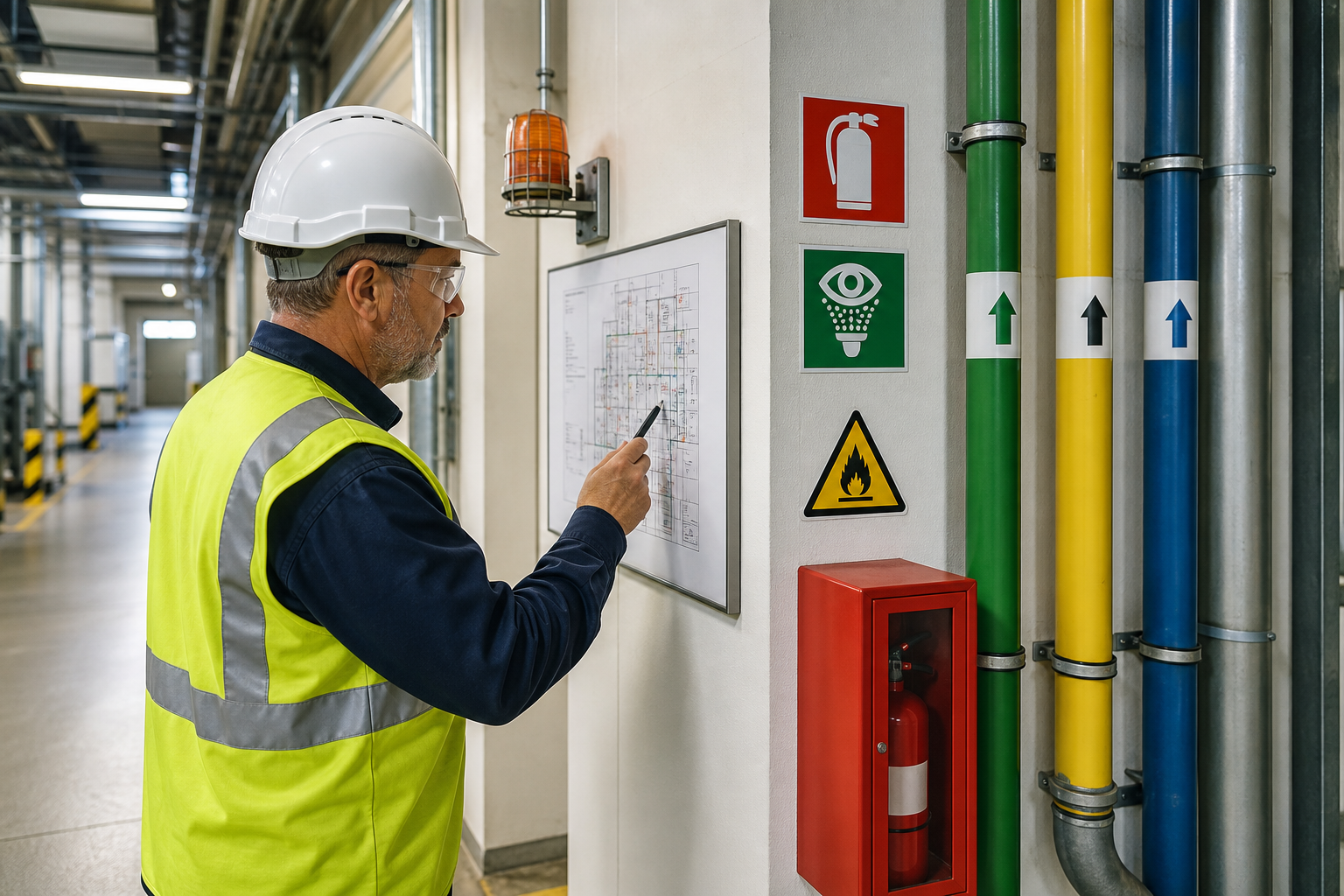
A facility rarely relies on one type of visual communication. Pipe markers may identify a piping system, while a safety sign controls access or communicates required protective equipment. A label may identify equipment or a work area, and fire protection signage may direct attention to emergency resources.
VisionMarker groups its range into piping identification, signs, labels and stickers, and fire protection products. Understanding each category makes it easier to specify the right product instead of treating every sign or label as interchangeable.
Piping Identification and Pipe Markers

Piping identification communicates information about piping systems so people working in or moving through a facility can distinguish one system from another. Pipe markers are therefore part of an operational identification system, not simply decorative signs.
When evaluating pipe markers, consider the information to be shown, the installation location, and the applicable standard or facility specification. VisionMarker positions its piping identification products around ASME A13.1 pipe markers, but requirements should still be confirmed for the specific product, system, standard edition, and jurisdiction.
Do not assume that an ASME A13.1 reference answers every piping identification question. Engineering, owner, EHS, or inspection requirements may also apply. Review the project specification and product documentation before ordering.
Safety Signs for Hazards, Procedures, and Access
Safety signs communicate actions, restrictions, hazards, and workplace requirements. Industrial signage may be used at entrances, work areas, traffic routes, equipment locations, or points where a person must make a decision before proceeding.
Examples include PPE required signs, eye protection and safety goggles messages, hand protection or face mask requirements, forklift traffic signs, lockout-related signs, restricted-entry notices, and hazard warnings. VisionMarker’s signs and posters category includes workplace safety messages such as these.
Start with the behavior or hazard that needs to be communicated. Then confirm that the wording is unambiguous, the location is appropriate, and the sign supports the facility’s procedures. A sign should reinforce a safety program, not substitute for training, controls, or documented procedures.
Labels and Stickers for Equipment and Work Areas
Labels and stickers place concise identification or instructions on equipment, surfaces, work areas, or other relevant locations. They can form part of a broader industrial labeling system when a facility needs consistent messages across multiple assets or areas.
VisionMarker offers labels and stickers as a dedicated category. Before selecting one, identify the surface and message, then consider exposure to UV radiation, moisture, chemicals, outdoor conditions, or other demanding factors.
Do not assume all labels have the same construction, adhesion, or environmental performance. Ask for product-specific information addressing the actual installation conditions.
Fire Protection Signage and Emergency Identification
Fire protection signage helps identify fire protection equipment, emergency resources, or related locations. It has a distinct role from general workplace signage because it supports recognition of fire protection and emergency provisions.
VisionMarker provides a fire protection product and signage category. Check the requirements for the specific building, facility type, equipment, and jurisdiction. A general fire-related label is not proof that an installation meets every applicable requirement.
Choosing the Right Product Category
| Communication purpose | Likely product type | Selection consideration |
|---|---|---|
| Identify or distinguish a piping system | Pipe markers | Review the piping standard, system details, facility specification, and environment. |
| Communicate hazards, PPE, traffic controls, or access rules | Safety signs and posters | Match the message to the hazard or procedure and confirm placement requirements. |
| Identify equipment, surfaces, or work areas | Labels and stickers | Check the surface, exposure conditions, message, and product-specific information. |
| Identify fire protection equipment or emergency resources | Fire protection signage | Verify requirements for the facility, equipment, location, and jurisdiction. |
How Standards Fit Into Selection
Standards are an important reference, but they must be connected to the specific product and application. VisionMarker identifies NFPA 170, ASME A13.1, NFPA-99C, CGA C-9-2002, and CAN/CGSB-24.3-12 in its compliance positioning. These references should not be treated as interchangeable or universal requirements.
- Identify the communication need. Determine whether the product identifies piping, communicates a hazard, marks access, labels equipment, or identifies fire protection resources.
- Determine the relevant standard. Consult project specifications, facility EHS requirements, engineering documents, and jurisdictional guidance.
- Confirm the edition and jurisdiction. Make sure documentation refers to the requirements relevant to the project.
- Review product-specific documentation. Confirm that the particular product addresses the intended application.
- Check internal requirements. Your facility may require more than a general industry standard.
Accounting for UV, Moisture, Chemicals, and Outdoor Exposure
Environmental conditions can affect whether a product is appropriate for a particular location. Outdoor exposure, UV radiation, moisture, chemicals, and demanding industrial conditions should be considered during selection.
VisionMarker states that its products are designed for durability and resistance to outdoor exposure, UV radiation, moisture, and chemicals. That positioning can help when screening a supplier, but it should not be read as a claim that every product performs identically in every environment.
Describe actual installation conditions when requesting information and ask the supplier to confirm suitability for the intended use.
A Practical Evaluation Framework for Facility Buyers
- Define the message. List hazards, procedures, equipment identities, piping systems, access restrictions, PPE requirements, and emergency resources.
- Inventory locations and quantities. Record areas, assets, piping runs, entrances, traffic routes, and emergency points.
- Identify standards and specifications. Separate piping, general safety, fire protection, and facility-specific requirements.
- Describe the environment. Note UV exposure, moisture, chemicals, outdoor placement, and other demanding conditions.
- Confirm wording and placement. Check the message, audience, location, and relationship to existing signs.
- Request documentation. Ask for information supporting the specific product’s intended use and stated standard alignment.
- Compare quote details. Confirm categories, quantities, scope, documentation, and stated turnaround expectations.
VisionMarker uses a quote-based purchasing model for at least some products, with product pages directing buyers to click for pricing. For product or pricing inquiries, use the company’s contact page.
What “Compliant” Should Mean Before You Order
“Compliant” should be treated as a product-and-application question, not a blanket description. Verify the specific product, applicable standard and edition, jurisdiction, intended facility use, environmental suitability, and internal EHS, engineering, owner, or inspection requirements.
ANSI, NFPA, ASME, CGA, and CAN/CGSB references address different areas. A supplier’s general standards positioning does not establish OSHA approval, guarantee inspection acceptance, or demonstrate that every product meets every listed standard.
Why Coordinating Identification Across a Facility Matters
A coordinated system supports consistent visual communication across piping, work areas, equipment, access points, and emergency resources. The objective is not to purchase the largest possible number of signs, but to ensure each important message has an appropriate product, location, and documented basis.
A facility may need pipe markers, safety signs, labels and stickers, and fire protection products as part of one identification effort. Planning them together helps avoid isolated purchases that do not fit the wider communication system.
Conclusion: Build the Signage System Around the Facility Need
Labeling and signage solutions coordinate communication about hazards, procedures, equipment identity, access requirements, and emergency information. The four main product groups are piping identification, safety signs, labels and stickers, and fire protection signage. Each may involve different standards, environmental considerations, and documentation.
Start with what people need to understand at each location. Match that need to a product category, verify the applicable standard and jurisdiction, assess environmental exposure, and request product-specific information before ordering. A single category may suit a focused need, while a coordinated supplier may help when several types of identification are being updated.
Review VisionMarker’s product categories or contact VisionMarker for pricing and quote inquiries for a specific labeling and signage project.