Canada

Fire protection signage codes determine which signs a facility must display, where they must be placed, and how they must perform. This step-by-step checklist helps facility managers and EHS teams map equipment, draft AHJ-ready mockups, choose durable materials, and follow an ordered vendor flow. Use it on site, and verify every item with your Authority Having Jurisdiction before installation.
Step-by-step checklist: take these actions on site now
- Survey and map fire protection elements. Walk the site and mark every fire department connection, fire alarm control panel, fire extinguisher, sprinkler riser, fire pump room, fire and smoke barrier, and protected opening. Produce a simple site plan layer with each element and its building elevation or grid reference.
- Identify applicable code triggers. Determine if local ordinances or a municipal sign book govern your site, and note applicable national documents such as the International Fire Code (IFC) and NFPA standards. The IFC requires identification of certain fire protection equipment and AHJ approval of signage in many cases (for example, see IFC 509.1 for identification). Many municipalities publish sign books that standardize wording and placement; use those as the primary local reference for mockups. Examples of municipal sign books include the Anna, Texas sign book (Anna, TX sign book) and the Addison, Texas exhibit on fire prevention and protection (Addison, TX exhibit).
- List required sign types on each element. For each mapped item, note the sign type likely required. Typical items include FDC signs, directional FDC signs, fire alarm control identification, fire pump room signs, sprinkler riser tags, fire extinguisher location signs, fire and smoke barrier signs, and protected opening tags. This list becomes your sign schedule for drafting mockups.
- Draft example wording and mockups. Produce sign mockups that show proposed wording, size, color, mounting location, and coordinate or elevation. Label mockups as “example only” and include a simple visibility or approach note. Keep mockups ready for AHJ review per the local sign book instructions such as those in municipal exhibits.
- Stop point: submit mockups and site plan to the AHJ. Before ordering or installing signs that identify fire protection systems, pause and request AHJ approval. IFC language and many municipal codes require that signage for fire protection systems be approved by the Fire Code Official prior to installation. Expect the AHJ to require exact wording, sizes, mounting heights, and sometimes sign color or reflectivity.
- Select materials matched to location. Choose substrata, adhesives, and finishes for each sign based on environmental exposure. For outdoor FDCs and approach-mounted signs choose UV-stable substrates, fade-resistant inks, and protective overlaminates. For indoor wet or chemical-exposed areas select chemical-resistant films or engraved metal plaques. VisionMarker documents products that are engineered for UV, moisture, and chemical resistance, which helps when evaluating vendor claims (VisionMarker).
- Order samples and approve mockups. Request physical samples for each material option and a full-size mockup that includes mounting hardware, reflectivity, or photoluminescent properties if required. Approve samples in writing and attach AHJ comments when they exist.
- Install and document. After AHJ approval and signed mockup acceptance, schedule installation. Document each installed sign with a photo, GPS or grid reference, mounting height, and installation date. Retain AHJ approval records with the sign log for future inspections.
- Maintain the signage program. Add sign inspection to preventive maintenance. Inspect for fading, peeling, obstruction, or layout changes that require signage updates. Replace or refurbish signs before they become illegible from expected approach paths.
Which codes to check first and how they differ
Begin with local requirements, including any municipal sign book or code exhibit that governs wording and mounting. Those local documents are often the authoritative source for final sign language in your jurisdiction. Use national codes as a baseline. The International Fire Code provides identification rules and references where signage must be approved by the Fire Code Official. For egress and life safety related signage consult IFC provisions that address when photoluminescent or illuminated signs are necessary for visibility during power loss.
NFPA standards and NFPA sign guidance such as NFPA 170 cover symbol use, color conventions, and sign formats for emergency and operational signs. VisionMarker’s resource on NFPA 170 signs can help align designs to those conventions NFPA 170 Signs: Cut Confusion and Keep People Safe. Always treat municipal sign books as the primary local authority when they exist.
Common code-required fire protection signs and example wording

Below are sign types commonly required by codes and AHJs. Example wording is for drafting mockups only. Confirm exact wording and format with your AHJ before production.
- Fire Department Connection (FDC), example only: “FIRE DEPARTMENT CONNECTION, 2 1/2 IN, SIAMESE, STANDPIPE CONNECTION.” Verify inlet type, directional arrows, and mounting height with the AHJ and your local sign book.
- Fire alarm control panel, example only: “FIRE ALARM CONTROL PANEL – AUTHORIZED PERSONNEL ONLY.” Many municipal sign books standardize this wording and mounting rules.
- Fire pump room, example only: “FIRE PUMP ROOM – KEEP DOOR LOCKED – NO STORAGE.” Confirm whether additional hazard information is required by local code.
- Fire and smoke barrier or protected opening, example only: “FIRE AND SMOKE BARRIER – DO NOT MODIFY OPENING WITHOUT APPROVAL.” Protected opening tags inform firefighters and maintenance staff about construction features and required approvals.
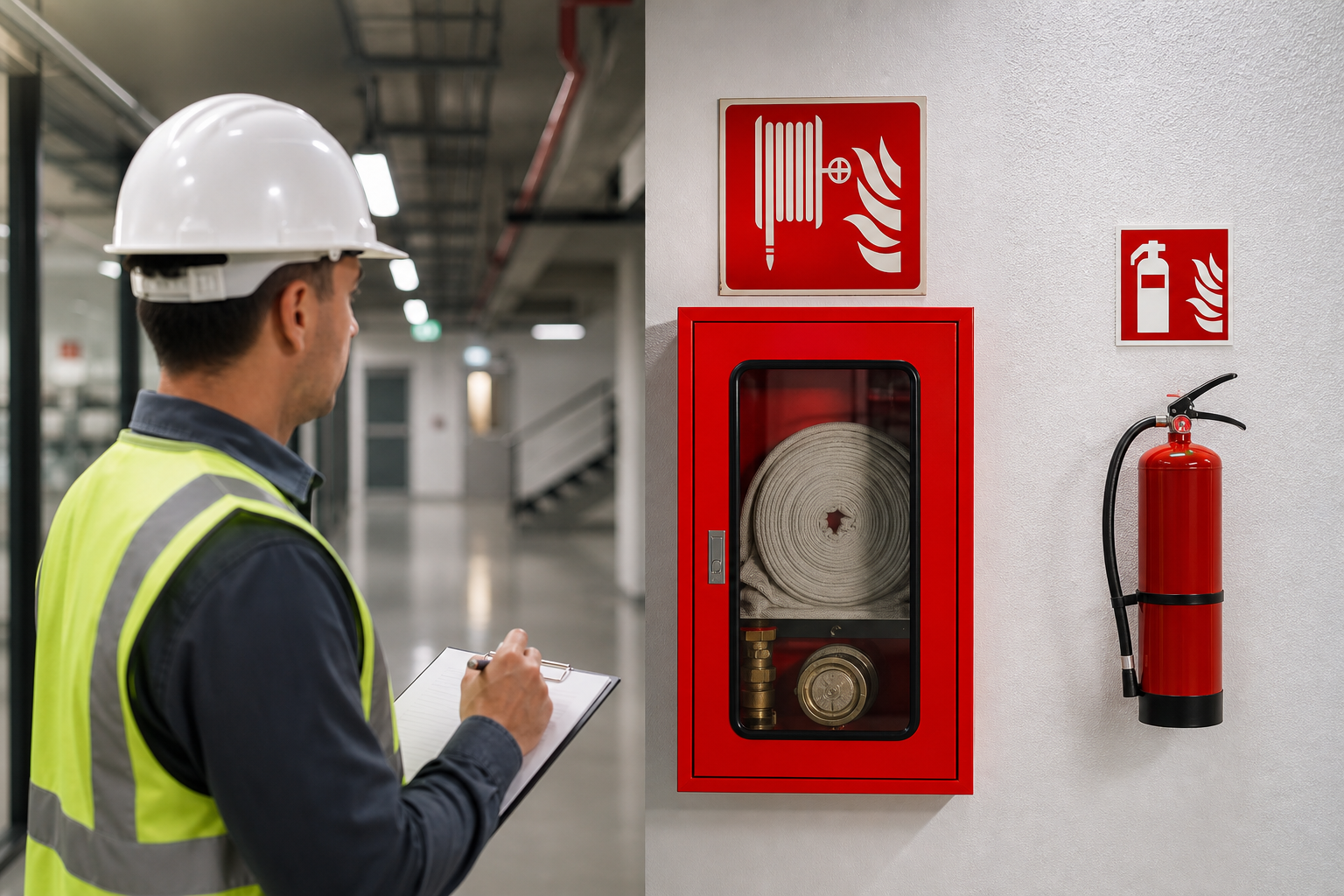
- Fire extinguisher location, example only: “FIRE EXTINGUISHER – TYPE ABC – MONTHLY INSPECTION TAG ATTACHED.” Some jurisdictions require inspection frequency and tag details on extinguisher signage.
Placement, size, visibility, and when illumination is required
Place signs so they are visible from expected arrival or approach routes and keep them free of obstruction. Outdoor FDC signs should be mounted and angled so arriving apparatus can see connection details from the roadway. For egress-related signage, codes may require photoluminescent or illuminated signs to maintain visibility during power loss. Include a visibility diagram with mockups if viewing distance or sight lines are questionable.
Use legible letter heights matched to viewing distance and approach speed. When the code is silent, consult the AHJ and submit a visibility diagram that shows mounting height, viewing distance, and typical approach vectors.
Choose materials that survive industrial conditions

Match material selection to the expected environment. Key criteria are UV stability, moisture resistance, chemical resistance, and mechanical durability. Outdoor FDC and approach signs often perform best on anodized aluminum or UV-stable composite panels with fade-resistant inks and overlaminates. Indoor signs exposed to washdown, solvents, or acids often require chemical-resistant vinyl films, specialty laminates, or engraved metal plates. Ask vendors to specify substrate, ink chemistry, overlaminate type, and adhesion system so you can evaluate expected service life. VisionMarker publishes product details on durability and ANSI-certified offerings that may help compare options (VisionMarker).
When to stop and get AHJ approval and how to coordinate with the fire department
Critical stop points are any signs that identify fire protection systems, any changes to signage included in permit submittals, and egress or life-safety signage. Many municipal exhibits and code language require Fire Code Official approval before installation. Prepare a concise submittal packet for the AHJ that contains a legible site plan layer with sign locations, full-size mockups showing wording and colors, material specifications, mounting details and heights, and a short code reference or local sign book citation. Deliver the packet per the AHJ process and request written approval or stamped mockups before ordering bulk signs.
Ordering, vendor decision criteria, and installation documentation
Use a vendor flow that reduces the risk of nonconforming signs. Decision criteria should include documented standards compliance, clear material and finish specifications, sample approval, production lead time, and warranty terms. A recommended ordering flow is: request a quote, submit AHJ-approved mockups, obtain material samples, approve a full-size mockup, place the order, inspect the shipment, install signs, and update the sign log with photos and AHJ approval documentation. VisionMarker supports quote-based requests and can provide mockups and material samples to help with AHJ submissions (VisionMarker).
Frequently asked questions
Who approves fire protection signs and when must I get AHJ sign approval?
The Fire Code Official or AHJ approves fire protection signage. Many codes and municipal exhibits require approval prior to installation. Stop and submit mockups and the site plan to the AHJ before ordering signs that identify fire protection systems. Municipal sign books often outline the exact packet content the AHJ expects such as wording, mounting heights, and material notes.
Do fire protection signs need to be photoluminescent or illuminated?
Photoluminescent or illuminated signs are required when a code, standard, or AHJ determines that visibility during power loss is necessary. This is most common for egress paths and stairwell signage. If your mockup could be affected by loss of lighting, include illumination or photoluminescent specifications in the AHJ submittal and ask the AHJ to confirm the requirement.
What minimum information should an FDC sign include and where must it be placed?
Minimum information varies by jurisdiction, but an FDC sign commonly identifies the connection, inlet size or type, and includes directional arrows when the connection is not visible from the approach. Exact placement and wording are AHJ dependent. Refer to the local sign book or municipal exhibit for sample language and submit the proposed wording for AHJ approval.
How should I handle conflicting signage requirements between jurisdictions?
When jurisdictions conflict, the local AHJ or municipal sign book controls for that location. If you manage multiple facilities in different jurisdictions, prepare separate sign schedules and mockups per location and coordinate AHJ approvals site by site.
How long do outdoor fire protection signs typically last and what warranty questions should I ask a vendor?
Service life depends on material, UV exposure, and chemical contact. Ask the vendor for projected fade resistance, substrate type, ink system, overlaminate, and any warranty on materials or delamination. Request real-world sample performance data or case examples when possible and factor replacement intervals into your maintenance plan.
VisionMarker can provide mockups, material samples, and quote-based pricing for compliant, durable fire protection signage. Want help translating your AHJ-approved mockups into quotes and durable compliant signs?