Canada

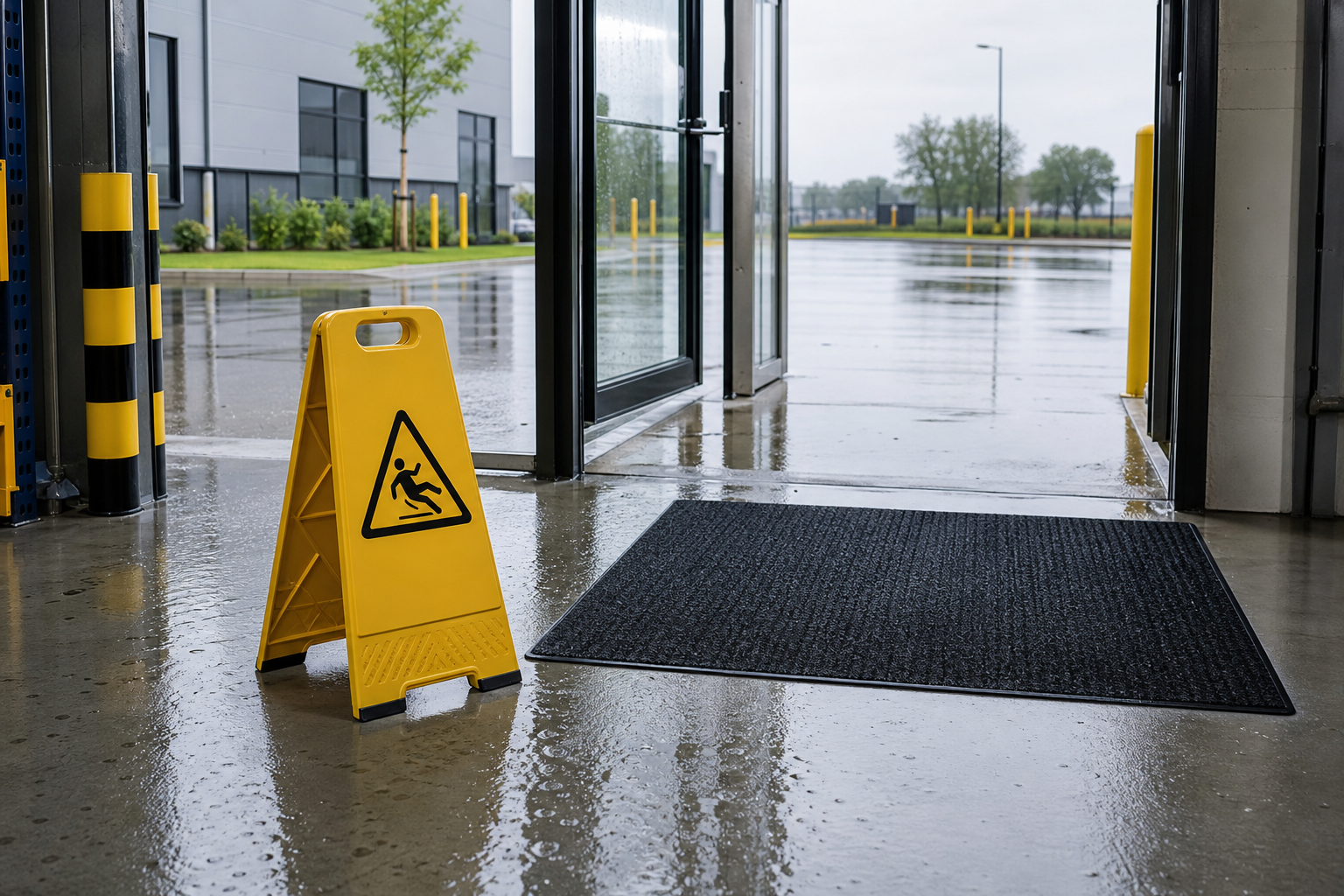
Slippery floor signage warns people about a wet or potentially slippery walking surface, but it does not remove the hazard or replace cleaning, drainage, barriers, mats, or other controls. Choose the format based on whether the hazard is temporary or ongoing, how far away people need to see the warning, the traffic pattern, and exposure to moisture, chemicals, UV, and impact.
What Slippery Floor Signage Does and Does Not Do
A wet-floor sign communicates that people should slow down, avoid the affected area where possible, and account for a changed walking surface. It gives workers, visitors, and customers information at the point where they need to decide how to proceed.
The sign is only one part of the response. OSHA requires employers to keep walking-working surfaces clean and, to the extent feasible, dry. Where wet processes exist, the rule also addresses drainage and dry standing places such as platforms or mats. See OSHA 29 CFR 1910.22.
Use a six-part response sequence
- Identify: Find the spill, leak, condensation, cleaning activity, or process creating the wet surface.
- Protect: Place a visible warning before people enter the affected route. Restrict access or add a barrier when the hazard is substantial.
- Correct: Stop the source where possible, clean the spill, improve drainage, or address the maintenance condition.
- Warn: Position the sign where approaching people can see and understand it before reaching the hazard.
- Verify: Check the floor, route, sightlines, and sign condition after corrective work.
- Remove or relocate: Take away the temporary warning when the hazard is controlled, or move it if the affected area changes.
A sign beside a continuing leak or contaminated surface is not a completed control. It tells people about the condition while the facility addresses the condition itself.
OSHA Expectations and the Limits of Liability Answers
Does OSHA require wet-floor signs? OSHA does not prescribe one universal wet-floor sign format, size, material, or phrase for every workplace. Its rules address walking-working surfaces and signs or symbols used to designate hazards where failing to identify them could lead to injury or property damage. New and replacement accident-prevention signs must follow applicable specifications in 29 CFR 1910.145.
OSHA guidance for restaurant serving areas says to keep floors clean and dry and provide warning signs for wet-floor areas. It also identifies non-slip matting as a practice to consider where areas tend to be wet. The right control for an industrial plant, laboratory, healthcare facility, or warehouse depends on the process and site conditions.
Is a wet-floor sign a legal requirement?
Hazard warning is part of responsible workplace safety, but the legal requirement depends on the applicable regulation, workplace facts, and jurisdiction. A facility should not treat a sign as a universal legal shield, nor assume that the absence of one automatically determines an incident outcome.
Can someone sue after slipping on a wet floor with no sign? A person may pursue a claim, but the outcome depends on the facts and applicable law. The presence or absence of a sign is only one consideration.
Choose the Format by Hazard and Workflow

The best slippery floor sign is one people can see before entering the hazard area and that staff can deploy consistently. Temporary spills usually call for portable warnings, while recurring conditions may need a portable warning plus a durable sign, floor marking, barrier, drainage improvement, or process control.
| Format | Best fit | Strengths | Limitations and checks |
|---|---|---|---|
| Folding A-frame | Temporary spills, cleaning, and changing routes | Portable, visible from two directions, and easy to store | Can be moved, knocked over, obscured, or left after the hazard ends |
| Wall-mounted sign | Entrances, washrooms, service areas, or recurring locations | Consistent decision-point placement | Does not automatically warn people at floor level or cover a moving hazard |
| Floor decal | Stable locations where people look down before stepping | Low profile and useful where freestanding signs obstruct movement | Needs a suitable clean surface and can wear through traffic, dirt, or water |
| Cone sign | Localized spills or maintenance tasks | Portable and recognizable in active work areas | Limited message area and easy to hide behind equipment |
| Post-mounted sign | Outdoor routes or recurring zones without a practical wall | Visible along an approach path | Needs suitable clearance and resistance to weather and impact |
Use these decision rules
- Short-lived spill: Use a portable sign at the approach point, then clean and remove it when safe.
- Cleaning route: Cover each approach and route change, not only the room where cleaning began.
- Recurring wet process: Combine warnings with drainage, dry standing areas, mats, barriers, or other suitable controls.
- High-traffic entrance: Use a warning visible from the actual approach and add a mat or other control when tracked-in water recurs.
- Restricted maintenance area: Pair the sign with a physical barrier or access control when entry is unsafe.
- Permanent condition: Correct the condition and add durable area, process, floor, or equipment identification instead of relying indefinitely on a temporary sign.
Place Warnings Where People Decide and Approach

Placement should follow the route a person takes, not simply the location where staff noticed water. Wet floors, spills, and clutter can create slip, trip, and fall hazards, so warnings should be visible before people reach the affected surface.
Scenario-based placement guidance
- Entrances: Place the warning before the wet area begins, clear of doors, queues, displays, and mats. Assess each approach direction.
- Washrooms: Position the sign at the approach to the affected floor and add another if the route continues around a corner.
- Kitchens: Warn staff before they enter the wet section and coordinate the sign with non-slip matting or other controls.
- Corridors: Place the warning far enough ahead for people to slow down or change direction. Repeat it after an intersection when needed.
- Production areas: Identify the boundary of the affected route, not only the visible puddle. Evaluate durable warnings and process controls for normal wet operations.
- Loading zones: Account for pedestrian and vehicle movement, outdoor light, rain, mud, and obstructions.
- Maintenance work: Protect both ends of a route where applicable and use a barrier when tools, hoses, open panels, or the work itself create an entry hazard.
For consistent wording, placement, and upkeep across departments, use a shared approach to safety labels and stickers.
Select Wording, Size, Material, and Product Fit
“CAUTION SLIPPERY WHEN WET” emphasizes the risk created by moisture, while “CAUTION WET FLOOR” states the condition directly. Use high contrast, control glare, and add a symbol when it improves recognition for multilingual workplaces or fast-moving areas.
Consider approach distance, viewing angle, obstructions, lighting, and available space before selecting dimensions. Do not use a generic wet-floor message for restricted entry, chemical exposure, an open floor area, or vehicle movement.
VisionMarker product options
For CAUTION SLIPPERY WHEN WET, VisionMarker lists aluminum, rigid PVC, and vinyl options. Listed sizes include 10” x 14”, 18” x 12”, 2.75 x 4”, 24 x 18”, 24” x 36”, 3” x 8”, 6” x 10”, 6” x 4”, and 7” x 10”. The listing references ANSI Z535 and OSHA 1910.1200(c). See the CAUTION SLIPPERY WHEN WET sign options.
For CAUTION WET FLOOR, VisionMarker lists aluminum, rigid PVC, and vinyl options in the same broad range of sizes. Review the CAUTION WET FLOOR sign options.
Match the Sign to the Facility Environment
Choose the complete sign construction for the application. Review moisture, cleaning chemicals, UV exposure, temperature changes, abrasion, impact, surface condition, and how often staff will move or clean the sign.
VisionMarker states that its industrial signs and identifications are designed to withstand weather, UV exposure, moisture, and chemical products. A material suitable for a protected interior wall may not fit an exposed loading area or wet production zone.
Temporary versus permanent warnings
Portable signs suit cleaning, spills, and short-term maintenance. Wall, floor, or post-mounted warnings suit recurring locations where the message must remain available at a defined decision point.
Permanent signage does not replace hazard correction. If water repeatedly reaches a walkway, investigate the source, drainage, surface, work practice, or traffic arrangement.
Deploy, Inspect, Store, and Remove the Warning
- Deploy before exposure: Put the warning in place before people enter the affected route.
- Check the approach: Confirm it is visible, upright, legible, and unobstructed from each relevant direction.
- Control the source: Clean the spill, stop the leak, improve drainage, or apply the needed process control.
- Inspect during the task: Check for dirt, fading, cracks, unstable placement, or a changed route.
- Clean and store portable signs: Remove residue and moisture using a suitable method, then store them where staff can find them quickly.
- Replace damaged warnings: Remove cracked, illegible, heavily worn, or unstable signs from service.
- Remove when controlled: Take away the warning once the temporary condition has ended.
For a focused review of deployment problems, see these slippery when wet signs considerations.
What to Include in a Signage Order
- Hazard: Spill, cleaning, condensation, wet process, leak, rain, or another condition.
- Message: Select the clearest wording for the hazard.
- Use period: Temporary, recurring, or permanent.
- Format: Portable, wall-mounted, floor-level, cone, post-mounted, or combined.
- Dimensions: Match approach distance, viewing angle, lighting, and available space.
- Material: Note moisture, UV, chemicals, abrasion, impact, and cleaning conditions.
- Language and symbols: Identify bilingual or multilingual needs and pictogram preferences.
- Placement: List entrances, directions, intersections, corridors, boundaries, and obstructions.
- Quantity: Count each deployment zone and approach route, plus spares.
- Operating process: Document storage, deployment, inspection, removal, and replacement responsibilities.
- Standards review: Record product-level references and confirm application fit with the responsible reviewer.
Worked example
A facility with tracked-in rain at its main entrance and a recurring wet process beside a production corridor should treat these as separate applications. The entrance needs portable warnings during wet weather, along with a mat or other suitable control. The production area needs a defined boundary, warnings at relevant approaches, and review of drainage and dry standing arrangements.
Choose the Next Step for Your Facility
Use portable slippery floor signage for temporary conditions, select a material and size that match the environment and approach, and pair every warning with correction of the wet condition. For recurring hazards, add durable identification and physical or process controls.
Frequently asked questions
Does OSHA require wet floor signs?
OSHA requires clean and, to the extent feasible, dry walking-working surfaces and addresses signs used to designate hazards. It does not establish one universal wet-floor sign size, format, material, or wording.
Is a wet floor sign a legal requirement?
The exact requirement depends on applicable rules, facts, and jurisdiction. A sign is not a substitute for correcting the hazard.
Can someone sue after slipping on a wet floor with no sign?
A person may pursue a claim, but the result depends on the circumstances and governing law. The presence or absence of a sign is one fact among others.
Can a slippery floor sign alone make an area compliant or prevent liability?
A sign is a warning control, not a substitute for correcting the wet condition or applying other suitable controls. OSHA addresses clean, dry walking-working surfaces and hazard warnings; facilities should address the source and use suitable controls for the specific condition.
When you are ready to compare wording, materials, and sizes, VisionMarker provides industrial safety signs for workplace communication and identification.