Canada

Choose UV resistant labels when sunlight could fade the message, weaken the label face, or contribute to adhesive failure. That decision is only the starting point: outdoor labels may also face rain, washdown, chemicals, temperature changes, abrasion, and difficult surfaces.
The best choice matches the full application. Facility managers, EHS professionals, maintenance teams, and procurement leaders should evaluate the material, adhesive, print protection, substrate, visibility, and inspection requirements together rather than treating “UV resistant” as a guarantee of total weatherproofing or compliance.
Quick summary

- Use UV resistant labels where direct sunlight or high-UV conditions could affect legibility or adhesion.
- Compare vinyl, polyester, polycarbonate, and laminated constructions according to flexibility, chemicals, moisture, temperature, and abrasion.
- Evaluate the adhesive and application surface separately from the label face.
- For piping identification, consider curvature, insulation, temperature, chemical exposure, attachment method, and viewing distance.
- Before ordering, provide exposure, surface, dimensions, message, quantity, and applicable site or standards requirements.
When Do You Need UV Resistant Labels?
UV resistance matters whenever sunlight can reach a label for long periods. This includes exterior equipment, tanks, utility areas, outdoor storage, construction zones, exposed piping, and signs near large windows or high-intensity indoor lighting.
Sunlight can cause fading, discoloration, cracking, or loss of contrast in the face material, printed message, or protective layer. Exposure can also contribute to adhesive deterioration, although adhesive performance depends on the substrate, surface preparation, temperature, moisture, and chemistry as well as UV exposure.
For labels installed in outdoor and high-UV areas, prioritize materials engineered to withstand UV radiation and weathering. Then verify the other conditions the label must tolerate. UV resistance does not automatically mean waterproof, chemical-resistant, suitable for high temperatures, abrasion-resistant, or appropriate for every outdoor surface.
Compare Label Materials Before You Order

Material selection should begin with the environment and the job the label must perform. The following comparison is a starting point, not a substitute for confirming the specifications of the exact product, adhesive, printing method, and laminate.
| Construction | Often considered for | Potential strengths | Questions or limitations |
|---|---|---|---|
| Flexible vinyl | General outdoor labels, curved surfaces, and equipment identification | Flexible and conformable, with options designed for moisture and outdoor exposure | Confirm chemical, temperature, abrasion, and long-term UV performance |
| Polyester | Equipment, containers, and applications needing a robust film | Can provide stronger resistance to handling, moisture, and some chemicals | Confirm flexibility, surface compatibility, print durability, and temperature range |
| Polycarbonate | Demanding handling, abrasion, or equipment conditions | May be appropriate where a tougher face material is needed | Verify UV stability, chemical compatibility, conformability, and adhesive selection |
| Laminated construction | Applications needing added protection over printed surfaces | Can protect messages from handling, moisture, or abrasion | Laminate, edges, adhesive, and printing system must suit the environment |
| Paper-backed stock | Protected indoor inventory and routing labels | Often suited to lower-demand indoor applications | Usually requires added protection for wet, outdoor, or chemical exposure |
For a closer comparison of industrial labels and stickers materials, consider how each option responds to UV exposure, moisture, chemicals, temperature, abrasion, and the shape of the application surface.
Vinyl, Polyester, or Polycarbonate?
Flexible vinyl is often a practical starting point for general-purpose outdoor identification and curved surfaces, provided the specific construction is rated for the expected exposure. Confirm its UV, moisture, chemical, and temperature specifications before using it in a demanding location.
Polyester or polycarbonate may deserve consideration when the label will face aggressive cleaning, chemical contact, repeated handling, or abrasion. The material name alone does not establish suitability. The face material, ink or print method, protective layer, adhesive, and substrate compatibility all influence performance.
Lamination can add protection to a printed message, but it should be treated as part of a complete construction rather than an automatic solution. Ask whether the laminate suits the expected UV exposure and whether its edges can remain bonded.
Check the Adhesive and Surface, Not Just the Label Face
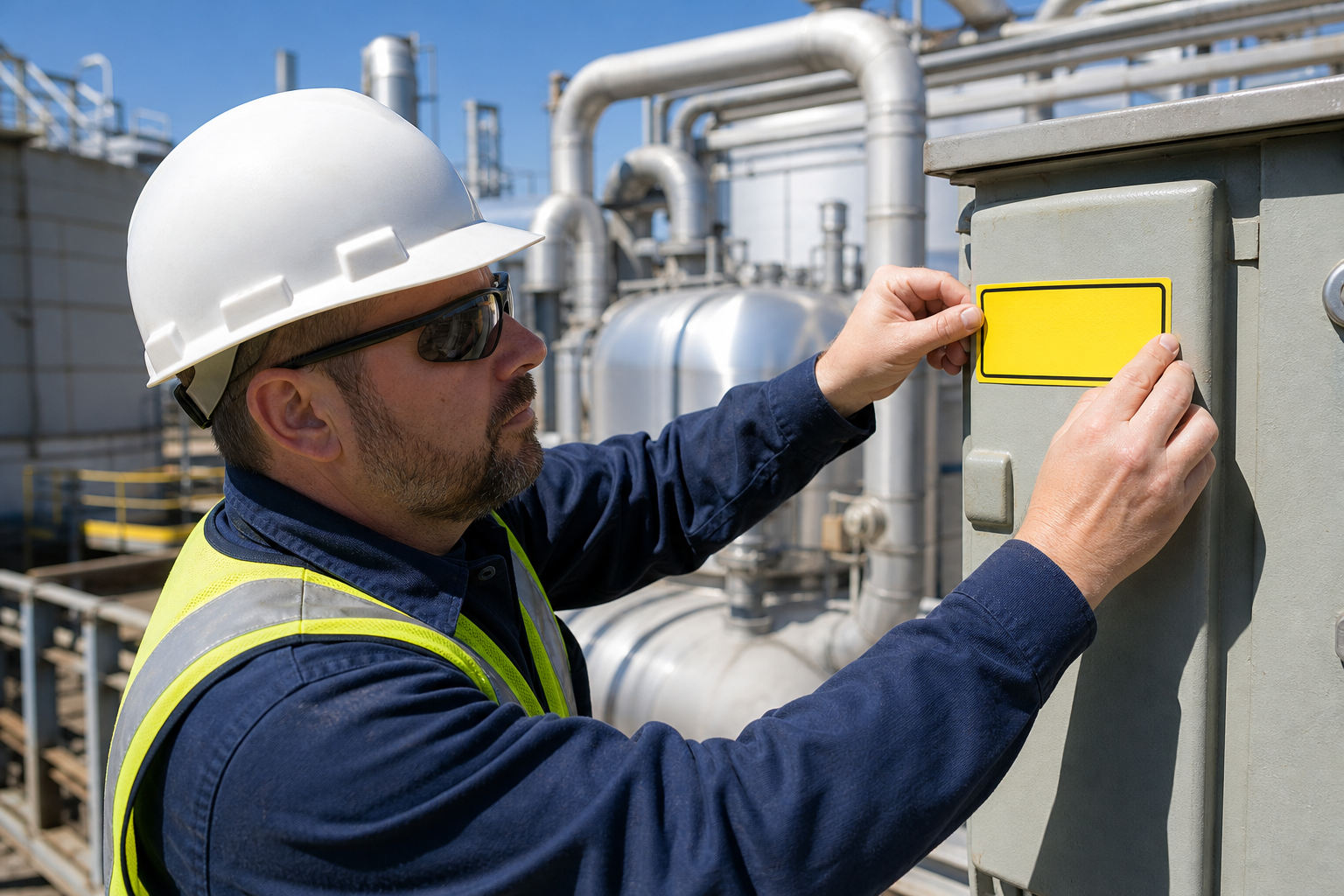
There are two separate durability questions: will the label face remain readable, and will the adhesive keep it attached? A UV-resistant face can still peel if applied to an oily, wet, dusty, rough, low-energy, painted, or incompatible surface.
Before installation, identify whether the surface is flat, curved, textured, insulated, painted, corroded, or exposed to unusual heat. Clean away oil, dirt, and loose material, allow the surface to dry fully, and apply firm pressure for consistent contact.
For outdoor or chemically exposed piping, compare pipe marker materials and adhesive-backed options with the actual pipe surface and service conditions. Where adhesion is unreliable because of insulation, texture, temperature, or contamination, ask whether an alternative attachment method or sample test is appropriate.
Where UV Resistant Labels Fit in Industrial Identification
UV resistant labels can support identification across outdoor equipment, tanks, utility assets, warehouse areas, construction sites, and facility infrastructure. They may communicate an asset number, hazard, operating instruction, inspection status, or localized warning.
Use the label’s role to determine the required size, wording, contrast, and viewing distance. A small equipment label may be read at arm’s length, while an outdoor warning or identification marker may need to be recognized from a work route or vehicle approach.
Labels and stickers should not automatically replace pipe markers, fire protection signage, workplace signs, procedures, training, or other controls. Treat them as one part of a consistent industrial identification system.
Using UV Resistant Labels for Piping Identification
Outdoor and sun-exposed piping creates several requirements at once. The marker must remain visible, stay attached, conform to the surface where appropriate, and communicate the necessary service or hazard information. The line may also face chemicals, washdown, high temperatures, abrasion, insulation, or frequent maintenance.
Document the pipe diameter, surface condition, insulation, location, viewing distance, and exposure. Then confirm whether a flexible wrap-around marker, rigid marker, or another attachment method is appropriate. Include the required legend, arrows, colors, dimensions, and facility requirements in the review.
Do not assume that a UV-resistant label alone establishes compliance for piping identification. Check the applicable standard, site specification, service information, color convention, marker placement, and legibility requirements for the particular facility.
Site-Assessment Checklist for UV-Exposed Labels
- Location: Is it indoors, outdoors, partially sheltered, or exposed to high UV?
- Sunlight: Will it receive direct sun, reflected light, seasonal exposure, or continuous exposure?
- Moisture: Will it encounter rain, condensation, washdown, ice, or standing water?
- Chemicals: Identify cleaners, solvents, process chemicals, oils, or fumes.
- Temperature: Note normal and extreme surface temperatures during operation and installation.
- Abrasion: Consider impacts, scraping, tools, traffic, handling, and cleaning.
- Surface: Describe the substrate, coating, texture, curvature, insulation, and available area.
- Visibility: Specify viewing distance, approach angle, lighting, contrast, and message size.
- Lifecycle: State the inspection interval and replacement requirements.
- Requirements: List facility specifications, standards, colors, dimensions, and approvals.
What to Ask Before Ordering
- What face material suits the stated UV, moisture, chemical, temperature, and abrasion exposure?
- Is the adhesive compatible with the surface, coating, curvature, insulation, and application temperature?
- How are the print, ink, or colors protected?
- Would a laminate or another protective construction be appropriate?
- What dimensions, font size, colors, contrast, arrows, or symbols suit the viewing distance?
- Should the application be tested with a sample?
- What installation preparation is required?
- What quantity, spare stock, replacement frequency, and delivery timing should be planned?
- Which product documentation supports the stated requirements?
Include photographs or a clear description of difficult surfaces when possible. Resolving compatibility questions before production is more useful than choosing solely by material name or catalog appearance.
Inspection and Replacement Checklist
Inspect UV-exposed labels during facility walks, maintenance rounds, or signage audits. Look for fading, loss of contrast, cracking, bubbling, lifted edges, peeling, curling, scratches, chemical staining, abrasion, obstruction, unreadable text, and information that no longer matches the asset.
Record the location, failure mode, exposure conditions, and replacement action. Replace a label when the message can no longer be read reliably or when the identified hazard, asset, or procedure has changed.
UV Resistance Is Not the Same as Compliance
Durability and compliance are separate decisions. A label can remain attached and readable while still using the wrong message, color, dimensions, placement, or identification convention for a facility or application.
For U.S. workplaces, OSHA identifies yellow as the basic color for caution and physical hazards, while red is the basic color for fire protection equipment and apparatus. Review the applicable requirements rather than assuming that any UV-resistant label satisfies OSHA, ANSI, NFPA, ASME, CGA, or Canadian requirements. OSHA’s safety color guidance provides the official federal reference for those color provisions.
Frequently Asked Questions
Are UV resistant labels automatically waterproof?
No. UV resistance addresses ultraviolet exposure, while water resistance depends on the face material, print protection, adhesive, edges, and construction. Specify rain, condensation, washdown, and standing-water exposure separately.
Which is better for outdoor labels: vinyl, polyester, or polycarbonate?
There is no universal winner. Flexible vinyl may suit general outdoor or curved applications, while polyester or polycarbonate may suit more demanding chemical, temperature, handling, or abrasion conditions. Confirm the complete construction.
Why do outdoor labels peel even when the material is UV resistant?
Peeling may result from an incompatible surface, contamination, moisture during installation, insufficient pressure, extreme temperature, curvature, textured coating, or an unsuitable adhesive.
Can UV resistant labels be used as pipe markers?
They can be considered when the material, attachment method, dimensions, message, visibility, and service conditions are appropriate. Confirm the requirements for the specific pipe system.
What information should I include when requesting a quote?
Provide the location, sun exposure, moisture and chemical conditions, temperature, surface and curvature, viewing distance, wording, colors, dimensions, quantity, timing, replacement needs, and applicable requirements.
Conclusion: Match UV Resistance to the Whole Application
UV resistant labels are appropriate when sunlight could compromise legibility, color, face material, or adhesion. The practical choice is a complete construction matched to sunlight, moisture, chemicals, temperature, abrasion, surface condition, visibility, installation method, and maintenance expectations.
Start with a site assessment, compare qualified materials, verify the adhesive and surface, and request product-specific information before ordering. For piping identification and safety-critical uses, review facility requirements separately and plan regular inspections.
VisionMarker offers industrial labels and stickers, piping identification, signs, and fire protection products. To discuss the application and request pricing, visit VisionMarker.