Canada

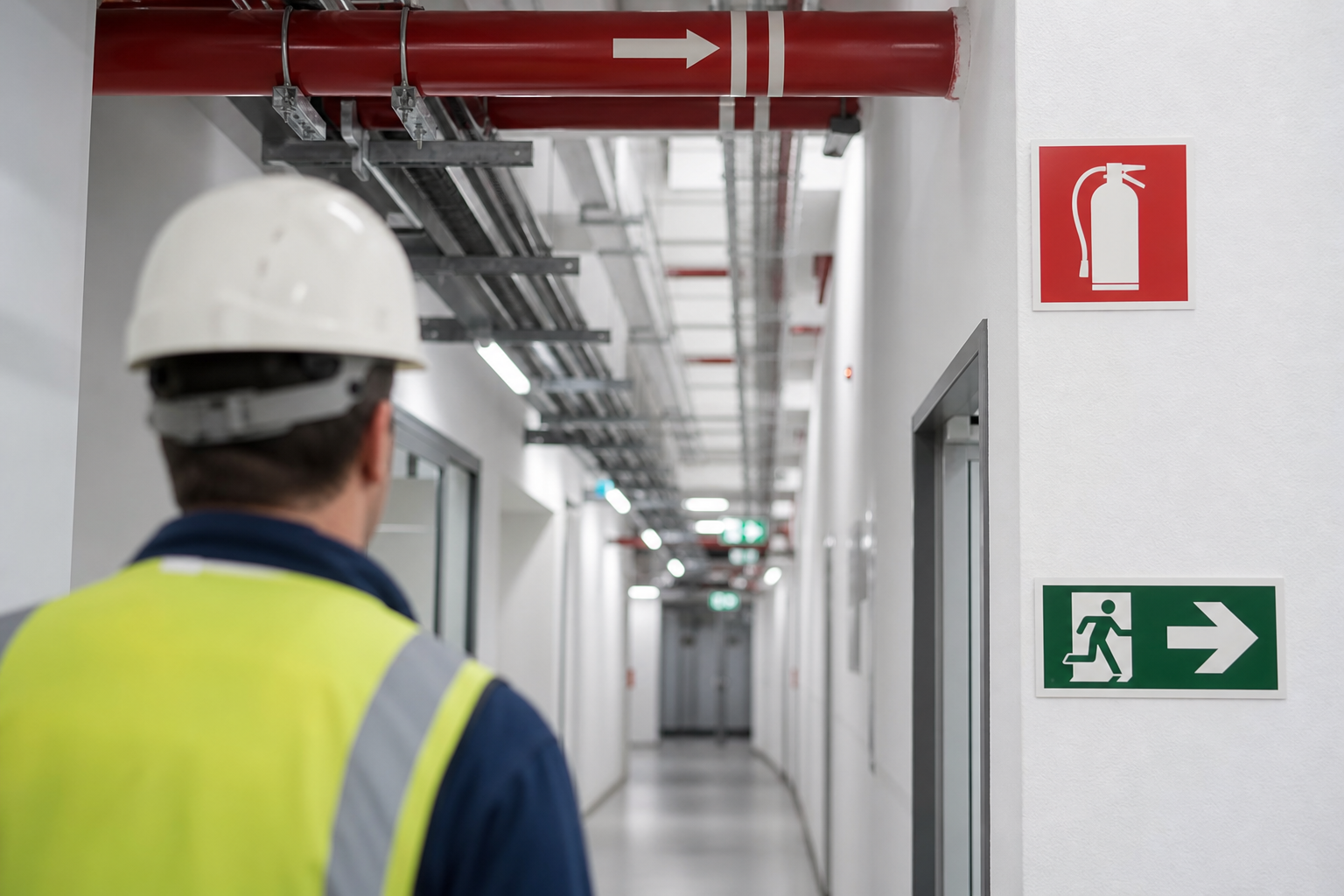
NFPA 170 signs concern fire safety and emergency symbols, but they are only one part of a facility’s safety communication system. Before ordering, confirm whether you need a fire or emergency symbol, a pipe marker, a general workplace safety sign, an equipment label, or several of these together.
The right selection depends on the hazard, message, location, visibility, environment, applicable code requirements, and product-level claims. NFPA 170 should not be treated as a universal compliance certificate or as a replacement for fire protection equipment, emergency procedures, inspections, training, or site-specific approval.
What NFPA 170 Covers
NFPA 170 concerns fire safety and emergency symbols used to communicate information during normal operations and emergencies. In practical terms, these symbols can help identify fire protection equipment, communicate emergency actions, support directional information, and make important locations easier to recognize.
The exact sign required depends on the facility, the application, and the rules adopted by the relevant authority. OSHA explains that, where approved by the authority having jurisdiction, NFPA 170 pictograms may be used for certain exit-sign communication. That does not mean every pictogram or sign is automatically acceptable in every building or jurisdiction. See the OSHA explanation of exit signs and NFPA 170 pictograms for that specific context.
NFPA 170 also does not determine whether a facility has adequate detection, suppression, alarm, egress, or emergency-response systems. Signs make those systems easier to find and understand, but the broader fire protection program still requires its own review.
Where Fire and Emergency Signs Fit in a Facility Safety System

Fire protection signage is the visual layer of a larger system. A facility may need signs that identify emergency equipment, direct people toward exits, mark routes, communicate keep-clear requirements, or provide instructions near a fire protection asset.
That communication works best when it is coordinated with the physical layout and the actions people must take. A sign near an extinguisher should help people recognize the equipment and keep access visible. A directional sign should be positioned where someone must choose a route. An egress sign should support the facility’s approved emergency path rather than create a conflicting direction.
Signs should not substitute for correcting blocked access, maintaining equipment, controlling hazards, or training employees. A clear symbol cannot compensate for an inaccessible extinguisher, an inoperative alarm, an obstructed exit, or an emergency procedure that people have not been taught.
For a broader explanation of how signs, equipment identification, egress markings, and other elements work together, review this guide to fire protection products.
NFPA 170 Signs Compared With Other Identification Systems
Many ordering errors happen because different types of communication are treated as interchangeable. The following comparison clarifies the primary question each system answers.
| Communication type | Primary question | Typical application | Important limitation |
|---|---|---|---|
| NFPA 170 symbols | What fire safety or emergency information should a person recognize? | Fire protection equipment, emergency actions, symbols, and wayfinding | Does not establish complete facility compliance or replace required text, equipment, or procedures. |
| ASME A13.1 pipe markers | What is inside this pipe, and which way is it flowing? | Process, utility, and fire protection piping identification | Does not replace a fire equipment symbol or general emergency sign. |
| General workplace safety signs | What hazard, required action, restriction, or safe practice applies here? | PPE, traffic, lockout, slips, restricted entry, and other work areas | Must be selected for the specific hazard and location. |
| Equipment labels | What is this asset, control, component, or warning? | Panels, valves, machinery, cabinets, and individual assets | A label may not provide the visibility or area-wide communication required from a sign. |
These categories can appear in the same facility. Broader work health and safety signs may communicate PPE, hazards, safe practices, and emergency routes, while NFPA 170-related signs focus on fire safety and emergency symbols.
NFPA 170 vs. ASME A13.1: Which Standard Applies?
The central distinction is the information being communicated. NFPA 170 addresses fire safety and emergency symbols. Pipe identification communicates the contents of a piping system and, where required, the direction of flow.
For example, a fire protection pipe may need a pipe marker that identifies its contents and shows flow direction. A nearby sign may identify an extinguisher, hose station, alarm control, or emergency route. These communications serve different purposes and may both be necessary.
OSHA enforcement material illustrates why pipe identification should be reviewed separately. The cited example refers to identifying piping contents with a lettered legend and using arrows to indicate flow direction. That is a different question from whether a fire or emergency symbol is visible. Review the OSHA piping identification example for the distinction.
Do not assume that a supplier’s reference to NFPA 170 means every product is an NFPA 170 sign, or that a pipe marker is covered simply because it appears in a fire protection catalog. Verify the intended product, its stated alignment, and the requirements for the actual installation.
A Practical Facility Scenario: When Both Systems Are Needed
Consider an illustrative mechanical area containing a fire protection pipe, an extinguisher cabinet, and a route leading toward an exit. The pipe marker answers, “What does this pipe carry, and which way do the contents move?” A fire equipment symbol answers, “What emergency resource is located here?” A directional or egress sign answers, “Where should a person go?”
One communication cannot reliably answer all three questions. If the pipe is clearly marked but the extinguisher is difficult to locate, the piping identification has not solved the equipment-identification problem. If the extinguisher is marked but the pipe contents are unclear, the equipment sign has not solved the piping identification problem.
NFPA 170 Sign Pre-Order Checklist
Prepare the following information before requesting a quote or approving an order:
- Identify the hazard or system. State whether the sign relates to an extinguisher, alarm, hose station, exit, emergency route, fire protection pipe, restricted area, or another application.
- Define the exact message. Decide whether the sign identifies equipment, gives directions, communicates an emergency action, marks a keep-clear area, or provides another instruction.
- Confirm the symbol and wording. Ask whether a symbol alone is sufficient or whether text, a pictogram, or both are required.
- Document the location. Record the room, corridor, equipment area, entrance, intersection, or other installation point.
- Assess viewing conditions. Consider viewing distance, line of sight, lighting, glare, obstructions, and orientation.
- Record the mounting surface. Identify whether it is smooth, textured, curved, coated, damp, or difficult to access.
- Describe environmental exposure. Include indoor or outdoor use, UV radiation, moisture, chemicals, cleaning agents, abrasion, temperature concerns, and impact.
- Specify dimensions and quantity. List the size, number of locations, repeated messages, and differences between areas.
- Identify applicable requirements. Record the jurisdiction, adopted fire and building codes, internal specifications, owner requirements, and any AHJ review.
- Verify product-level claims. Confirm that stated standard alignment or certification applies to the exact product and intended use.
VisionMarker’s ordering guidance similarly recommends including location, surface, exposure, message, visibility needs, quantity, dimensions, and applicable standard review when requesting pricing.
Who Should Review the Final Sign Selection?
The authority having jurisdiction may determine which fire, building, or egress requirements apply in a particular location. That review is separate from a supplier’s product description.
Within the facility, the EHS or safety lead can assess the hazard and communication purpose. Engineering or maintenance can verify piping information, equipment locations, access, and installation conditions. Operations can identify workflow and traffic issues. A facility compliance representative can coordinate internal specifications and documentation.
For piping, verify the service name, marker content, flow-direction requirements, placement, and changes caused by rerouting, insulation, equipment replacement, or maintenance. For fire safety signs, confirm the symbol, wording, location, and relationship to the approved emergency plan.
Installation, Inspection, and Replacement Checks
When signs arrive, compare them with the approved order before installation. Check the wording, symbol, dimensions, quantity, and intended location. For pipe markers, verify service information and flow direction rather than relying on a visual check alone.
After installation, inspect whether signs are visible from the approach path and whether equipment, stored materials, doors, temporary barriers, or new construction obstruct them. Confirm that each sign supports the decision a person must make at that location.
Include signage in facility change reviews. Replace or reassess signs when they are faded, peeling, damaged, illegible, relocated, or no longer accurate because the hazard, equipment, route, or process has changed.
What to Include in a Signage Quote Request
Include the facility area, sign purpose, exact wording or symbol, dimensions, quantity, viewing conditions, mounting surface, environmental exposure, and any related pipe markers or labels required for the same project.
Also state the standards, internal specifications, or approvals that must be reviewed. If the project involves piping, provide verified service information and flow-direction requirements. If it involves emergency equipment or egress, identify relevant locations and the facility reviewer responsible for approval.
VisionMarker provides industrial signs, fire protection products, pipe markers, labels, and stickers for customers in the USA and Canada. Its catalog uses a quote-based process for many products, so a complete project brief can help the team respond to the actual application.
Frequently Asked Questions
Does NFPA 170 apply to pipe markers?
Not as a general pipe-marking standard. NFPA 170 concerns fire safety and emergency symbols, while pipe markers identify piping contents and, where required, flow direction. Review applicable pipe-identification requirements separately, commonly including ASME A13.1.
Can an NFPA 170 symbol replace a fire protection sign with text?
That depends on the application, adopted requirements, and authority having jurisdiction. OSHA identifies circumstances where NFPA 170 pictograms may be used for exit-sign communication when approved by the AHJ. Do not assume the same answer applies to every sign.
Are all fire safety signs automatically NFPA 170 compliant?
No. Verify the symbol, wording, product-level claims, application, jurisdiction, and required reviewer approval before ordering.
What information should I provide when ordering NFPA 170-related signs?
Provide the purpose, exact message or symbol, location, viewing distance, lighting, dimensions, quantity, mounting surface, environmental exposure, applicable standards, and final approver. Include related pipe markers or labels when relevant.
Who approves NFPA 170 signage for a facility?
The appropriate authority varies by location and project. Coordinate the authority having jurisdiction with the facility’s EHS, engineering, maintenance, operations, or compliance team.
Conclusion: Verify the Standard Before You Order
NFPA 170 signs are fire safety and emergency symbols within a broader facility communication system. They can help people recognize equipment, routes, instructions, and emergency information, but they do not replace fire protection hardware, procedures, training, inspections, or site-specific code review.
Before ordering, separate the questions: use the appropriate fire and emergency symbol review for NFPA 170-related signage, and use a separate piping identification review for contents, legends, and flow direction. Then confirm the message, location, visibility, environment, product claims, jurisdiction, and final approval path.
For signs, pipe markers, labels and stickers, fire protection products, and quote-based project requests, visit VisionMarker.