Canada

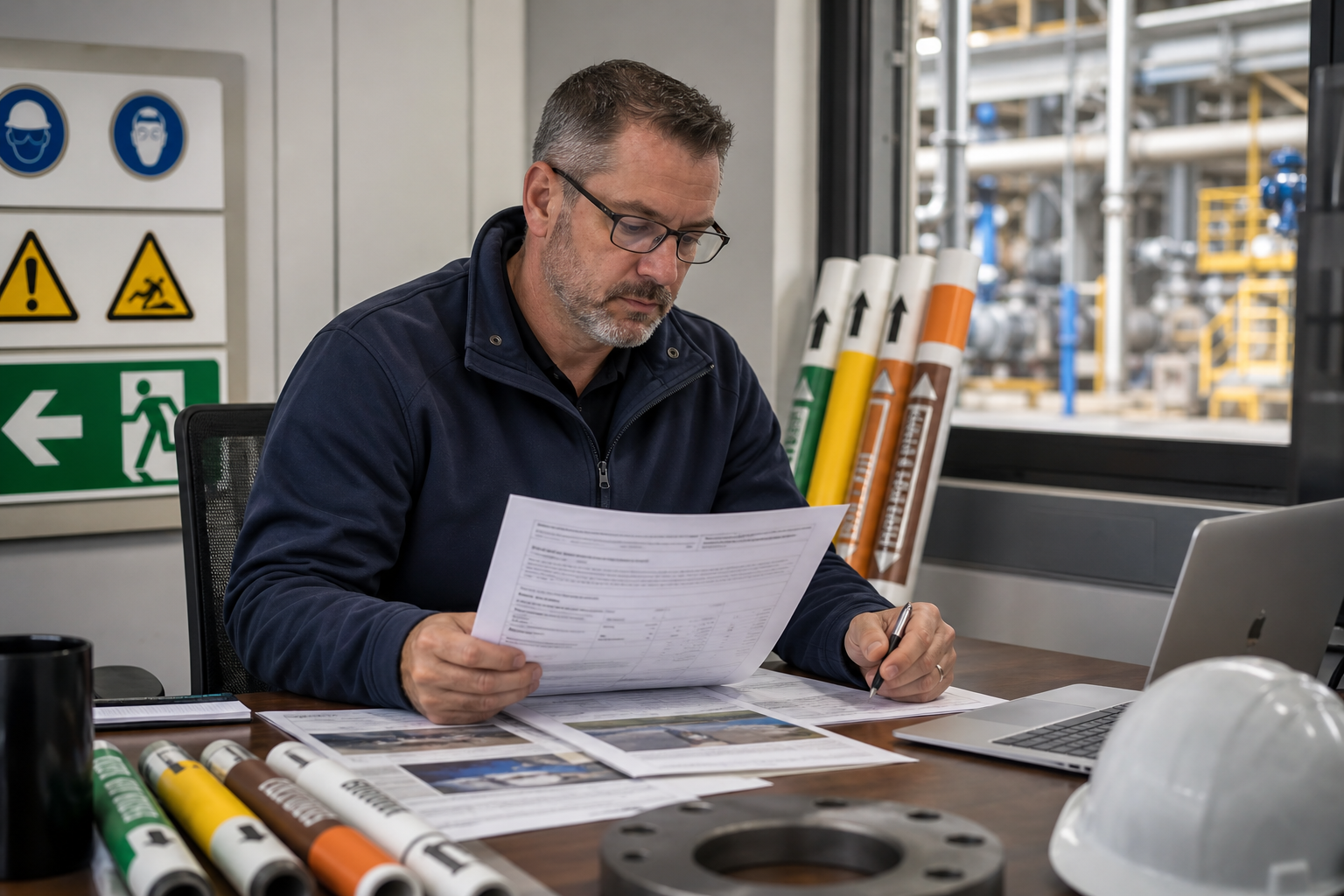
A reliable custom signage quote starts with a complete project brief, not a short request for “custom signs.” Suppliers need to understand what each sign must communicate, where it will be installed, how it will be exposed to the environment, and which standards or facility requirements apply.
This custom signage quoting workflow helps facility managers, EHS professionals, maintenance supervisors, and operations leaders prepare an accurate RFQ, compare supplier responses, and approve production with fewer avoidable revisions. It applies to industrial signage, labels and stickers, fire protection signage, and custom pipe markers.
1. Start With the Application and Scope
Begin by describing the operational problem the signage must solve. Is the project intended to identify a hazard, require PPE, control access, direct traffic, mark fire protection equipment, identify an asset, or communicate information on a pipe or piece of equipment?
Then define the project boundary. A facility-wide program may include general safety signs, industrial labels, fire protection products, and piping identification. A smaller order may involve one message or a replacement label. Separating these requirements prevents a generic product specification from being applied to several different jobs.
Identify the reader and viewing conditions. State whether the sign will be read by employees, contractors, visitors, drivers, maintenance personnel, or emergency responders. Note the expected viewing distance, lighting, traffic speed, and whether people will approach from one direction or several.
2. Build the Sign Specification Before Requesting Pricing

A supplier can price a defined specification more consistently than a general concept. For each sign or label, prepare the exact wording, symbols, signal words, dimensions, orientation, quantity, colors, artwork, mounting method, installation surface, and required delivery date.
Keep a sign schedule with one row per item. Separate different sizes, messages, materials, and installation locations instead of combining them into one unexplained quantity.
- Message: Provide approved wording, abbreviations, language requirements, and equipment identifiers.
- Visual elements: Identify symbols, arrows, signal words, logos, borders, stripes, and color requirements.
- Dimensions: State finished width, height, shape, orientation, and required text size.
- Quantity: Separate each size, message, material, and location.
- Construction: Specify the preferred material if known, or request a recommendation based on exposure.
- Mounting: Identify adhesive, holes, brackets, straps, magnetic attachment, or another method.
- Artwork: Attach approved files, drawings, photographs, or a layout.
- Timing: Provide the required arrival date and relevant project milestone.
For safety signs, distinguish required PPE, warning, prohibition, emergency, and directional messages. The final specification should match the facility’s risk assessment and sign program.
3. Document Material and Environmental Conditions
Material selection affects durability, appearance, installation, and price. Tell the supplier whether the sign or label will be indoors, outdoors, or partially protected. Add conditions such as direct UV exposure, moisture, washdown, chemical splash, abrasion, temperature changes, frequent cleaning, grease, dust, and physical impact.
Identify the surface: painted metal, bare metal, galvanized steel, plastic, concrete, glass, insulation, equipment housing, or another substrate. A label suitable for a clean, smooth surface may not work on a textured, curved, contaminated, or low-energy surface.
Ask about temperature limits, adhesive suitability, expected service life, removability, print method, protective layers, and legibility after exposure. The relevant industrial label materials should be selected using actual substrate and exposure conditions, not the product name alone.
VisionMarker states that its industrial signs and identifications are designed for weather, UV exposure, moisture, and chemical products. Confirm that this positioning applies to the exact material, printing method, adhesive, and protective construction in your quote.
4. Add Pipe-Marker Details for Piping Identification
Custom pipe markers require information that does not apply to a general wall sign. Identify the pipe contents or service, hazard information, required legend, and flow direction. Include pipe diameter, insulation thickness, surface condition, operating environment, and whether the marker must wrap around the pipe or attach as a rigid sign.
Map valves, outlets, connections, equipment interfaces, route changes, access points, and areas where maintenance personnel need to identify the line quickly. Marker size and quantity may change according to pipe size, viewing distance, and the locations requiring identification.
Official safety guidance recommends identifying pipelines at reasonable intervals and at outlets, valves, or connections. It also recommends durable tags when tags identify pipelines carrying hazardous substances. Review the official piping identification checklist when building your site schedule.
Do not assume a general industrial sign specification is sufficient for piping identification. Ask the project owner, engineer, EHS team, or authority having jurisdiction which standard, facility legend, and current edition govern the work. VisionMarker references ASME A13.1 and other North American standards, but the exact requirement should be confirmed for the project and product.
5. Confirm Standards and Documentation
List every standard, owner specification, internal design rule, and regional requirement the supplier must consider. Depending on the application, requirements may involve ANSI, NFPA, ASME, CGA, or Canadian standards.
- Which standard or facility specification was used for the proposed layout?
- What edition or revision applies?
- Does the claim apply to the exact material, size, color, legend, and construction quoted?
- Can the supplier provide a data sheet, certification statement, test information, or other required documentation?
- Are there project requirements for bilingual text, symbols, color bands, or installation?
A quote supports your review process, but it does not by itself guarantee regulatory compliance or inspector approval.
6. Submit an RFQ That Produces Comparable Quotes
Package the RFQ so every supplier receives the same information. Include the sign schedule, drawings, artwork, photographs, useful site plans, quantities, delivery location, preferred material, installation notes, and the person responsible for technical approval.
A site plan helps when quantities depend on location. Mark entrances, process areas, pipe routes, valves, fire equipment, restricted areas, traffic lanes, and other decision points. If the plan is preliminary, label it clearly and identify supplier assumptions.
Before submitting an RFQ, define the proof approval workflow. State who approves wording and artwork, whether samples or technical documents are required, how revisions will be recorded, and what must appear on the final quote.
Request line-item quantities, dimensions, material construction, mounting method, artwork or setup charges, proofing, packaging, shipping, taxes, delivery assumptions, and exclusions. This exposes missing information before an order is placed.
7. Compare Quotes by Scope and Risk
Price is only one part of the comparison. A lower total may reflect a smaller quantity, thinner construction, different adhesive, omitted proofing, excluded shipping, or an assumption that your team will provide finished artwork.
| Area | Verify |
|---|---|
| Scope | Messages, sizes, quantities, variants, and locations included |
| Construction | Face material, print method, protective layer, adhesive, and fasteners |
| Compliance | Applicable standard, product-specific evidence, edition, and documents |
| Proofing | Artwork responsibility, revisions, samples, and approval point |
| Delivery | Production assumptions, packaging, shipping, taxes, destination, and date |
| Exclusions | Installation, artwork preparation, site verification, tooling, and expedited work |
Ask the supplier to clarify any line that does not match your RFQ. Written clarification can prevent costly misunderstandings when several sign types or locations are included.
8. Review the Proof Before Production
Proof approval is a technical check, not just a spelling review. Compare the proof with the approved sign schedule and inspect every field before authorizing production.
- Confirm wording, spelling, abbreviations, numbers, and language.
- Check signal words, symbols, arrows, borders, stripes, colors, and contrast.
- Verify dimensions, orientation, holes, adhesive, and mounting details.
- For pipe markers, confirm contents, hazards, flow direction, marker size, and placement assumptions.
- Match each proof to the correct quantity and location.
- Confirm material, protective construction, and environmental assumptions.
- Check delivery, destination, packaging, and approved substitutions.
Record comments by proof version and identify the person giving final approval. Do not rely on an informal email thread for complex, multi-site, or safety-critical work.
9. Confirm the Order and Retain Records
Retain the final artwork, accepted proof, quote, purchase order, product documentation, standards references, quantities, material details, shipping records, and change approvals. These records support replacements, process changes, audits, and matching identification at another facility.
Document installation notes, including surface preparation, orientation, placement intervals, valve and outlet locations, and areas requiring periodic inspection.
When Is a Custom Quote Better Than a Standard Product?
A standard product may be sufficient when the message, size, material, mounting method, and quantity are already clear and available. Custom pricing becomes more useful for nonstandard wording, unusual dimensions, difficult exposure, multiple variants, custom pipe legends, coordinated facility programs, or project-specific documentation.
Customization is particularly useful when an incorrect legend, material, quantity, or mounting method could delay commissioning or create rework. A structured quote and proof process surfaces those decisions before production.
Questions to Ask Before Approval
- Does the quote include every message, size, quantity, and location?
- Which material, adhesive, protective layer, and mounting method are included?
- Are the materials suitable for the documented exposure conditions?
- Which standard or facility specification was used?
- What product-specific documentation is available?
- How are proofs, revisions, and final approval recorded?
- Are artwork, samples, installation, packaging, shipping, taxes, or expedited production excluded?
- For pipe markers, are contents, flow direction, diameter, insulation, valves, outlets, and locations accounted for?
- What assumptions could change the total?
Conclusion: Turn a Sign Request Into a Controlled Buying Process
The strongest workflow defines the application, writes the specification, documents the environment, separates pipe-marker requirements, confirms standards, submits a consistent RFQ, compares the full scope, and approves the proof systematically.
VisionMarker offers industrial labeling and signage solutions including pipe markers, signs, labels and stickers, and fire protection products. Review VisionMarker to browse its offerings or request project pricing.