Canada

Last updated: October 2026
By Dante de Felice · VisionMarker Editorial · Last updated: 2026-10-26
What this guide covers
In this article, “fire protection products” primarily means the signage and identification layer used around fire equipment and emergency routes. VisionMarker supplies industrial signs, labels, pipe markers, directional arrows, and keep-clear markings; it is not presented here as a supplier of complete fire alarm, sprinkler, suppression, or extinguisher systems.
The right visual system makes equipment easier to locate, keeps access from becoming obstructed, and gives employees, visitors, maintenance teams, and responders a consistent way to interpret a facility. Product selection still depends on the building, occupancy, hazards, equipment, and local authority requirements.
- What fire protection products include
- Standards and U.S. compliance context
- How to select products for a facility
- Where to place signs and markers
- Inspection and maintenance
- A practical rollout checklist
- Frequently asked questions
What are fire protection products?
Fire protection products are the equipment, signs, labels, markings, and identification tools used to prevent, detect, contain, communicate, or respond to fire hazards. The category is broad rather than a single U.S. regulatory classification. In VisionMarker’s product context, the most relevant items are fire-protection signage and identification products that help people find equipment and understand hazards.
Common product groups
- Equipment-location signs: wall signs and symbols identifying extinguishers, hose cabinets, alarm pull stations, and related equipment.
- Directional signs: arrows and repeated markers that guide people to equipment or exits when a direct line of sight is unavailable.
- Keep-clear markings: floor or wall messages that help preserve access around extinguishers, cabinets, valves, panels, and other emergency assets.
- Hazard and instruction signs: concise warnings about fire hazards, fixed extinguishing agents, restricted areas, or required actions.
- Equipment labels and tags: asset identification, inspection information, valve labels, and service-related references.
- Pipe markers: legends, color fields, and flow arrows used to identify fire-service piping and other facility lines where applicable.
- Egress and emergency wayfinding: signs and arrows that support evacuation plans and help occupants reach exits or assembly areas.
These visual products do not replace a properly selected extinguisher, alarm, sprinkler, or suppression system. Instead, they make installed equipment and emergency information easier to recognize and use. A facility should have qualified fire-safety professionals determine equipment type, quantity, design, and servicing requirements.
Standards and U.S. compliance context
Standards and regulations serve different purposes. OSHA requirements address workplace safety responsibilities and sign specifications, while consensus standards can provide conventions for symbols, pipe identification, equipment design, or installation. Local fire codes and the authority having jurisdiction may add requirements that vary by facility and location.
How the main references fit together
- OSHA sign specifications: OSHA’s accident-prevention sign requirements address the design, application, and use of signs and symbols intended to identify hazards. New and replacement signs should be selected with those specifications in mind.
- Fire-safety symbols: NFPA 170 is intended to standardize fire-safety, emergency, and associated-hazard symbols so people and responders can interpret visual information consistently.
- Pipe identification: ASME A13.1 conventions are commonly used as a framework for identifying piping contents and flow direction. Confirm the applicable edition and facility requirements before ordering a sitewide program.
- Equipment visibility and access: OSHA materials state that portable extinguishers should be visually inspected monthly, receive an annual maintenance check, remain clearly visible, and remain unobstructed.
- Fixed extinguishing systems: Where an extinguishing agent may create a hazard, warning signs should be posted at the entrance to and inside protected areas, with concise and readable wording.
Use the OSHA specifications for accident-prevention signs and tags as a regulatory reference, not as a substitute for a complete code review. Requirements can depend on occupancy, construction, process hazards, employee exposure, and the jurisdiction in which the site operates.
“ANSI certified signs” is also worth handling carefully. A product may be designed to follow recognized sign conventions or manufactured to a stated standard, but the phrase should not be treated as proof that one sign makes an entire facility compliant. Confirm the product specification, application, material, and installation conditions with the responsible safety professional.
How to select fire protection products
Selection should begin with the facility rather than with a catalog category. Walk the site, identify the decisions people must make during an emergency, and document where equipment, routes, panels, valves, and hazards are located.
1. Map hazards and emergency assets
Record areas such as production floors, warehouses, loading docks, kitchens, electrical rooms, mechanical rooms, laboratories, and outdoor storage. Note ignition sources, combustible materials, vehicle traffic, chemicals, cleaning routines, temperature changes, and locations where racks or stored goods can hide equipment.
On the same plan, mark extinguishers, hose cabinets, alarm pull stations, control panels, sprinkler control valves, fire-service connections, exits, stairs, assembly points, and restricted areas. This map becomes the basis for sign placement and helps reveal assets that are difficult to see from normal approach paths.
2. Match the message to the decision
A sign should answer a specific question quickly: What is here? Which way do I go? What must remain clear? Is entry restricted? Is a fire-extinguishing agent hazardous? Avoid combining too many messages on one panel when separate, short signs would be easier to read.
- Use an equipment-location sign when the asset is present but not obvious.
- Use a directional arrow when a wall, rack, doorway, or turn interrupts the sightline.
- Use a keep-clear message where storage, carts, vehicles, or work materials could encroach.
- Use a hazard warning where employees need advance notice of a fire or extinguishing-agent risk.
- Use a pipe marker or valve label where maintenance or response teams must identify a line or control point.
3. Choose materials for the environment
Indoor office signage has different demands from a loading dock, washdown area, chemical room, or exterior utility corridor. Consider ultraviolet exposure, moisture, abrasion, cleaning chemicals, temperature, dust, mounting surface, viewing distance, and whether the sign will be touched or struck by equipment.
VisionMarker describes its products as designed for demanding environments and offers industrial labeling and signage across piping identification, signs, labels and stickers, and fire-protection signage. Review the fire safety products overview for the available product categories, then verify the specific material and application before placing an order.
4. Standardize across shifts and sites
Use one approved vocabulary, symbol set, color approach, arrow style, and pipe-marker legend wherever the same hazard appears. Consistency matters when employees move between departments or when contractors and emergency responders enter an unfamiliar area.
Where to place signs, labels, and markers
Placement should follow the way people approach and make decisions. A sign hidden behind a door, stored material, vehicle, or rack does not provide reliable guidance even if the message itself is correct.
Protect visibility and access
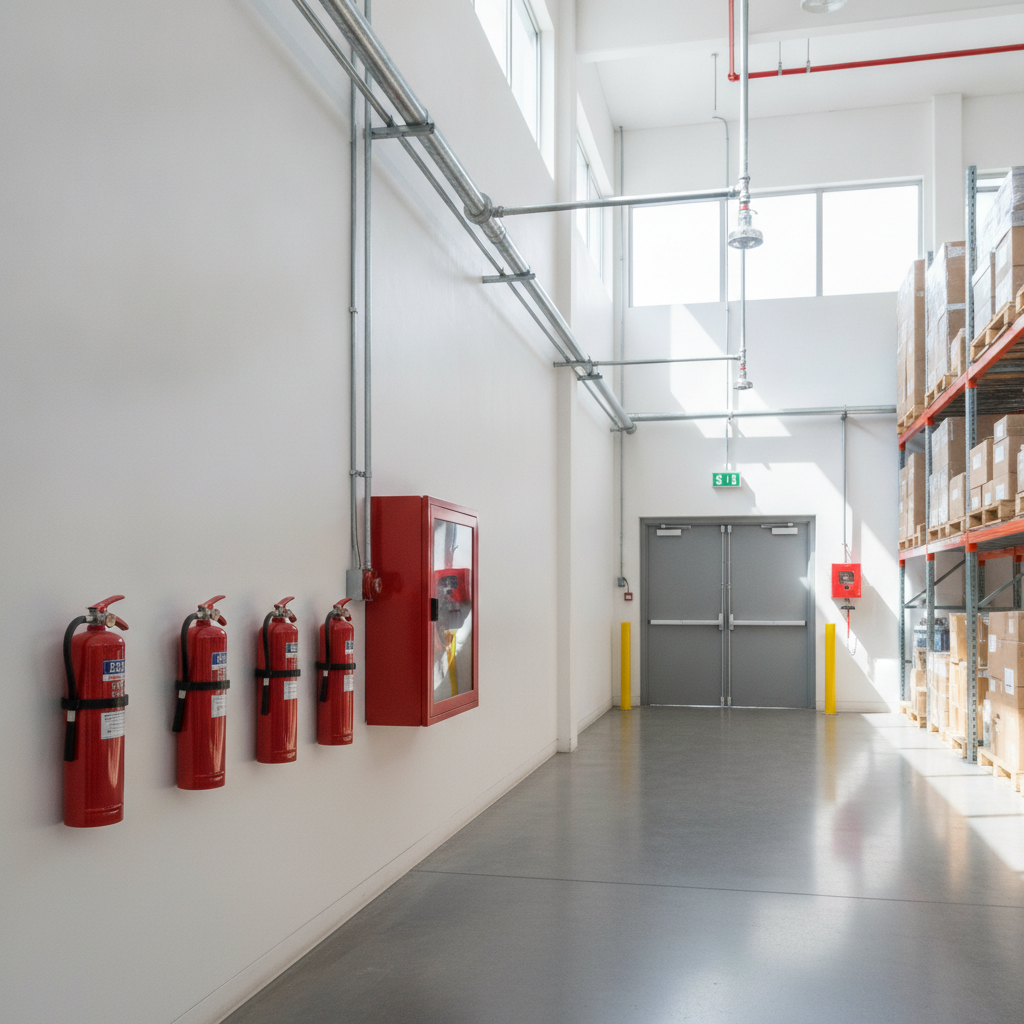
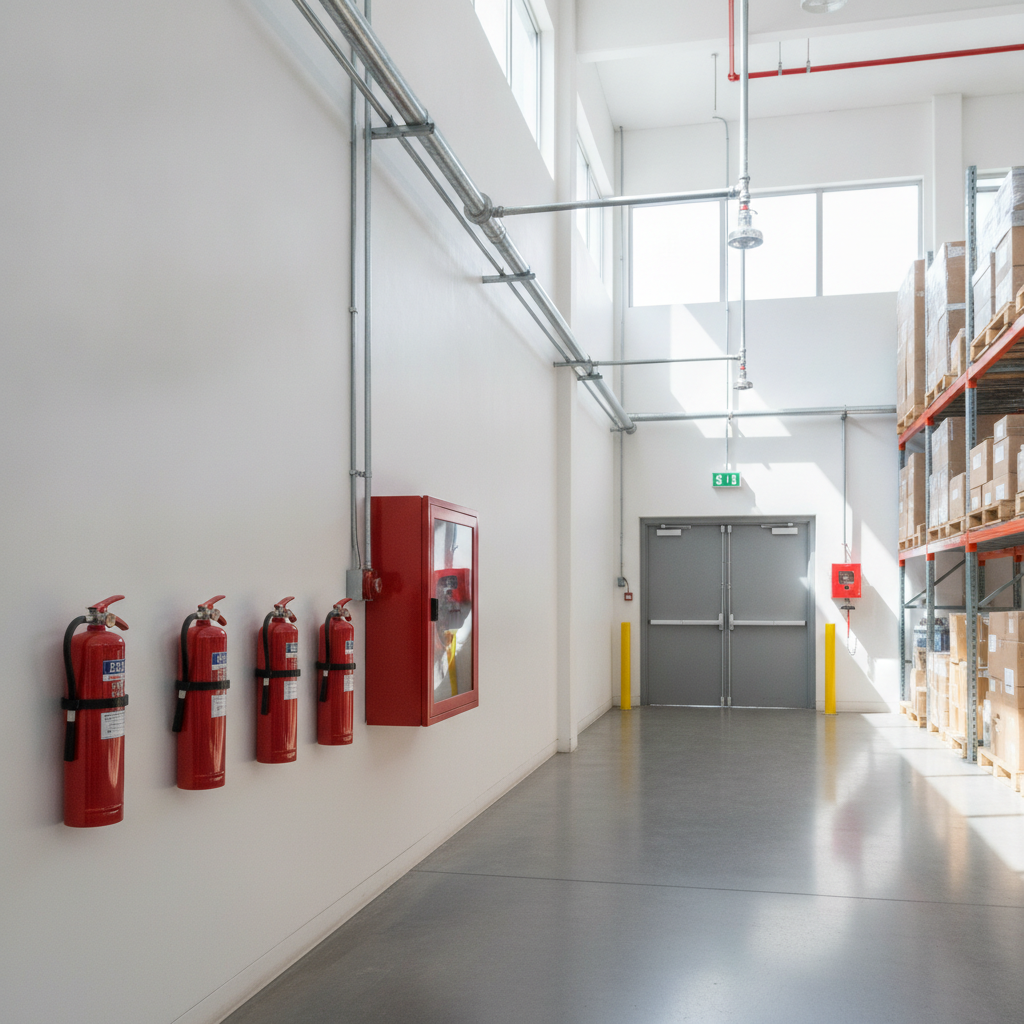
- Place an equipment-location sign above or near the asset where it can be seen from the normal approach route.
- Add directional signs at corridor intersections, aisle ends, doors, and other points where the next destination is uncertain.
- Use floor or wall keep-clear markings where pallets, carts, stock, or vehicles could block an extinguisher, cabinet, panel, valve, or connection.
- Repeat signs in long, high-bay, or rack-heavy spaces when one sign cannot be seen from the full approach distance.
- Keep emergency messages separate from decorative graphics, dense instructions, or unrelated notices that compete for attention.
Identify fire-service piping and controls
Pipe markers should be readable from the positions where maintenance and response decisions occur. Include the relevant legend and flow direction, and label valves or control points so workers do not have to guess which line or device they are handling.
Do not assume that a pipe-marking program can be designed from color alone. Mixed utilities, poor lighting, aging paint, and similar-looking lines make clear legends and repeated identification important. Confirm the applicable piping convention and site legend before installation.
Account for changing U.S. facilities
Warehouses, distribution centers, manufacturing sites, and construction areas change frequently. New racking, temporary storage, process equipment, tenant improvements, and altered egress routes can make an originally sensible sign program inaccurate. Recheck signs after layout changes rather than waiting for an annual review.
Inspection and maintenance
Fire signage and identification should be included in routine facility inspections. The review is not only about whether a sign is still attached; it should confirm that the message remains visible, legible, accurate, and useful from the approach path.
Monthly visual review
- Confirm extinguishers and other identified equipment remain in their designated locations.
- Check that signs are visible and not obscured by inventory, doors, vehicles, temporary partitions, or decorations.
- Look for fading, peeling, cracking, corrosion, chemical damage, or unreadable text.
- Verify that floor keep-clear markings still match the equipment footprint and traffic pattern.
- Check that directional arrows still point toward the correct equipment or route.
- Compare pipe markers and valve labels with current piping, process, and room conditions.
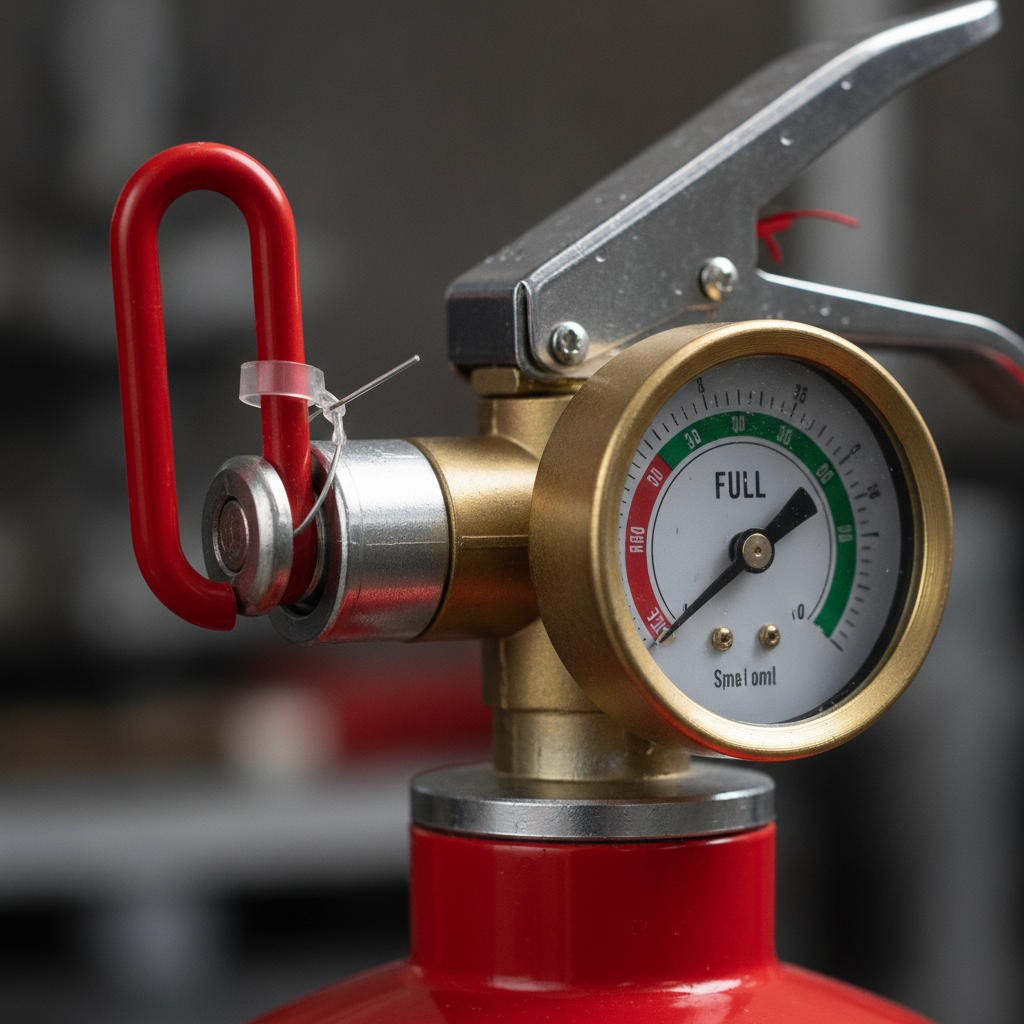
OSHA’s portable-extinguisher guidance calls for monthly visual inspections and annual maintenance checks. Those equipment inspections should be performed within the responsible workplace program; signage checks support the program but do not replace inspection, testing, servicing, or training requirements for the equipment itself.
Annual and change-driven review
Schedule a broader walk-through at least annually and whenever the facility changes. Compare the emergency map with the physical site, review blocked or relocated assets, confirm signs in hazardous fixed-extinguishing areas, and replace damaged or outdated identification.
Keep an inspection record showing the date, area reviewed, issue found, corrective action, responsible person, and completion date. A simple record makes recurring problems visible and helps managers demonstrate that hazards were addressed rather than merely noticed.
A practical rollout checklist
A phased rollout helps a facility improve quickly without losing control of its standards. Use the following sequence for a single building or a national program.
- Survey: walk every area and map equipment, exits, hazards, valves, panels, and obstructed sightlines.
- Prioritize: correct missing equipment signs, blocked access, incorrect arrows, and unreadable hazard warnings first.
- Define the standard: approve messages, symbols, dimensions, colors, materials, mounting methods, and a pipe-marker legend.
- Order by environment: select substrates and finishes that suit indoor, outdoor, wet, chemical, high-traffic, or high-temperature conditions.
- Install and photograph: record the installed location and note any remaining obstruction or layout constraint.
- Train: show employees what the symbols mean, how to report damage, and why equipment access must remain clear.
- Audit: add the program to monthly inspections and review it after construction, process changes, incidents, or relocation of assets.
For a focused starting point, review VisionMarker’s fire signage guide. It can help teams think through sign purpose, visibility, and placement before they create a sitewide order.

Frequently asked questions
What should a facility standardize first?
Start with the signs and markings that affect immediate response: extinguisher and hose-cabinet identification, alarm pull-station visibility, exit and directional messages, and keep-clear markings. Then create a consistent symbol and message standard for additional areas so new signs do not introduce conflicting formats.
Are fire protection products the same as fire extinguishers and sprinkler systems?
No. The term can include complete fire-protection equipment, but VisionMarker’s supplied business scope is primarily signage, labels, pipe markers, directional arrows, and related identification products. Equipment selection, system design, installation, inspection, and servicing should be handled according to the applicable requirements and qualified professionals.
How often should fire signs be checked?
Include signs in routine monthly facility and extinguisher-area checks, confirming visibility, legibility, accuracy, and unobstructed access. Perform a broader review at least annually and after layout, equipment, process, or egress changes. Replace signs when they are damaged, faded, detached, or no longer describe the area correctly.
What makes a sign suitable for an industrial environment?
Suitability depends on the installation conditions. Review resistance to UV exposure, moisture, chemicals, abrasion, temperature, and cleaning practices, as well as viewing distance and mounting surface. A sign should also use a clear message or symbol appropriate to the hazard and the people who need to act on it.
Build a clearer fire-protection identification program
Effective fire protection products begin with accurate site information. Map hazards and emergency assets, select concise messages, protect sightlines and clearances, identify piping and controls, and maintain the program as the facility changes.
For U.S. facilities, use OSHA requirements, applicable consensus standards, local code direction, and qualified professional advice together. VisionMarker can support the visual and identification layer with industrial signage, labels, pipe markers, and fire-protection products designed for workplace applications.
Plan your fire signage and identification system
Review the fire protection collection to compare signage and identification options for your facility, then confirm the required messages, materials, and installation conditions before ordering.