Canada

Custom printed labels are labels produced to a buyer’s requested specifications, such as wording, graphics, size, shape, material, adhesive, or quantity. In an industrial facility, they are useful when standard labels do not communicate the right information or fit the installation surface and environment. The correct choice depends on what the label must say, where it will be installed, how it will be handled, and whether a specialized safety or identification standard applies.
For facilities managing equipment, work areas, storage locations, or safety communication, custom printed labels can support a consistent identification system. However, a general custom label is not automatically the same as a regulated safety sign, pipe marker, or fire protection sign. Those categories may have separate design and compliance requirements.
What are custom printed labels?
A custom printed label is a printed identification or communication label configured for a particular application rather than selected solely from a standard, preprinted range. Customization may involve text, symbols, logos, colors, shape, dimensions, material, adhesive, finish, or quantity, depending on the supplier’s available options. Avery’s label information describes custom labels in terms of specifications such as shape, size, quantity, materials, and adhesives. OnlineLabels also identifies options including waterproof, matte, gloss, clear, and kraft materials or finishes.
For an industrial buyer, “custom” describes how the label is configured. It does not, by itself, establish regulatory status, durability, adhesive performance, or suitability for a particular hazard. Those characteristics must be evaluated against the application.
Where can custom printed labels help in a facility?

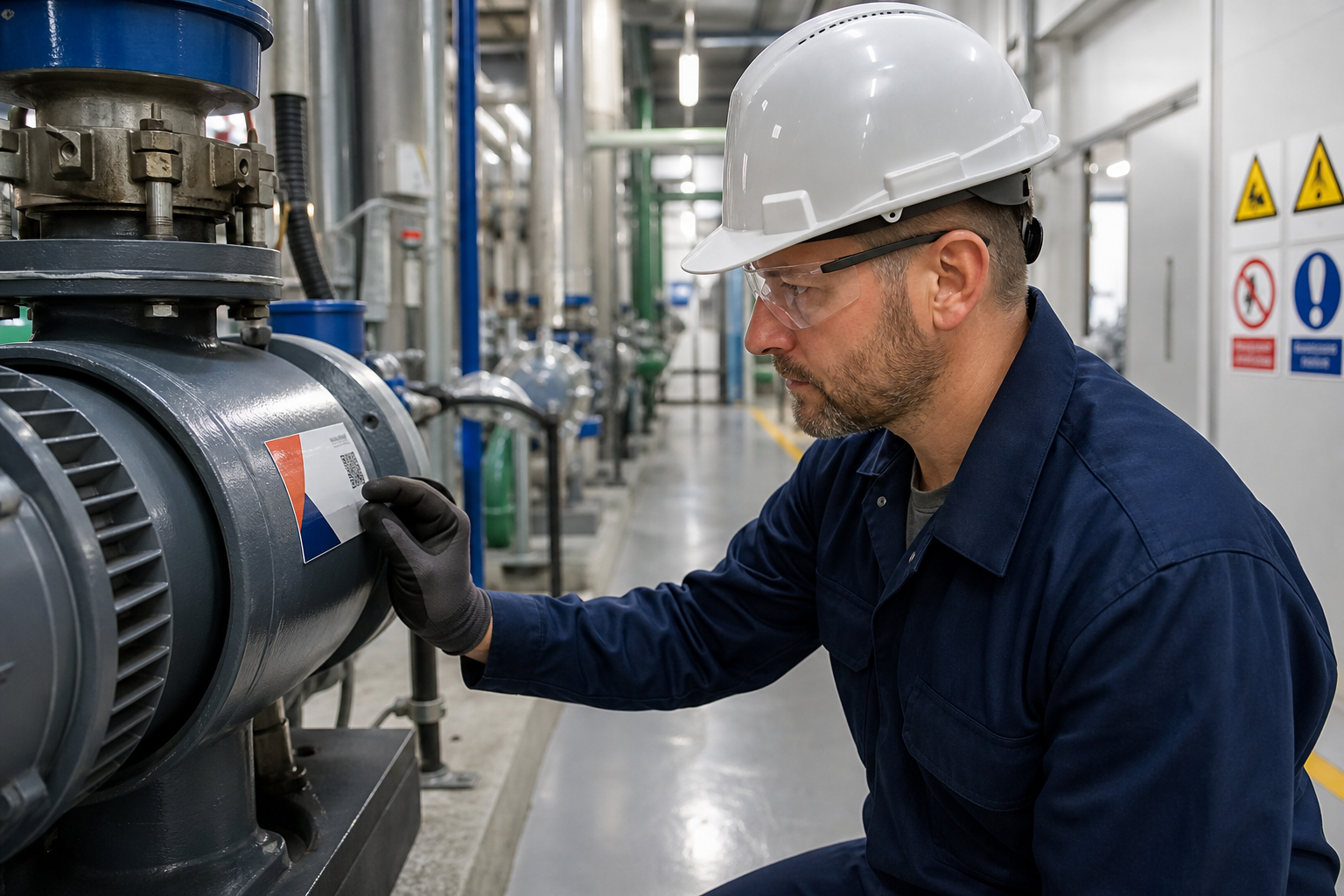
Custom printed labels can help when a facility needs clear, repeatable information specific to its equipment, processes, spaces, or procedures. Potential applications include equipment identification, asset or component information, location-specific instructions, handling information, and facility-specific messages.
A maintenance team may need consistent identification for equipment or components, while operations may need labels communicating a site-specific instruction. A label may also be part of a wider identification system that includes signs, pipe markers, and fire protection products. VisionMarker offers labels and stickers for industrial facility communication as part of its broader industrial labeling and signage range.
Define the label’s role before preparing artwork. Is it identifying an item, explaining a procedure, directing movement, communicating a hazard, restricting access, or supporting a regulated identification system? The answer determines whether a general custom label is suitable or whether a dedicated product category is more appropriate.
What should buyers specify before ordering?
A custom label should be selected around the application, not just its appearance. These decisions help suppliers understand the requirement and help facilities avoid labels that are difficult to read, install, or maintain.
1. The message, symbols, and artwork
Start with the information the label must communicate. Provide exact wording where possible and identify any symbols, logo, barcode, serial number, variable data, or other artwork. Also define whether the label provides identification, instruction, warning, restriction, or another facility-specific message.
Consider viewing distance, lighting, and whether workers need to understand it quickly. If artwork is supplied, ask whether the file must be print-ready or whether typeset instructions are acceptable. Decals.com’s custom label information describes uploaded artwork, size, and quantity as part of the ordering process.
2. Dimensions, shape, and format
Measure the available space and note the surface geometry. A label installed on a flat panel may have different requirements from one placed on a curved component, narrow enclosure, container, or irregular surface.
Consider the amount of information and viewing distance when choosing dimensions. State whether the order requires individual labels, sheets, rolls, or another format, if known. Confirm the available configuration for the intended application rather than assuming every supplier offers every size or format.
3. Material, adhesive, and exposure conditions
Describe the surface and environment, including indoor or outdoor exposure, ultraviolet radiation, moisture, chemicals, abrasion, temperature changes, cleaning, oil, dust, and frequent handling. Surface material, texture, cleanliness, and coatings can affect adhesion.
Material and adhesive should match those conditions. Confirm resistance for the specific product and exposure rather than assuming every label is weatherproof or chemically resistant. VisionMarker positions its industrial labeling and signage products as designed for demanding environments, emphasizing resistance to outdoor exposure, UV radiation, moisture, and chemicals. Confirm the appropriate construction and adhesive for the actual application.
4. Quantity, variations, and future reorders
State the expected quantity and number of versions. One design printed in quantity differs from several designs with different equipment names, locations, identifiers, or instructions.
For future reorders, preserve approved wording, artwork, dimensions, material, adhesive, and version information. Ask about minimum quantities, pricing, production schedules, and shipping rather than assuming them.
Custom printed labels versus specialized facility signage
Custom wording does not make a product interchangeable with every other type of industrial signage. A general label may suit facility-specific identification, while a dedicated safety sign, pipe marker, or fire protection sign may be needed when the message and installation are governed by a recognized standard.
VisionMarker distinguishes among piping identification, signs, labels and stickers, and fire protection products. First identify the communication need, then select the product category designed for it.
Which product type fits the communication need?
| Product type | Primary purpose | Decision point |
|---|---|---|
| General custom printed labels | Facility-specific identification, information, or instructions | Define the message, format, surface, environment, and durability. |
| Safety signs | Hazards, required actions, restrictions, or procedures | Review visibility needs and applicable safety or certification requirements. |
| Pipe markers | Identifying piping systems and contents or direction where applicable | Review relevant piping identification requirements, including whether ASME A13.1 applies. |
| Fire protection signage | Identifying fire protection equipment, systems, or locations | Review applicable fire protection requirements and intended product use. |
This comparison is a starting point, not a compliance determination. The correct product depends on the facility, message, installation, and applicable requirements.
When do standards and certifications become part of the decision?
Standards and certifications matter when a label or sign is used for a regulated hazard, piping system, fire protection application, medical or specialty gas system, or another situation with defined identification requirements. A custom message does not automatically make a label compliant.
VisionMarker emphasizes NFPA 170, ASME A13.1, NFPA-99C, CGA C-9-2002, and CAN/CGSB-24.3-12 across relevant product categories. Match the applicable standard to the actual use rather than adding one generically to a purchase request. If evaluating ANSI certified signs, review the intended message, location, and certification together.
What information should you include in a quote request?
Include the intended use, exact wording and artwork, dimensions and format, quantity and variations, mounting surface, indoor or outdoor location, exposure conditions, installation method, and required standard or certification. VisionMarker serves customers across the USA and Canada through a quote-based website process. These details make a request more useful than asking only for a generic price on custom labels.
Frequently asked questions
Are custom printed labels the same as safety signs?
No. A custom label may communicate facility-specific information, while a safety sign communicates a hazard, required action, restriction, or procedure and may have specific design or certification requirements.
Can custom printed labels be used outdoors or around chemicals?
They may be suitable when the material, adhesive, and construction are confirmed for the actual exposure. Request product-specific information for UV, moisture, chemicals, cleaning, and abrasion.
What information should I provide when requesting custom industrial labels?
Provide the intended use, wording or artwork, dimensions, quantity, variations, mounting surface, location, exposure conditions, installation method, and applicable standards or certifications.
Do custom printed labels automatically meet ANSI, NFPA, or ASME requirements?
No. Customization concerns design or configuration and does not automatically establish compliance. Confirm the relevant requirement and product suitability for regulated applications.
Conclusion: Choose the label around the application
Custom printed labels are useful when a facility needs information, artwork, dimensions, or a format that a standard label does not provide. Begin with the message, then account for viewing distance, available space, mounting surface, environmental exposure, adhesive needs, quantity, and future variations.
Do not use “custom” as a substitute for compliance review. When communication concerns piping identification, fire protection, or a defined safety requirement, compare a general label with the specialized product category and verify the applicable standard before ordering.
Explore VisionMarker’s labels and stickers or request a quote for an industrial labeling need.