Canada

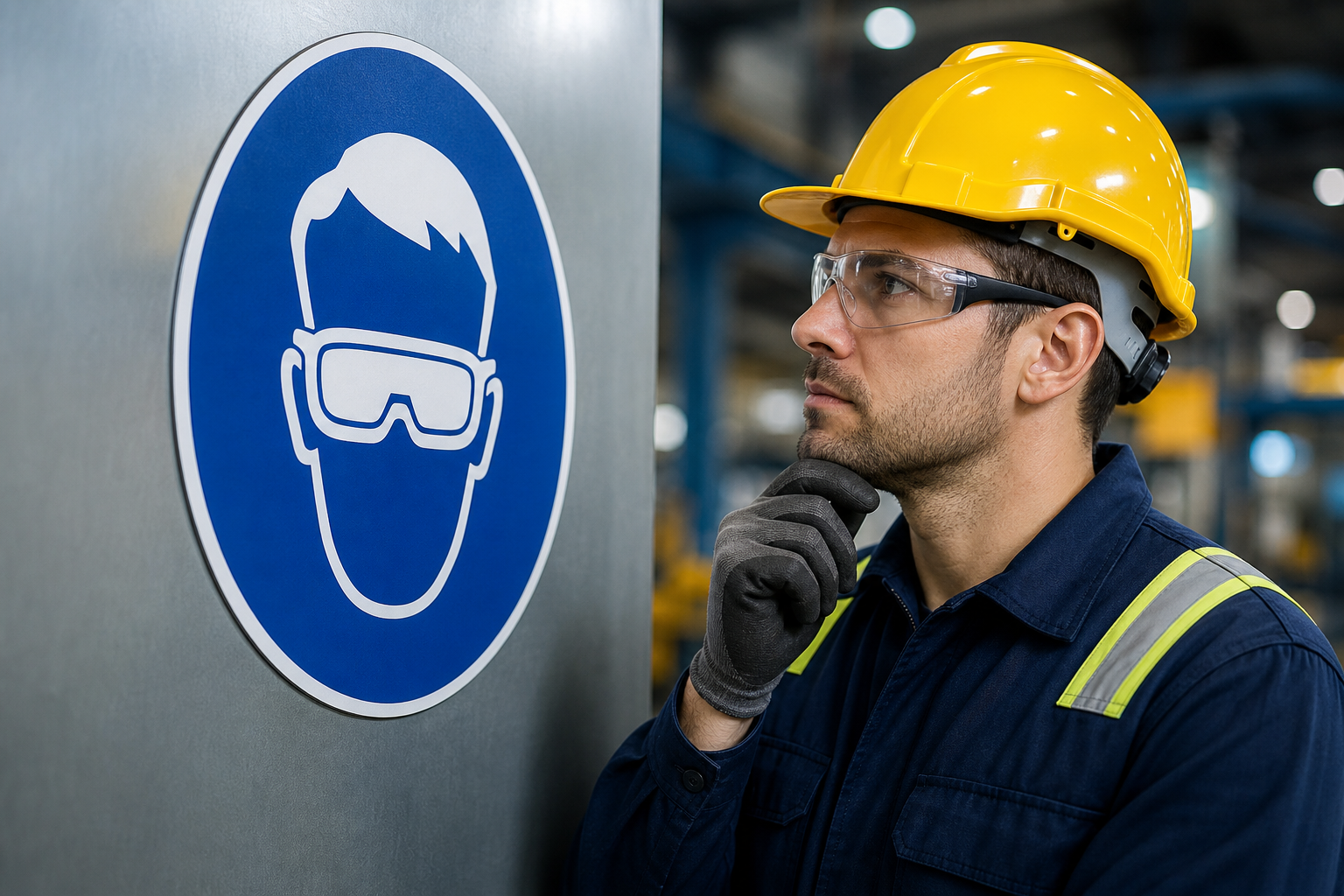
Choosing the right eye protection signs starts with questions, not aesthetics. This checklist organizes the red flags you must find before you order or install signage. For each risk we explain why it matters, how to verify it on-site or with a supplier, and the immediate action step if the answer fails the test. Use these items to protect workers, support your PPE program, and avoid wasted spend on signs that fade, confuse, or do not reflect the hazard.
Regulatory and standards red flags
Red flag: signs that omit or contradict the regulatory context for eye and face protection. Employers must provide eye and face protection when hazards exist. Signs should reflect that responsibility and not imply a substitute for PPE programs. Verify any claim about regulatory compliance with documentation.
What to check: ask the supplier which standards their signage is intended to support and request written confirmation. For example, OSHA requires eye and face protection whenever workers face hazards such as flying particles, liquid chemicals, or injurious light radiation, so ask the supplier to reference the applicable guidance OSHA summary for eye and face protection. Also confirm whether signage aligns with eyewear selection standards such as ANSI/ISEA Z87.1, and ask the supplier to show how the sign’s message matches the eyewear class you require ANSI/ISEA Z87.1 guidance.
Immediate action step: if the supplier cannot point to standards or provide documentation, treat that as a red flag and escalate to a vendor that will provide citations and material data sheets.
Hazard assessment red flags: is the sign justified by the actual risk
Red flag: blanket posting of “Eye protection required” without an accompanying hazard assessment. The most reliable way to choose PPE signs is to work backwards from a hazard assessment. A sign that does not match the documented hazard invites confusion and noncompliance.
What to check: run or review an area and task level assessment that categorizes the hazard as impact, splash, or optical radiation. A good hazard assessment records task, source, frequency, and the chosen control. Expert guidance recommends documenting the specific hazard that justifies signage before you order or post it.
Immediate action step: if you find a sign in place with no documented hazard, remove it from your standard ordering list and require the responsible manager to produce a short hazard justification before replacement signs are purchased.
Material and durability red flags

Red flag: the supplier will not provide material specifications, sample panels, or details about UV, chemical, and moisture resistance. In industrial settings these are operational requirements, not nice-to-have features. Durable construction matters because PVC, aluminum, photopolymer, and various vinyls perform differently in sun, chemical spray, and wash-down environments.
What to check: request a material data sheet and a sample or proof. Ask how the inks resist UV and whether the substrate and adhesives are rated for the temperature range and chemical exposure in your facility. If signs will be outdoors or in high-chemical areas, ask specifically for weatherproof or industrial-grade options and for a description of the expected service life under those conditions. VisionMarker emphasizes durable construction and standards alignment, so look for the supplier to describe UV, moisture, and chemical resistance and to position materials as ANSI certified where applicable.
Immediate action step: if the vendor cannot produce a technical sheet or sample, list that as a procurement disqualifier and source another supplier who supplies proof of durability.
Visibility, placement, and design red flags
Red flag: signs that are too small, low contrast, crowded by other messages, or placed outside normal sightlines. A perfectly compliant sign does no good if it is unreadable at the distance workers approach the hazard.
What to check: confirm sign size and pictogram clarity relative to anticipated viewing distance and typical sightlines. Verify mounting height and orientation so the sign faces oncoming traffic or workers. Ask whether the sign uses standard pictograms for eye protection and whether the iconography is ANSI style and high contrast. Pictograms and text should be legible under ambient lighting and not compete with other safety messages nearby. Practical advice recommends placing signs where workers stop or make a task decision, not where they will walk past without looking.
Immediate action step: if a proposed design uses low contrast, obscure pictograms, or lacks a mounting plan, request a revised proof with scaled dimensions and a photo mock-up of the intended location before you approve production. For a ready reference, review the supplier product page for safety goggles signs and placement guidance Safety Goggles Signs: Protect Your Team in 2026 Guide.
PPE program integration red flags
Red flag: signs instruct workers to wear specific eye protection that the employer does not supply, or signs that do not match the styles and ratings of the eyewear in your program. Signs should reinforce your written PPE policy and the eyewear options you provide.
What to check: confirm that signage language matches your PPE policy and the eyewear selection guidance used by your safety team. If your policy expects ANSI Z87.1 rated spectacles or splash goggles, the sign should not suggest the use of a different class of device. Also check whether signs include brief fit reminders or references to where compatible eyewear is located. EHS guidance stresses that eyewear selection and fit information are operational considerations that affect whether signage will actually change worker behavior.
Immediate action step: require the sign proof to include the exact wording your safety manager approves. If the supplier will not alter text to reflect your PPE policy, mark that supplier as a red flag for operational mismatch.
Customization and local requirement red flags

Red flag: inability or unwillingness to produce bilingual or jurisdiction specific signs when your sites require them. For multi-jurisdiction operations you may need bilingual signage such as English and French in Canada, or local code references included on the sign face.
What to check: ask whether the supplier can produce custom text, bilingual layouts, and whether they will print standard citations or pictograms as required by local regulators. Also check whether the supplier will add a citation line such as an internal policy reference or a code number if you need it for audit trails. VisionMarker serves US and Canadian customers and emphasizes standards alignment, so confirm that the supplier can produce signs that reflect the local needs of your facility.
Immediate action step: if the vendor refuses customization or cannot confirm bilingual production, find a supplier who can supply proof and a translated mock-up prior to ordering.
Procurement, logistics, and supplier answers to demand
Red flag: vague lead times, no proofs, hidden minimum orders, or refusal to provide material data sheets and standards documentation. These issues create delays and can cause nonconformance at audit time.
What to ask for in a quote: a written lead time, sample or proof approval process, minimum order quantities, material and ink data sheets, confirmation of any standards references printed on the sign, and a firm statement about returns or remakes if the proof is incorrect. Ask whether they provide installation guidance or services if you need help mounting multiple signs. Many suppliers use a quote based pricing model and will supply these details on request; insist on them prior to approval.
Immediate action step: treat any vagueness around proofs or materials as a red flag. If a supplier asks you to trust the product without paperwork, pause the order and request a sample run first. For product examples and to start a quote request, see the supplier product page for safety goggles signage Safety Goggles Signs: Protect Your Team in 2026 Guide.
On-site audit: the red-flag questions to use now
Use this short walk-through checklist. Ask each question and apply the action step immediately when the answer is a red flag.
- Is there a documented hazard assessment for this area? Action: If not, stop and document the hazard before approving any signs.
- Does the sign match the PPE policy and available eyewear? Action: If not, update the wording or withhold approval until the sign reflects the eyewear you supply.
- Can the supplier provide material and ink specifications and a sample? Action: If no, disqualify supplier until they can provide a technical sheet and sample.
- Is the sign legible at typical approach distance and under current lighting? Action: If no, request a larger size or higher contrast version and a mock-up photo of the installed location.
- Are signs bilingual or jurisdiction compliant where required? Action: If no, require bilingual proofs for Canadian sites or other local language requirements.
- Does the supplier include a proof and confirm lead time in writing? Action: If not, do not proceed until you have a signed proof and lead time.
Frequently asked questions
Do eye protection signs need to reference OSHA or ANSI standards to be compliant?
Signs themselves are not a substitute for employer obligations, but referencing the relevant standards helps auditors and workers understand the legal and technical context. OSHA requires eye and face protection where hazards exist and employers commonly reference ANSI/ISEA Z87.1 for eyewear selection. Ask a supplier to cite standards in writing and provide material documentation to support claims.
Where are the most effective locations to place eye protection signs in a facility?
Place signs at decision points where workers stop or prepare to enter a hazardous area, such as access doors to machine rooms, chemical handling stations, and maintenance bays. Also mount signs at eye level for the predominant population and ensure they are not obscured by machinery or other signage. A placement plan and photo mock-up should be part of your proofing process.
Can the same ‘Eye protection required’ sign be used indoors and outdoors?
Only if the material and inks are rated for the outdoor environment. Outdoor or wash-down areas require substrates and inks that resist UV, moisture, and chemicals. Ask for a material data sheet and a sample to confirm suitability before you approve outdoor use.
What documentation should a supplier provide to prove material durability and standards compliance?
Require a material data sheet, ink and adhesive specifications, a sample or proof, and any certificates or statements that reference standards used. If a supplier cannot provide these items, consider it a red flag and seek an alternative vendor.
When should you choose a custom or bilingual eye protection sign instead of a stock sign?
Choose custom or bilingual signs when local codes, workforce language needs, or internal PPE policy require specific wording, translations, or additional instructions. For Canadian operations, bilingual English and French text is commonly required. Ask the supplier for a mock-up that includes translations and any required code citations before production.
VisionMarker can help with standards driven safety signage and provides product pages and quote options for safety goggles signs and related PPE signage. If you need a proof, bilingual options, or material data sheets, request them up front so you avoid these red flags during procurement.
Ready to remove guesswork from your signage program? Contact VisionMarker for proofs, material data sheets, and custom quotes so you only install eye protection signs that match your hazards and last on the job.