Canada

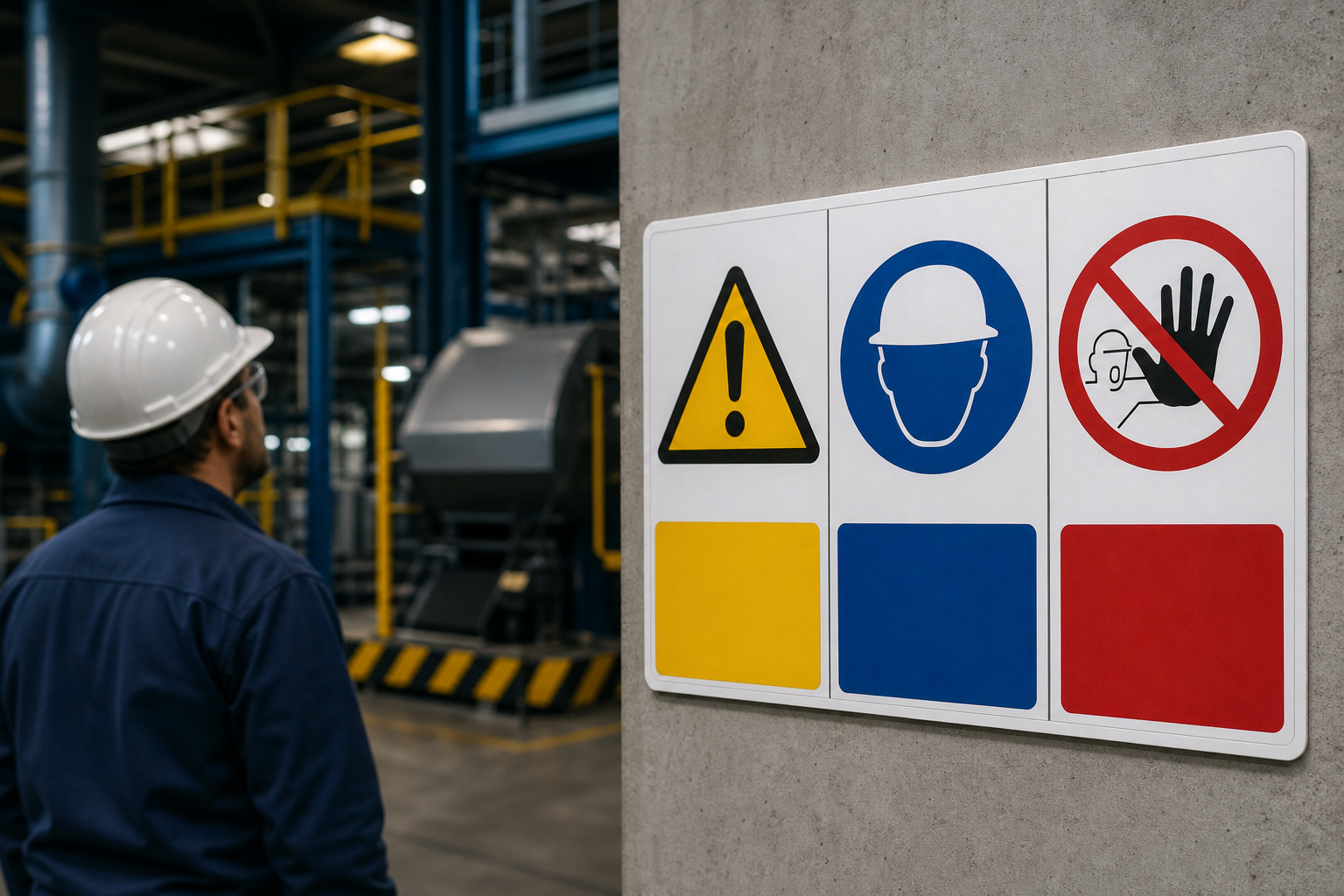
Facility managers, EHS leaders, and maintenance supervisors need signs that communicate hazards instantly, last in demanding environments, and meet inspection expectations. This comparison explains common ANSI safety sign symbols, maps them to the standards inspectors expect, and provides practical rules for pictogram versus text choices, substrate selection, sizing and placement, and procurement language you can use when requesting quotes.
What ANSI safety sign symbols are and which standards govern them
ANSI safety sign symbols are standardized pictograms, color palettes, and layout conventions used to communicate hazards, required actions, and general information. The ANSI Z535 family covers symbol graphics, signal words, and sign formats that many U.S. facilities adopt as best practice. OSHA references ANSI color and design specifications in its regulation on accident prevention signs and tags, so citing the correct standards helps during specification and inspection conversations. For practical guidance on applying the Z535 series to product labels, the CPSC Manufacturer’s Guide is a useful discussion of implementation and clarity.
Key standards and guidance frequently cited in procurement and inspection documents include ANSI Z535 series (Z535.3 and Z535.4), OSHA 1910.145 for accident prevention signs and tags, and discipline-specific standards such as ASME A13.1 for pipe markers and NFPA 170 for fire safety symbols. Canadian facilities should consult CAN/CGSB guidance where applicable.
Common ANSI pictograms and their exact meanings
Below are the most used ANSI pictogram categories, concise procurement-ready definitions, and examples of typical applications.
Danger, warning, and caution
- Danger: Indicates an immediate hazard that will result in death or serious injury if not avoided. Use on high-voltage equipment, live electrical panels, exposed rotating machinery, or confined space entrances where immediate risk exists. Style: red signal word panel and a clear pictogram.
- Warning: Signals a hazardous situation that could result in death or serious injury if not avoided. Use for machinery guard warnings, pressure vessels, or elevated-temperature surfaces where serious harm is possible but the situation is less imminent than danger conditions.
- Caution: Denotes a potentially hazardous situation that may result in minor or moderate injury. Use for trip hazards, low headroom, or slippery surfaces where outcomes are less severe but still require attention.
Prohibition, mandatory, and notice
- Prohibition: A circular pictogram with a red slash indicates forbidden actions, for example no smoking, no open flames, or no entry for unauthorized personnel near flammable or oxygen-enriched areas.
- Mandatory: A blue circular pictogram instructs required actions, for example eye protection required, hard hat required, or lockout/tagout procedures mandated in a work area.
- Notice: Conveys information not directly related to personal injury, such as visitor procedures, equipment operating hours, or administrative instructions; use when the message is informational rather than hazard-based.
For a concise visual primer you can circulate to stakeholders, see the site resource Safety Symbols Explained: Protect Your Team.
How ANSI symbols map to OSHA, NFPA, ASME, and Canadian standards
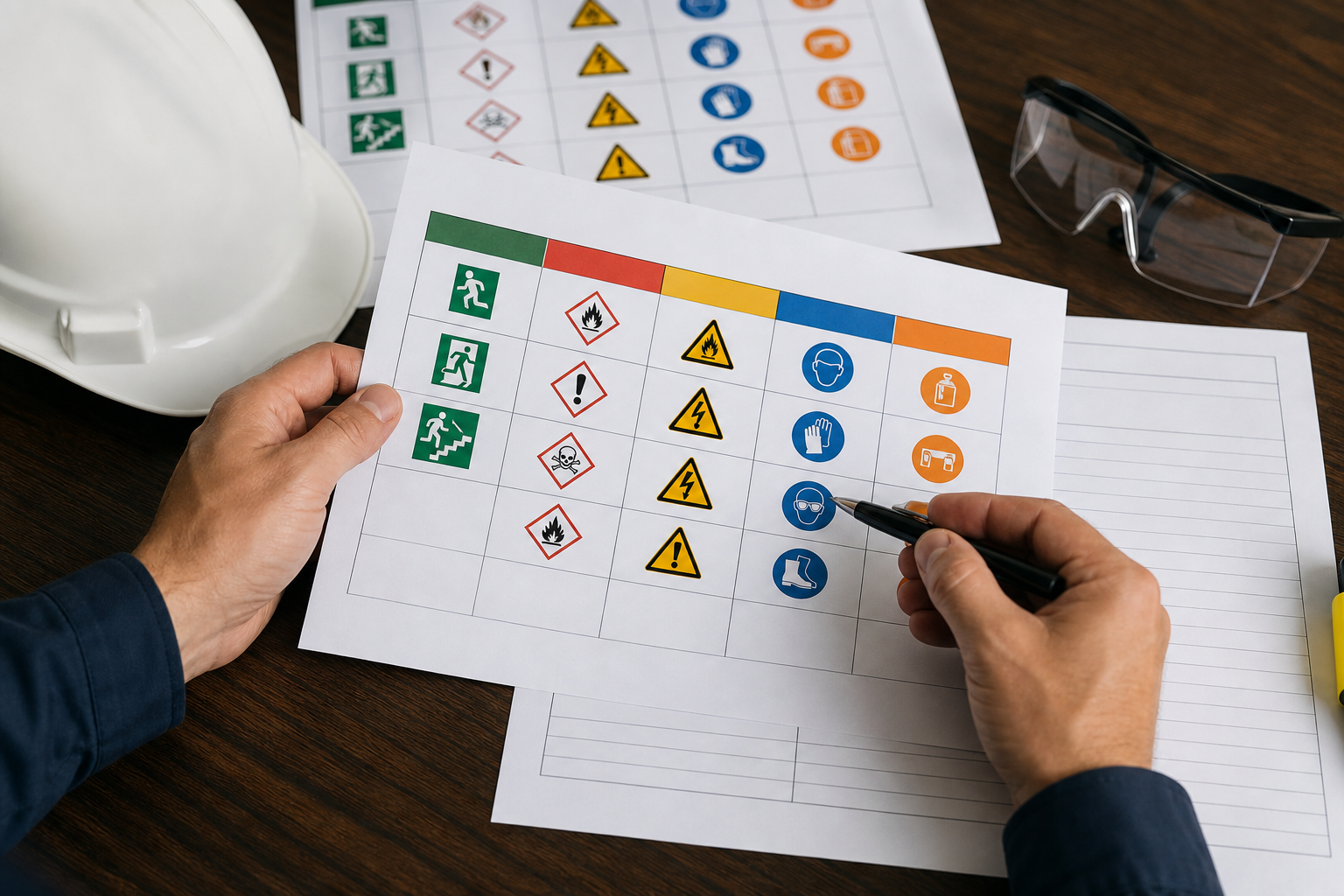
OSHA does not publish a proprietary symbol set, but it references ANSI design and color specifications in 1910.145. Using ANSI-consistent colors, signal words, and layouts is widely accepted for meeting OSHA expectations for sign clarity. When other disciplines intersect with signage, follow the discipline-specific rule: use ASME A13.1-compliant pipe markers for fluid identification and include flow arrows where the code requires them; use NFPA 170 conventions for fire and emergency symbol applications; consult CAN/CGSB standards for Canadian installations.
When specifying signage in contracts or RFQs, name the exact standards you expect the artwork and materials to follow. For example: “Signs to conform to ANSI Z535.3 for signal words and Z535.4 for safety symbol design; colors and construction to meet OSHA 1910.145 requirements where applicable.” This explicit wording reduces confusion and helps vendors provide appropriate proofs and materials data.
Pictogram versus text: choosing for comprehension and multilingual sites
Decide between symbol-only, text-only, or combined symbol-plus-text signs based on the reader profile and incident risk. Symbol-only signs are processed fastest visually and work well for experienced workers who repeatedly encounter the same equipment. Combined signs, with a brief signal word and one or two lines of text under a pictogram, reduce ambiguity and help contractors, visitors, and multilingual teams.
The CPSC Manufacturer’s Guide and ANSI Z535.3 both support combined formats for clarity and legibility. Use the following decision criteria:
- Frequent exposure and trained staff: symbol-only can be acceptable for repeated, routine tasks.
- Multilingual or low-literacy workforce: combined pictogram plus short text in the most common site languages improves comprehension.
- Life-safety or emergency locations: always use a strong pictogram with a short, directive message describing the required action.
Materials and mounting: pick the right substrate for UV, moisture, and chemicals
Material selection determines how long a sign remains legible in field conditions. Common substrates and their typical strengths:
- Rigid aluminum: Good for outdoor use, UV exposure, and long service life in corrosive or industrial atmospheres.
- Engineered plastics (e.g., polyethylene, polypropylene, polycarbonate): Offer chemical resistance and higher temperature tolerance; useful near chemical feed, steam, or where impact resistance matters.
- Weatherproof vinyl labels: Flexible for curved pipes or conduit; select high-performance adhesives for washdown areas and low-surface-energy coatings.
- Laminates and overlaminates: Add abrasion, chemical, and UV resistance for labels and printed signs exposed to harsh cleaning or sunlight.
Ask suppliers for material data sheets and recommended service environments rather than accepting generic durability claims. Specify adhesive properties for painted or coated surfaces and request outdoor-exposure samples if signage will be exterior. VisionMarker and other reputable suppliers provide datasheets and sample runs so you can evaluate adhesion, color stability, and legend legibility before full production.
Placement and sizing: where to put symbols, arrows, and pipe markers

Proper placement and size are essential so the symbol is seen and understood before a worker reaches the hazard. Practical advice:
- Verify sightlines and mounting height for overhead and door-mounted signs; position the sign so the top third is within typical sight angle from walking or vehicle approaches.
- For equipment-mounted labels, place symbols where workers pause or access controls, not on hidden or recessed surfaces.
- For piping, follow ASME A13.1 recommendations for marker frequency along straight runs, at directional changes, and at valve locations; include flow direction arrows when required by process or safety protocols.
- Size pictograms and signal words based on primary viewing distance and ambient lighting; reference ANSI Z535.3 for legibility guidance when specifying exact type sizes.
When in doubt, order a sample batch in the intended size and mount it in a test location to confirm visibility under typical lighting and from expected approach angles.
Procurement checklist and supplier questions
Use this copy-paste RFQ language and checklist to reduce back-and-forth and compare suppliers on equal footing.
- Standards and claims: Please confirm which standards the product conforms to (list Z535 parts, OSHA 1910.145, ASME A13.1, NFPA 170, CAN/CGSB‑24.3‑12 as applicable).
- Materials: Provide material data sheets, laminate options, adhesive types, and recommended environments for each substrate.
- Artwork and approval: Supply a color proof showing exact pictogram artwork, signal-word placement, and final wording for approval prior to production.
- Samples: Include one production sample and one outdoor-exposed sample when the sign will be exterior.
- Durability testing: Describe any UV, abrasion, salt spray, or chemical resistance testing performed or reference industry test methods used.
- Traceability and QC: Provide information on batch marking, lot traceability, and inspection photography for the run.
- Lead time and minimums: State lead time windows and order minimums for custom artwork or short-run quantities.
Suggested procurement clause to paste into an RFQ or purchase order:
Supply signage and labels to conform to ANSI Z535 series as specified. Provide material data sheets, color proofs, and one production sample. Confirm conformance to OSHA 1910.145 and ASME A13.1 where applicable.
Include a visual reference such as Safety Symbols Explained: Protect Your Team when circulating proofs to stakeholders to ensure consistent interpretation of pictograms and wording.
Real objections, common mistakes, and what to expect from vendors
Common concerns you will hear from purchasing and finance teams include cost differences between printed signs and engineered labels, lead time for custom art, and uncertainty about “ANSI-certified” phrasing. Practical responses and verification steps:
- “ANSI-certified” phrasing: ANSI is a standards developer and does not certify products. Ask vendors which Z535 parts they followed, and request proofs and material datasheets to verify conformity.
- Undersized pictograms: Require proofs at final size and, if possible, a field-mounted sample to confirm legibility at expected viewing distances.
- Vague durability claims: Ask for datasheets, test results, or references to recognized test methods instead of generic statements like “weatherproof.”
- Turnaround expectations: Confirm lead times for custom art vs stock designs and whether expedited production is available for safety-critical needs.
Reputable vendors will provide explicit answers, proofs, and samples without delay. If a supplier resists supplying a sample or datasheet, consider that a warning sign and request references or choose an alternative.
FAQ
What standards define ANSI safety sign symbols and where can I quote them
Quote the ANSI Z535 family for symbol design, signal words, and format. Use OSHA 1910.145 when you need a regulatory reference that incorporates ANSI color and format requirements. For product labeling guidance, the CPSC Manufacturer’s Guide discusses Z535 implementation for clarity and consumer safety.
Does OSHA require ANSI symbols on workplace signs
OSHA does not mandate a single pictogram set, but 1910.145 references ANSI color and format guidance. Using ANSI-consistent formats and colors is widely accepted as meeting OSHA expectations for clarity and construction. Interpret OSHA guidance in the context of site hazards and any other applicable codes.
How do I verify a supplier’s sign is ANSI compliant
Request the specific Z535 parts followed, ask for color proofs and material datasheets, and require a production sample for field review. Confirm signal-word placement, pictogram proportions, and color matches against the referenced Z535 documents before approving full production.
What size and color contrast should ANSI pictograms use for visibility
Size is determined by viewing distance and recognition time. Use the legibility recommendations in ANSI Z535.3 for signal-word and legend sizing, and verify color contrast with the ANSI color references incorporated in OSHA 1910.145 when specifying exact colors and contrast requirements.
Can I use ISO pictograms in place of ANSI symbols in U.S. facilities
ISO pictograms are internationally consistent and usable in many contexts, especially at multinational sites. For U.S. regulatory clarity, many EHS teams prefer ANSI Z535-based designs because OSHA references ANSI specifications. If you use ISO symbols, document the decision, ensure legibility, and include concise text in the site language to reduce interpretation risk.
Key takeaway: choose the symbol family that best aligns with your regulatory obligations, workforce, and inspection context, and require proofs and samples before full production.
For official OSHA guidance on sign construction and color, see OSHA 1910.145. For practical label development guidance, see the CPSC Manufacturer’s Guide.
VisionMarker supplies ANSI-aligned signs, ASME A13.1 pipe markers, and engineered labels built for UV, moisture, and chemical resistance across the USA and Canada. For symbol primers and downloadable visuals see Safety Symbols Explained: Protect Your Team.
For compliant, durable safety signs and piping identification, contact VisionMarker to request quotes, proofs, and product specifications.