Canada


Piping identification is the system of labels, markers, and tags used to name pipe contents, show flow direction, and support safe work, emergency response, and maintenance. For facility managers, EHS professionals, and maintenance teams in the USA and Canada, clear pipe marking reduces response time during incidents, prevents cross‑connection errors, and makes routine inspections faster. VisionMarker provides piping identification products and resources designed to meet North American standards and hold up in demanding industrial environments. For product information and quote requests visit the VisionMarker site (VisionMarker).
North American standards to reference
Several documents and codes provide the established approaches most facilities follow for pipe marking. ASME A13.1 is the primary guidance for color, legend, and placement conventions, and many suppliers and facilities use its core concepts for general systems. For the basic rule that the text legend and a directional arrow are the primary means of identifying pipe contents, see the industry summary at Seton for a practical interpretation of ASME A13.1 principles (Seton pipe & valve regulations and standards).
OSHA checklists and facility design standards reinforce visibility and location requirements. For example, an OSHA piping identification checklist advises that names or abbreviations must be readily visible on pipes near valves and outlets (OSHA piping systems: identification). Project specifications and construction guidance often add detail on how to place legends on overhead piping so they are visible from below; see a sample design directive from the University of Colorado Anschutz for placement guidance on overhead routes (SECTION 230553 identification for piping and equipment).
When you plan or audit pipe marking, treat these references as practical starting points rather than identical code across all jurisdictions. Some industries, medical gas systems, and regulated processes will cite NFPA 170, NFPA‑99C, CGA C‑9‑2002, or Canadian standards in addition to ASME A13.1. VisionMarker product pages and guides note alignment with these North American references to help buyers choose compliant items; see VisionMarker for examples of standards-aware product choices.
Five essential placement rules: what to label and where
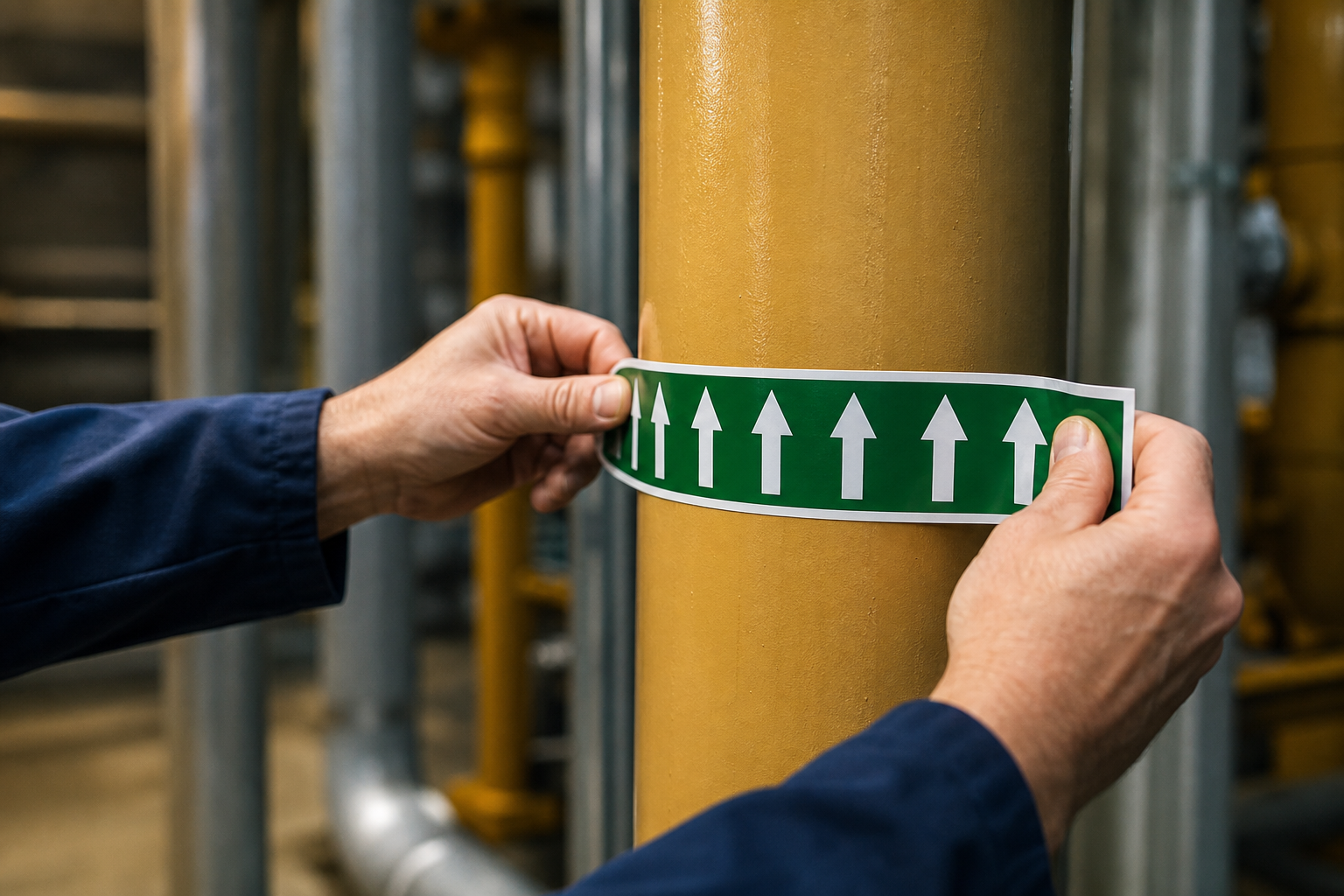
1. Include a clear text legend and a directional arrow
Always label the pipe with the substance name or an approved abbreviation and show flow direction using an arrow. The text legend and arrow are the most important elements for identifying contents and flow to operators and responders, a principle reflected in ASME and industry summaries (Seton). Why it matters: text and arrow prevent misinterpretation during valve operations and emergencies.
2. Place markings near valves and outlets
Mark pipes at or close to valves, outlets, and points where the line is accessed. OSHA guidance highlights that when a pipe is identified by name or abbreviation, the information should be readily visible near each valve or outlet (OSHA). Why it matters: identifying content at control points cuts the risk of operating the wrong valve.
3. Put legends on the lower half of overhead piping
For overhead pipes, apply the legend on the lower half of the run so personnel standing below can read it, as recommended by construction specifications and design guidelines (University of Colorado design and construction). Why it matters: correct orientation avoids obscured or upside down text and reduces misreads.
4. Reapply markers at regular intervals and at floor or wall breaks
Apply markers at consistent distances so a person in a plant aisle can read the legend without tracing the run. Where piping crosses floors or passes through walls mark both sides of the break. Why it matters: frequent markers reduce the need to trace lines visually and speed inspections.
5. Mark both ends of concealed or insulated runs
For concealed piping, mark the accessible ends or service points rather than attempting to place labels under insulation. Why it matters: it preserves information for maintenance and prevents removal of insulation to identify lines.
Materials and specs for long‑lasting pipe markers
Choose marker materials based on the environment. Common options include pressure‑sensitive vinyl labels, laminated polyester labels, UV‑stable plastics, and corrosion‑resistant metal tags. Each has tradeoffs in adhesion, chemical resistance, temperature range, and abrasion resistance.
- Vinyl adhesive labels, economical and conformable for curved copper or PVC. They perform well indoors and in mild outdoor exposures when rated for UV resistance.
- Laminated polyester, more resistant to solvents, abrasion, and moisture, suitable for chemical plants and damp environments.
- UV‑stable plastics, molded or extruded markers engineered to resist fading and cracking in direct sunlight.
- Metal tags, stainless steel or aluminum for very high temperatures, abrasion, or mechanical exposure where adhesive labels fail.
Minimum durability data to request from suppliers include UV fade resistance, chemical compatibility information, operating temperature range, adhesive shear or peel test results, and an expected service life statement for the specified environment. VisionMarker product pages describe materials engineered for UV, moisture, and chemical exposure to support long service life; review vendor durability claims and request samples for site validation (piping identification guide).
Four common mistakes purchasers make and how to avoid them

- Using ambiguous abbreviations. Problem: unclear shorthand causes confusion across shifts. Fix: adopt a documented abbreviation key tied to P&IDs and include the full name at access points.
- Choosing the wrong material for the environment. Problem: labels that peel, fade, or dissolve. Fix: match material specs to chemical exposures, temperature and UV exposure, and ask for compatibility data.
- Ignoring directional arrows or valve area visibility. Problem: labels placed out of view at control points. Fix: inspect valve stations during the audit and mark within sight lines as OSHA guidance recommends (OSHA).
- Inconsistent labelling across facilities. Problem: varying legends and colors confuse workers who move between sites. Fix: adopt a standard labeling policy and apply it consistently across all buildings and plants.
Decision checklist for choosing compliant pipe markers
Use this quick buyer checklist to turn audit findings into procurement questions when you request samples or quotes.
- Standards and certification – Ask whether markers are produced to align with ASME A13.1 and if the vendor documents alignment with any industry specifics such as NFPA 170 or NFPA‑99C. For reference and interpretation see ASME guidance summaries and supplier notes (Seton).
- Durability and test data – Request UV fade testing, chemical compatibility statements, and temperature range data. Ask for a sample or a small pilot run to validate adhesion and legibility in your environment.
- Installation and mounting – Confirm recommended mounting frequency for your pipe sizes and whether markers are pressure sensitive, banded, or mechanically fastened.
- Legibility – Verify recommended font size, color contrast, and whether directional arrows are included. Confirm that legends match your P&IDs and valve tags.
- Procurement and support – Request a written quote for the quantities and installation method you specified, ask about sample availability, and confirm lead time and return policies for nonconforming batches.
For a practical template and product options that align with these criteria see the VisionMarker piping identification guide and contact the company for samples and a quote (piping identification guide).
Next steps and where to buy compliant markers
Quick audit checklist
- Walk high‑risk areas and note pipes without legends near valves.
- Record environments that need high chemical or UV resistance.
- Compare current legends to your P&IDs and abbreviation key.
- Gather representative samples to send to vendors for matching.
How to request samples and quotes
Send vendors your list of pipe sizes, materials in contact with the piping, and desired mounting method. Ask for sample markers for each material type you are considering and request durability data. Many suppliers operate on a quote basis for bulk orders, including VisionMarker, where product pages link to contact and quote options; visit VisionMarker to request pricing, technical data, or help specifying markers for your facility (VisionMarker).
Frequently asked questions
What information must a pipe marker include to meet ASME A13.1 basics
At minimum include a clear text legend naming the pipe contents and a directional arrow indicating flow. ASME A13.1 and practical summaries emphasize the legend and arrow as the primary identifiers; for a practical industry overview see Seton (Seton).
How often should I place pipe markers along a run and near valves
Place markers at valves and outlets and at regular intervals so a person walking an aisle can read labels without tracing the pipe. OSHA checklists advise that identification be visible near valves and access points (OSHA). Project specifications may set exact spacing depending on pipe size and visibility conditions.
Which materials resist chemical exposure and sunlight for outdoor piping
Laminated polyester and UV‑stable plastics typically resist solvents and sunlight better than standard vinyl. For very aggressive exposures consider metal tags. Always request chemical compatibility data and UV fade test results from the vendor and review site conditions before selecting a material. VisionMarker materials are described with environmental resistance in product notes and guides (piping identification guide).
Do US and Canadian standards require different colors or legends for pipe markers
US facilities commonly follow ASME A13.1 conventions, and Canadian projects may cite CAN/CGSB documents or other local requirements. Requirements vary by industry and regulated systems, so confirm the applicable standard for your project and align marker legends and colors accordingly. VisionMarker documents standards alignment for North American products to help buyers choose compatible markers (VisionMarker).
What should I ask a vendor before ordering bulk pipe markers for a plant
Ask about standards alignment, material and test data, sample availability, recommended mounting frequency, and whether the vendor will match legends to your P&IDs. Request a written quote for the exact quantities and installation method, and ask for a pilot sample run where possible to validate performance on site.
For sample requests, quotes, and detailed product guidance visit VisionMarker to review products and request a piping identification quote VisionMarker.