Canada

Equipment nameplates and custom equipment labels can both identify assets, but they are not interchangeable in every application. A nameplate is usually the better fit when a project calls for durable, permanently attached equipment identification with specified data. A custom label may be more practical for facility-specific equipment IDs, instructions, components, or multiple versions across a site.
The right choice depends on the information required, equipment surface, environmental exposure, visibility, attachment method, and any engineering, facility, or jurisdictional specification. Treat the product name as a starting point, not proof that the item satisfies a particular requirement.
Key Takeaways
- Choose a nameplate for permanent identification or when specified data is required.
- Opt for a custom label for flexible identification and facility-specific instructions.
- Evaluate environmental factors such as UV exposure, moisture, and chemicals before ordering.
- Do not use nameplates as substitutes for safety signs or fire protection signage.
- Prepare detailed information before requesting a quote to ensure accuracy.
Quick summary

- Choose a nameplate when equipment needs permanent identification or project documents specify a plate, durable marking, or defined data fields.
- Choose a custom equipment label for flexible identification, asset information, component details, or facility-specific instructions.
- Check UV exposure, moisture, chemicals, cleaning, impact, temperature, viewing distance, and attachment constraints before ordering.
- Do not use an equipment nameplate as a substitute for hazard warnings, PPE signs, pipe markers, access restrictions, or fire protection signage.
- Prepare an equipment inventory, approved wording, dimensions, quantities, environmental details, and documentation questions before requesting a quote.
Equipment nameplates and equipment labels serve different jobs
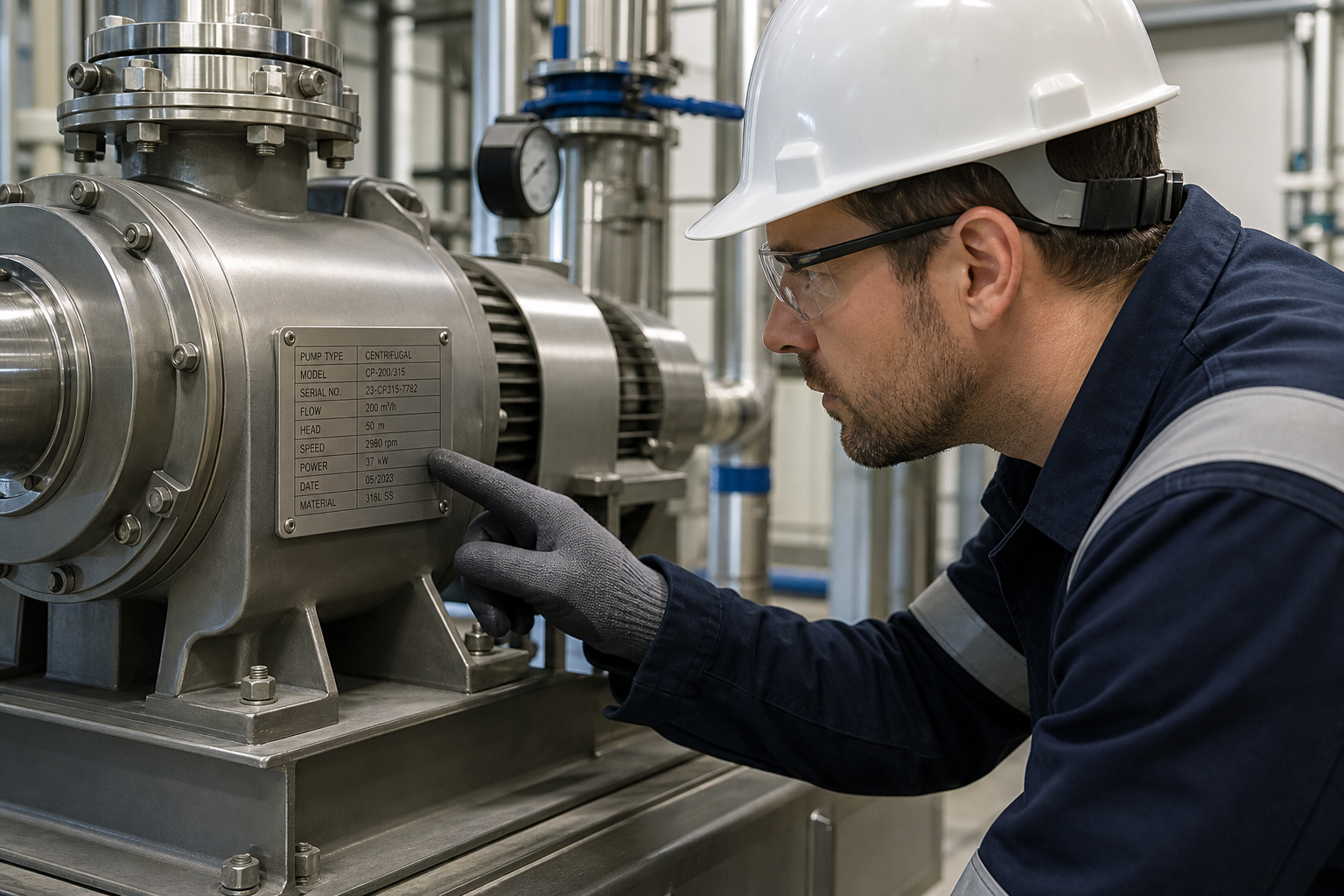
An equipment nameplate is a durable identification plate associated with a specific machine, system, or major asset. Exact construction and required information vary by equipment type and project. One official New Jersey specification, for example, describes equipment nameplates as permanently attached metal plates that may include the manufacturer, model number, serial number, and electrical data. That is a project requirement example, not a universal rule.
Custom equipment labels are more adaptable. They can identify equipment, components, cabinets, work areas, locations, or facility-specific instructions. A site may use different versions for different assets, with the format selected around the surface and communication need. VisionMarker’s discussion of custom printed labels distinguishes facility-specific identification from specialized safety signs, pipe markers, and fire protection signage.
In practice, the choice is often not either-or. A facility may use permanent nameplates for major equipment, custom labels for internal asset identification, pipe markers for piping systems, and safety signs where a person must recognize a hazard or take a required action.
Equipment nameplates vs custom labels: comparison by buying criteria

The following comparison organizes the decision. It is a specification checklist, not a claim that one product type automatically meets every code, standard, or site requirement.
| Criterion | Equipment nameplate | Custom equipment label |
|---|---|---|
| Primary purpose | Permanent or long-term identity for a specific asset | Flexible equipment, component, location, or instruction identification |
| Information | May include manufacturer, model, serial number, ratings, or other specified data | May include asset IDs, locations, maintenance details, or site-specific wording |
| Permanence | Often selected for durable, permanently attached identification | Depends on construction, adhesive, surface, and operating conditions |
| Material and construction | Defined by the specification and required durability | Selected around the message, surface, exposure, and application method |
| Attachment | May require a specified permanent fastening method | May use adhesive or another approved method, depending on the product |
| Best fit | Major assets, specified data plates, and long-term reference information | Multiple asset IDs, components, work areas, and facility-specific instructions |
| Documentation | Confirm project, engineering, equipment, and jurisdictional requirements | Confirm product suitability, surface compatibility, exposure resistance, and wording |
Start with the information the equipment must display
Before comparing materials, list the information that must remain readable. Possible fields include manufacturer, model number, serial number, equipment identification number, electrical ratings, circuit number, location, voltage, phases, number of wires, or maintenance information. Which fields apply depends on the equipment and governing documents.
A San Diego public specification provides another example of a detailed equipment identification requirement. It refers to circuit directory information, equipment identification, location, voltage, number of phases, and number of wires, and gives laminated plastic or engraved two-ply plates as examples of construction. Read this as a project-specific reference, not a universal standard.
Separate mandatory data from useful supplemental information. A short, readable plate or label is usually more useful than one crowded with text that cannot be seen from the normal inspection distance. Have engineering, maintenance, and EHS stakeholders approve the wording before production.
When an equipment nameplate is the better fit
A nameplate generally makes more sense when equipment needs a stable identity throughout its service life, project documents call for a plate, or information must remain associated with the asset through maintenance and operational changes. Major mechanical, electrical, or process equipment may fall into this category, subject to the applicable specification.
It is also a stronger starting point when identification must carry structured technical data rather than only a local asset number. Confirm the required material, dimensions, data fields, fastening method, legibility, and documentation with the responsible engineer, equipment manufacturer, facility owner, or authority having jurisdiction.
When a custom equipment label is the better fit
A custom label may be preferable when a facility needs unique asset identifiers, component information, work-area instructions, cabinet details, or many related versions. Labels can support a consistent identification system while allowing wording to reflect the facility’s naming conventions.
They are useful when the communication need is operational rather than a formal equipment data plate. Examples include identifying a pump by an internal asset number, marking a component for maintenance, or communicating a site-specific instruction at the point of work. The label still needs to be selected for the surface and exposure conditions.
A custom label is not automatically a regulated safety sign, pipe marker, or fire protection sign. If the message warns about a hazard, requires PPE, restricts access, identifies piping, or marks emergency equipment, review that communication type separately.
Match the identification product to the surface and environment
Durability begins with installation conditions. Note whether the equipment is indoors or outdoors, exposed to direct UV radiation, subject to moisture or washdown, near chemicals, exposed to heat or cold, handled frequently, or at risk of abrasion and impact. VisionMarker states that its industrial signs and identifications are designed for weather, UV rays, moisture, and chemical exposure, but suitability still needs confirmation for the specific product and application.
The surface matters just as much. Record whether it is smooth, textured, curved, painted, coated, oily, dirty, porous, or already marked. A product that performs well on a clean, flat cabinet may not suit a rough housing or equipment exposed to aggressive cleaning.
Use a sign materials comparison to organize questions about UV exposure, moisture, chemicals, impact, cleaning, and mounting surface. For labels, ask specifically about the surface and adhesive system rather than evaluating the printed face alone.
OSHA’s supplied electrical-standard source states that required equipment markings must have sufficient durability to withstand the environment involved. That does not make every nameplate or label OSHA-compliant, so verify the specific marking requirement and product documentation before approval.
Check visibility and attachment before approving the design
A durable identification product still fails if people cannot read it. Consider normal viewing distance, lighting, glare, shadows, equipment obstructions, and whether the reader will be standing, walking, or performing maintenance. Check text size, contrast, layout, and location against how the equipment is actually accessed.
Confirm whether the surface permits the proposed fastening or adhesive method, whether the product remains accessible for inspection, and whether vibration, heat, cleaning, or repeated handling could affect attachment. A permanent requirement may call for more than a durable printed face.
Do not substitute nameplates for safety signs or pipe markers
Equipment identification answers, “What is this asset?” A safety sign may answer, “What hazard is present?” or “What must I do before proceeding?” A pipe marker identifies a piping system and may communicate contents or direction. Fire protection signage helps people recognize emergency equipment or related resources.
These communication types can appear together, but they perform different jobs. A machine nameplate does not replace a PPE required sign, forklift traffic sign, entry restriction, lockout instruction, pipe marker, or fire protection sign. VisionMarker’s information on industrial labeling and signage solutions describes these categories as complementary parts of a broader facility communication system.
What to include in an equipment identification quote request
- Equipment inventory: List equipment, asset numbers, locations, and quantities.
- Required fields: Identify mandatory model, serial, ratings, circuit, location, or asset data.
- Approved wording: Supply final text, abbreviations, symbols, and language versions.
- Dimensions and layout: State available space, dimensions, viewing distance, and proof requirements.
- Quantity and versions: Separate total quantity from unique designs or equipment records.
- Surface and attachment: Describe material, texture, curvature, coating, cleanliness, and fastening limits.
- Environmental exposure: Note UV, moisture, chemicals, cleaning, heat, cold, abrasion, and impact.
- Project requirements: Attach engineering documents, facility standards, equipment specifications, or jurisdictional instructions.
- Documentation questions: Ask what supports the proposed material, attachment, environmental suitability, and standard alignment.
- Schedule: State the required delivery date without assuming supplier turnaround.
For additional preparation, the labels and stickers ordering checklist covers message purpose, surfaces, exposure, visibility, and quantities that can also affect an equipment identification request.
A practical decision framework for facility buyers
- Define the communication purpose. Decide whether the item identifies equipment, gives an instruction, warns of a hazard, identifies piping, or marks emergency resources.
- List mandatory information. Separate specification-driven data from optional facility information.
- Inspect installation conditions. Record surface, exposure, cleaning, temperature, visibility, and attachment constraints.
- Check governing documents. Review engineering specifications, facility requirements, equipment documentation, and jurisdictional guidance.
- Compare construction options. Evaluate permanence, material, fastening, readability, update needs, and product documentation.
- Request a detailed quote. Provide inventory, approved wording, quantities, conditions, and suitability questions.
As a concise rule, favor an equipment nameplate when permanent asset identity and specified technical data are the priority. Favor a custom equipment label when flexible facility identification or instructions are the priority. Use separate safety signs, pipe markers, and fire protection products whenever the communication purpose requires them.
Frequently asked questions
Are equipment nameplates legally required for every piece of industrial equipment?
No universal answer applies to every equipment type, facility, or jurisdiction. Requirements may come from regulation, engineering specification, equipment manufacturer, contract, facility standard, or authority having jurisdiction.
What information should an equipment nameplate include?
Possible information includes manufacturer, model number, serial number, electrical data, equipment ID, circuit information, location, voltage, phases, and number of wires. The applicable specification determines which fields are required.
Can a custom equipment label replace a metal nameplate?
Only when project or facility requirements permit the substitution and the label provides the required durability, information, visibility, and attachment. A custom label is not automatically equivalent to a specified metal nameplate.
How should equipment identification withstand UV, moisture, and chemicals?
Document the actual exposure and match product construction, face material, adhesive or fastening method, and installation surface to those conditions. Ask for product-specific suitability information.
What should I provide when requesting a quote?
Provide the equipment list, required data fields, approved wording, dimensions, quantity, number of versions, surface details, environmental exposure, viewing conditions, attachment constraints, specifications, documentation needs, and delivery date.
Conclusion: choose the identification method that matches the specification
Equipment nameplates and custom equipment labels solve related but different identification problems. The strongest choice is based on required information, permanence, surface, environment, visibility, attachment, and the project or jurisdictional documents that apply.
For a broader facility system, keep equipment identification separate from hazard warnings, PPE requirements, piping identification, and fire protection signage. That makes each message easier to understand and gives reviewers the documentation needed to assess the product and installation.
VisionMarker provides industrial labels, signs, piping identification, and fire protection signage across the USA and Canada. Contact the company with your equipment details and requirements for product guidance and pricing.