Canada

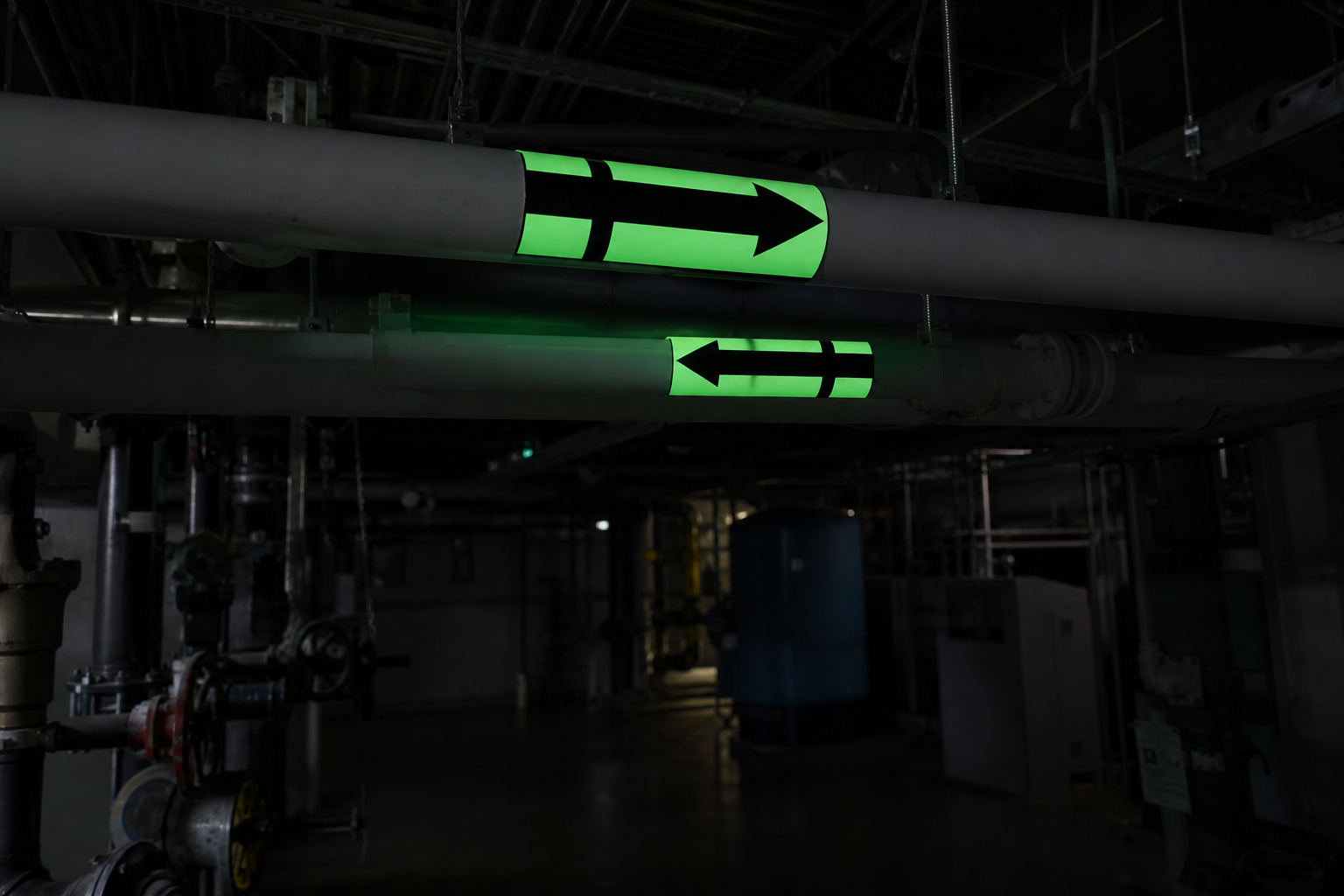
Photoluminescent pipe markers use light-charged material to remain visible after normal lighting is reduced or lost. They can help maintenance teams, operators, and emergency personnel identify piping in utility rooms, industrial areas, and other locations where visibility may become difficult.
Their value is not simply that they glow. A marker must still communicate accurate pipe contents, flow direction where applicable, and hazard information in a format that fits the facility. Photoluminescent markers are an identification aid, not a replacement for emergency lighting, exit signs, or a complete fire-protection system.
Quick summary

- Photoluminescent markers absorb available light and provide visibility in darkness or reduced lighting, subject to product-specific performance.
- They still need accurate legends, suitable colors, readable text, and flow-direction information where required.
- They may help near fire-water lines, suppression systems, utility rooms, and enclosed routes where power loss could slow identification.
- Request data covering brightness, decay, charging conditions, materials, adhesive suitability, and environmental resistance.
- Confirm the applicable ASME A13.1 edition, facility legend, owner specifications, and technical review requirements before ordering.
What are photoluminescent pipe markers?
A photoluminescent pipe marker is a label, band, or tape that incorporates material capable of absorbing light and remaining visible when surrounding illumination decreases. Depending on the product, it may be self-adhesive or designed as a wrap-around marker.
Photoluminescent does not mean permanently illuminated. The material requires an appropriate light source or charging condition, and visibility changes over time. Brightness, duration, charging requirements, viewing distance, background contrast, and environmental performance should be confirmed from product documentation rather than assumed from the product name.
What information should the marker communicate?

Photoluminescence changes how a marker may be seen. It does not change the information the piping identification system needs to convey. Start with verified service information, including the fluid or material conveyed, the facility’s approved legend, hazard information, and flow direction where required.
ASME A13.1 establishes a common system for identifying fluids conveyed in aboveground piping and addresses characteristics such as legends and colors. Review the standard’s current scope before selecting products. VisionMarker’s ASME A13.1 pipe marker guidance also recommends documenting pipe service, identifying text, location, and flow-direction requirements before ordering.
A glowing marker with an incorrect legend is still an identification problem. Compare every marker with the piping schedule, process documentation, or facility identification plan, particularly where older and newer piping schemes meet.
Where can photoluminescent pipe markers help?
These markers may be worth considering where normal visibility can be reduced and quick pipe identification remains important. Potential applications include utility rooms, industrial process areas, fire-water or suppression piping, enclosed routes, and locations where a power interruption could affect ordinary lighting.
The decision should follow the facility’s risk assessment and access needs. Not every pipe requires photoluminescent treatment, and the product should not be presented as a substitute for emergency illumination or required fire signage.
When photoluminescent pipe markers are part of a broader emergency-visibility plan, combine photoluminescent path marking with clearly identified fire-water lines and suppression media. This creates a more coherent visual system without replacing alarms, evacuation planning, inspections, or emergency lighting.
Photoluminescent versus conventional pipe markers
Conventional markers may be sufficient where lighting is reliable, access is controlled, and the facility’s identification plan does not require added low-light visibility. Photoluminescent options add another performance characteristic that may be valuable in selected areas, but they also require additional specification checks.
| Consideration | Conventional marker | Photoluminescent marker |
|---|---|---|
| Ordinary lighting | Designed for visibility under normal illumination. | Designed for ordinary visibility plus visibility after exposure to light, subject to product performance. |
| Lighting loss | Visibility may depend on backup or emergency lighting. | May remain visible in reduced lighting for a documented period. |
| Specification | Focuses on service, legend, color, text, size, placement, and material. | Requires those same checks plus charging, brightness, decay, and test-data review. |
| Environment | Must suit UV, moisture, chemicals, temperature, cleaning, and abrasion. | Must meet the same environmental needs without assuming glow performance is unaffected. |
| Limitations | Can become difficult to read when illumination is inadequate. | Does not replace emergency lighting or guarantee visibility without suitable charging. |
How standards fit into the decision
ASME A13.1 is relevant to the underlying piping-identification system, including how aboveground piping is identified. A photoluminescent layer does not automatically make a marker compliant, and buying a marker does not establish compliance for the entire facility.
Confirm the applicable standard edition, project specification, owner requirements, facility legend, and jurisdictional review before approving the order. OSHA also identifies red for fire-protection equipment and danger where applicable, and yellow for caution and physical hazards such as tripping or falling. Consider those requirements alongside the rules that specifically govern your piping system.
Ask the responsible EHS professional, engineer, maintenance authority, or project reviewer to resolve conflicts between standards, legacy markings, and internal specifications. A supplier can help interpret product options, but the facility remains responsible for approving its identification scheme.
Check the environment before specifying the marker
Industrial signage may face weather, UV radiation, moisture, chemical products, washdown, abrasion, temperature changes, or frequent cleaning. VisionMarker states that its industrial signs and identifications are designed for these types of exposure, but that general positioning should not be extended automatically to every photoluminescent construction or adhesive.
Review the pipe or insulation surface before selecting an adhesive marker. Consider surface cleanliness, curvature, texture, insulation jacketing, condensation, oil or chemical residue, and whether the marker must be removed during maintenance. Confirm whether the product is intended for indoor or outdoor service and whether its printed surface is protected.
What performance evidence should you request?
Do not evaluate a product solely because it is described as glow-in-the-dark or photoluminescent. Ask for the test method and conditions behind the claim. Useful documentation may address initial brightness, decay over time, charging illumination, measurement intervals, viewing conditions, substrate construction, and intended installation environment.
Ask whether the stated results apply to the exact configuration you are ordering. A different film, ink, protective layer, adhesive, background color, or printed legend may affect performance. VisionMarker’s discussion of photoluminescent performance highlights the importance of test data and cautions against unsupported brightness or duration claims.
Where the marker will support emergency identification, request a sample or technical submittal. Compare it with the facility’s lighting conditions and viewing distances instead of treating a laboratory value as a guarantee of field performance.
Photoluminescent pipe marker specification checklist
- Pipe service: Record contents, system name, hazard information, and required warning language.
- Flow direction: Identify where arrows are needed and verify direction against current process documentation.
- Identification scheme: Confirm the applicable ASME A13.1 edition, color conventions, facility legend, and project requirements.
- Size and readability: Provide pipe diameter, insulation details, viewing distance, available space, and text-height requirements.
- Placement: Map valves, equipment connections, access points, route changes, and low-light priority areas.
- Environment: Note UV, moisture, chemicals, washdown, abrasion, temperature, and cleaning methods.
- Construction: Ask about substrate, protective surface, adhesive, insulation compatibility, and preparation.
- Photoluminescent data: Request charging conditions, brightness measurements, decay results, test methods, and limitations.
- Approval documents: Request a proof, sample, technical data sheet, and relevant certification or test documentation.
- Order details: Confirm quantities, sizes, custom legends, production assumptions, and delivery expectations in writing.
When should you request supplier guidance?
Contact a supplier once you have a reliable piping list and can describe the installation conditions. Photos of representative pipe surfaces, insulation, access areas, and lighting conditions can help identify compatibility questions before production. A clear quantity schedule also makes it easier to review a quote and detect missing or inconsistent legends.
VisionMarker provides pipe markers and broader industrial labeling and signage products across the USA and Canada. Its catalog includes piping identification, signs, labels and stickers, and fire protection products, while many purchases use a quote-based process. Product guidance should be based on the project information you provide, not a generic marker selection.
Frequently asked questions
Are photoluminescent pipe markers required in every facility?
No. Their suitability depends on applicable codes, standards, owner requirements, risk assessment, lighting conditions, and technical review.
Do they replace emergency lighting?
No. They support identification in reduced lighting but do not replace emergency lighting, exit signs, alarms, evacuation systems, or other required fire-protection measures.
Can they follow ASME A13.1 requirements?
They may support an ASME A13.1-based identification scheme, but the exact product and facility plan must be reviewed. Confirm colors, legends, text, flow arrows, edition, and project requirements.
What performance data should be requested?
Request the test method, charging conditions, initial brightness, decay or duration measurements, viewing assumptions, material construction, and intended indoor or outdoor use.
Are they suitable for outdoor or chemical-exposure areas?
They may be suitable when the selected construction and adhesive are rated for the exposure. Verify UV, moisture, chemical, temperature, cleaning, and abrasion resistance.
Conclusion: specify for the visibility problem you have
Photoluminescent pipe markers can add useful visibility when normal lighting may be reduced or lost, especially in selected industrial, utility, and fire-protection areas. Their benefit depends on accurate piping information, readable identification, compatible materials, and documented performance.
Start by identifying the piping service, flow direction, lighting risk, environment, applicable standard edition, and responsible reviewer. Prepare those details and contact VisionMarker for product guidance and quote-based pricing on pipe markers and related industrial labeling solutions.