Canada

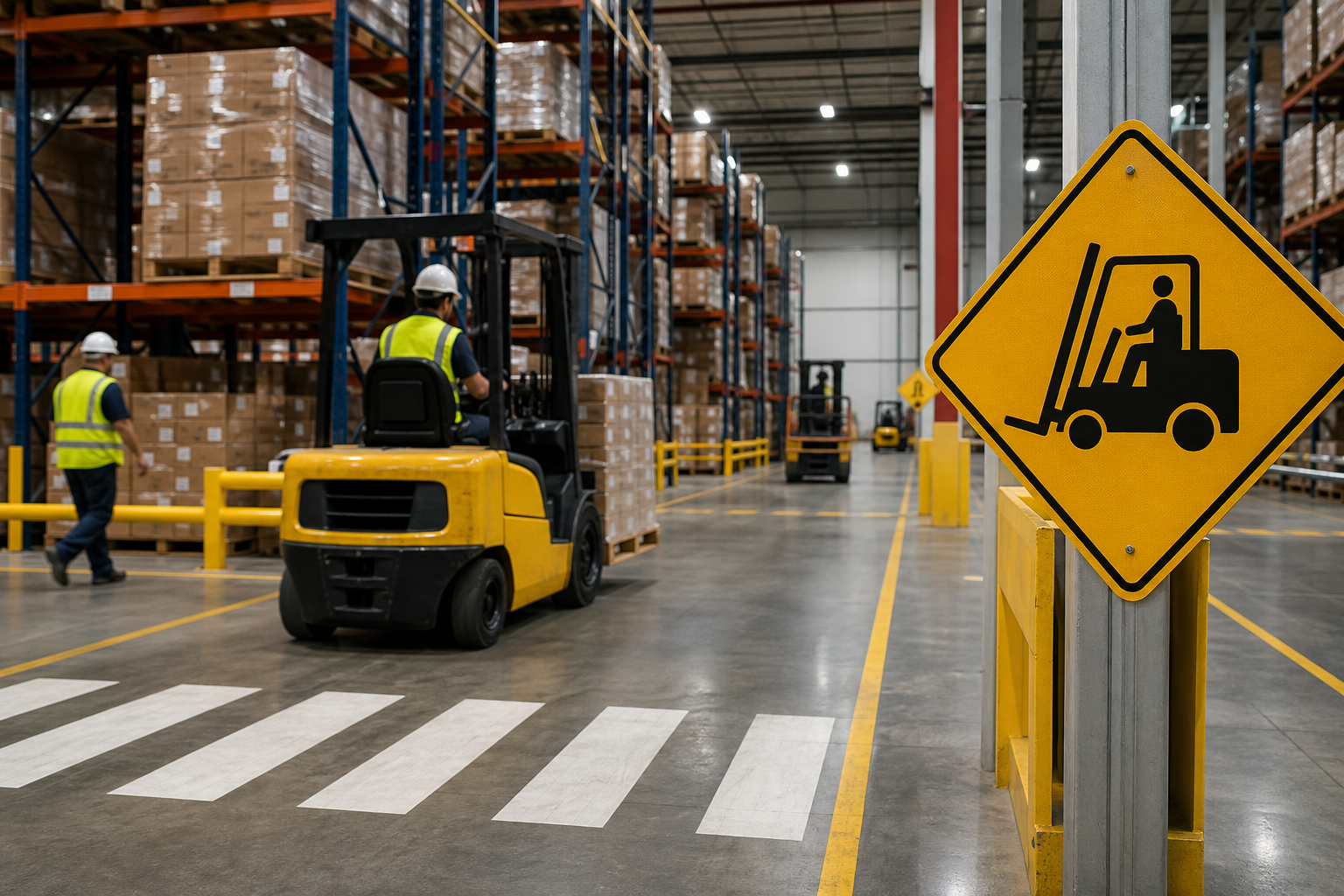
Correct forklift traffic sign placement begins with a site assessment, not a shopping list. This step-by-step plan gives facility managers and EHS professionals a practical, OSHA-aligned process to map vehicle and pedestrian routes, place the right signs where they will be seen, choose durable materials for indoor and outdoor zones, and run an audit-ready checklist. Follow the stop points and safety limits in each step so the rollout can be used during inspections and daily operations.
Step-by-step plan for forklift traffic sign placement
Use these ordered steps on site. Stop at each decision point and confirm the condition described before you continue to the next step. Where an authoritative source influences a decision, a link is included for reference.
- Assess the site and map vehicle and pedestrian routes.
- Place signs at critical locations identified on your map.
- Choose sign types, wording, and supporting floor markings.
- Mount signs for clear sight lines and pick materials for the environment.
- Integrate sign locations into a traffic management diagram and controls.
- Run the onsite checklist, correct issues, then order ANSI-certified signs and document the audit.
Step 1: assess the site and map vehicle and pedestrian routes
Start with a rapid survey that you can refine into a traffic map. Record these items during the walk down.
- Operating zones for forklifts and other powered industrial trucks, existing pedestrian routes, and any informal footpaths.
- All entry points to the forklift operating zone, including doors, bays, and personnel entrances.
- Intersections, blind corners, narrow aisles, loading docks, staging and charging areas, and repair bays.
- Sightline obstructions such as racks, stacked product, parked equipment, and columns.
- Existing striping, painted crossings, barriers, and any posted speed limits or traffic rules.
- Photographs and measured widths of aisles and walkways so signage and floor markings can be specified accurately.
WorkSafe Victoria recommends creating a clear traffic management diagram that shows operating areas, travel paths, exclusion zones, pedestrian routes, crossings, and access points. Display that diagram prominently on site so every shift can reference it during operations and inductions. For their guidance, see Forklift hazards and risk controls.
After mapping, mark every pedestrian entry to forklift zones as a candidate for an entry sign and every intersection as a candidate for intersection signage. These will move to Step 2 for placement decisions.
Step 2: place signs at critical locations
Install visible signs at the locations below. The list is ordered from highest to lower priority during an audit. At each location, stop and confirm that the sign will be readable by an approaching forklift operator and a pedestrian before final mounting.
Highest priority locations
- Pedestrian entry points into forklift operating zones. Post a CAUTION: FORKLIFT TRAFFIC or WARNING: INDUSTRIAL VEHICLE ZONE sign where people cross into areas where trucks travel. This aligns with OSHA guidance to mark permanent aisles and passageways used by mechanical handling equipment. See OSHA pedestrian traffic guidance.
- Pedestrian crossings across forklift aisles. Use FORKLIFT CROSSING or PEDESTRIAN CROSSING signs combined with painted crosswalks to force eye contact and slower speeds.
- Main intersections and T-junctions in travel routes. Mark with clear intersection signage and consider yield or stop messages where two-way forklift traffic meets.
Secondary locations
- Blind corners and long rack aisles. Install advance warning signs that alert both operators and pedestrians to limited sight distance.
- Loading docks and staging areas. Post signs that regulate entry, note truck movements, and show designated pedestrian paths to the office or break areas.
- Aisles and permanent passageways used by trucks. Where possible, use continuous signage combined with floor striping to reinforce separation and to meet the OSHA recommendation for unobstructed, marked aisles.
- Parking, battery charging, and maintenance areas for forklifts. Mark these areas so pedestrians are aware of parked equipment and possible movement.
Audit tip: use a handheld camera or phone to simulate the approach from forklift operator height and from a pedestrian viewpoint. If a sign is unreadable in those photos, relocate or enlarge it before installation. For practical sign message examples and compliance considerations, see Forklift Signs in 2026: Stay Compliant & Avoid Fines.
Step 3: choose sign types, wording, and supporting markings

Decide on the exact messages and the visual hierarchy for each area. Use short, standardized wordings so messages are understood under time pressure.
- Mandatory warnings at entries: CAUTION: FORKLIFT TRAFFIC or WARNING: INDUSTRIAL VEHICLE ZONE.
- Crossing signs: FORKLIFT CROSSING, WATCH FOR FORKLIFTS, or PEDESTRIAN CROSSING with a zebra bar on the floor.
- Intersection control: YIELD TO FORKLIFTS, STOP FOR FORKLIFTS, or SPEED LIMIT with the posted limit.
- Speed limit signs should be posted where operators change speed zones, and operators must be trained to observe posted limits and safe speeds as recommended by OSHA for safe traveling and maneuvering. See OSHA operating guidance.
- Floor markings: high-contrast striping for aisle edges, painted crossings at pedestrian routes, and hatched exclusion zones around door swings and dock edges.
Check your sign wording against your written traffic rules so messages are consistent with training and procedures. A site with speed limits and one-way aisles should use signs that repeat those rules where behavior is required. Use a pedestrian traffic zone checklist during selection and installation to verify messages and placement. See a sample checklist at Pedestrian Traffic Zone Safety Audit Check.
Step 4: mounting, height, visibility, and material selection
Mount signs so approaching drivers and pedestrians see them at eye level and with unblocked sight lines. For operator visibility, place signs at an elevation that keeps messaging in the operator’s forward field of view and out of cluttered background areas. For pedestrian visibility, mount signs where foot traffic naturally looks when entering or crossing an aisle, such as next to doors or beside painted crossings.
Select materials engineered for the environment. If signs are exposed to sunlight, moisture, or chemicals, choose UV-stable, weatherproof substrates and long-life inks. Retroreflective finishes help for night or low-light shifts. VisionMarker offers product lines built for UV, moisture, and chemical resistance and ANSI-certified options when standards alignment is required. See VisionMarker sign options at VisionMarker.
Placement stop point: do not finalize mounting until you have tested sight lines from both a vehicle cab and a pedestrian path, and until any temporary obstructions such as stacked product or parked equipment are moved. If a sign would be obscured by normal staging, choose a different location or add an advance warning sign.
Step 5: integrate signs into your traffic management diagram and controls
Add every installed sign to the facility traffic management diagram, show the order in which signs should be encountered along each route, and indicate where physical controls such as guardrails, bollards, or raised walkways are required instead of or alongside signage. WorkSafe Victoria recommends the diagram be displayed prominently so workers and visitors can see the overall plan. See Forklift hazards and risk controls for diagram guidance.
Use physical separation wherever pedestrian traffic cannot be reliably controlled by signs alone. OSHA advises separating forklift and pedestrian traffic where possible by providing pedestrian walkways, permanent railings, or other protective barriers, and by keeping aisles and passageways free from obstructions. If a pedestrian route passes close to a truck route and barriers are not feasible, upgrade warning controls such as active gates, flashing beacons, or crossing controls rather than relying on signs alone. See OSHA pedestrian traffic guidance.
Onsite checklist and printable diagram template

Use this audit-ready checklist during installation or a safety inspection. Mark each item Pass, Fail, or Not Applicable and record the corrective action and target date.
- All pedestrian entry points into forklift zones are signed and visible from both approaches.
- Crossings have signed messages plus painted crosswalks or raised crossings.
- Main intersections are signed and any one-way aisles are clearly marked.
- Blind corners have advance warning signs and, where possible, mirrors or audible alerts.
- Loading docks and staging areas are signed and have dedicated pedestrian routes separated from truck traffic.
- Speed limit signs are posted where speed changes occur and are consistent with written rules.
- Signs are mounted with clear sight lines and are not obscured by racks, product, or equipment.
- Materials selected match the exposure: UV/moisture/chemical resistant for outdoors, durable indoor substrates for heavy traffic.
- Traffic management diagram is posted at main entrances and updated to include new sign locations.
Printable diagram template: draw a floor plan that shows rack rows, docks, doors, pedestrian entrances, and drive aisles. Overlay colored lines for forklift routes, green lines for pedestrian routes, red hatched exclusion zones, and numbered callouts where each sign should be installed. Save a PDF of the diagram on the safety server and print one copy to pin to the safety board at the supervisors station.
Common objections and decision criteria
Will signs alone meet OSHA guidance? No. In many cases, signs are part of a layered control strategy. OSHA recommends separating forklift and pedestrian traffic where possible with walkways, rails, and unobstructed, marked aisles. Use signs to reinforce rules, but choose physical separation when pedestrian exposure is high or when sightlines are poor.
Who installs and maintains signs? A qualified facilities or maintenance team should mount signs and document installation locations. Procurement can source compliant, durable materials from a vendor, and EHS should schedule periodic checks to ensure legibility and that signs are not obstructed. Create a simple maintenance log to record replacements or relocations.
How to decide ANSI-certified vs economy signs? Use ANSI-certified, standards-aligned signs for permanent installations and for areas subject to audits. Consider economy signs for temporary work, but replace them with ANSI-quality units if the need persists. VisionMarker offers ANSI-certified and weatherproof options for both indoor and outdoor applications.
Next steps: audit, order ANSI-certified signs, and request a quote
Run the onsite checklist immediately after installation and record any failed items. When requesting quotes, include the traffic diagram, a count of sign types and sizes, desired mounting method, and the required material performance such as UV resistance or retroreflectivity. For detailed forklift sign options and examples you can reference during specification, see Forklift Signs in 2026: Stay Compliant & Avoid Fines.
Frequently asked questions
How high should forklift warning signs be mounted for clear visibility?
Mount signs so they fall within the approaching operator’s forward field of view and at a height visible to pedestrians entering the area. In practice, place signs at a consistent eye level for the intended viewers, avoid mounting behind racks or inside line-of-sight obstructions, and confirm visibility by inspecting from both vehicle cab height and pedestrian approach.
Are signs alone sufficient to meet OSHA forklift traffic separation guidance?
No. OSHA recommends separating forklift and pedestrian traffic where possible by providing pedestrian walkways, permanent railings, or other protective barriers and by keeping aisles free from obstructions. Use signs as one layer of control and add physical separation or active controls when exposure is high or sightlines are limited. See OSHA pedestrian traffic guidance for more detail.
What materials should I choose for signs used at outdoor loading docks?
Choose rigid, weatherproof substrates with UV-stable inks and protective coatings. Retroreflective finishes are useful for low-light shifts. VisionMarker lists product lines designed to resist UV, moisture, and chemicals, which is appropriate for outdoor docks and exterior areas.
Who should be responsible for installing and maintaining forklift traffic signs?
Your maintenance or facilities team should install signs using EHS-approved locations from the traffic diagram. EHS should own the inspection schedule and documentation of condition and legibility. Create a simple maintenance log to record replacements or relocations.
How often should I review and update forklift traffic signage and the traffic management plan?
Review signage and the traffic management diagram after any layout change, after near misses or incidents, and as part of a scheduled safety audit at least annually. Update signs immediately if routes change or if signs are obscured, damaged, or faded.
Ready to get ANSI-certified, weatherproof forklift and traffic control signs for your facility?