Canada

How OSHA HCS and GHS shape hazard communication signage
The U.S. Hazard Communication Standard, HCS, is aligned with the Globally Harmonized System of Classification and Labeling of Chemicals, often called GHS. That alignment determines what hazard information must appear on labels and linked safety data sheets. Required label elements include the product identifier, signal word, hazard statements, precautionary statements, supplier identification, and applicable pictograms. For a concise official summary see the OSHA Hazard Communication overview (OSHA HCS) for required label elements and SDS expectations.
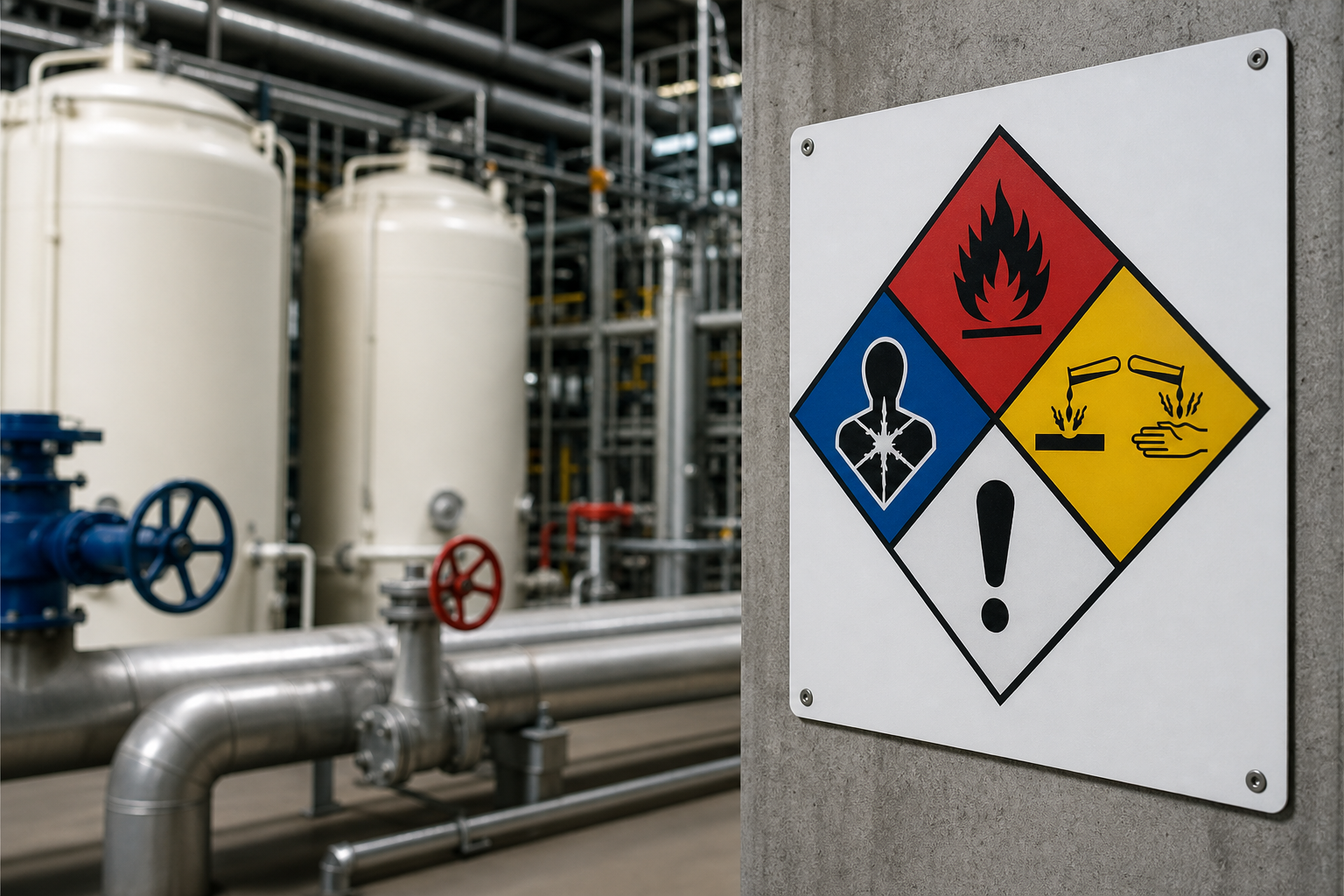
OSHA also prescribes the pictogram format used to flag chemical hazards. Each pictogram is a symbol on a white background framed by a red border. The pictogram set corresponds to specific hazard classes and categories. The OSHA quick card on pictograms is a practical reference for which symbols to display and how they must appear (OSHA pictogram quick card).
Five selection criteria EHS teams should use
When you compare signage and labeling options for chemical storage, process piping, drums, and outdoor tanks use these five decision criteria to score vendors and products consistently.
Standards alignment and mandatory label elements
Confirm that the sign or label format can include the HCS and GHS label elements when required. For container and portable vessel labels follow the HCS requirements listed by OSHA (OSHA HCS). For piping identify whether you must also follow ASME A13.1 guidance for pipe marker color and text. Ask vendors to confirm which North American standards they support so you can document conformity during an audit. VisionMarker documents adherence to standards such as ASME A13.1 and NFPA 170 on its product pages. For related first-party details, review Radiation Sign: Know the Danger and Stay Safe in.
Pictogram and symbol support
Choose suppliers that supply pictogram-ready art and that produce pictograms in the correct GHS style. Because GHS pictograms are standardized the vendor must reproduce the symbol, white field, and red frame accurately so the sign conveys the correct hazard class. Use the OSHA pictogram quick card when reviewing vendor proofs to verify correct proportions and symbols (OSHA pictogram quick card).
Material durability for UV moisture and chemical exposure
Select materials designed for the exposure profile of the install location. Common durable choices include laminated polyester or vinyl with chemical-resistant inks for splash zones rigid aluminum for long outdoor exposure and aggressive adhesives for curved surfaces and drums. VisionMarker emphasizes materials engineered to resist UV moisture and chemicals which is useful for outdoor tanks and process areas where signs must remain legible for years.
Customization sizing and installation options
Sign visibility depends on proper sizing and placement. Ask vendors about custom sizing wraparound pipe markers that meet ASME A13.1 spacing and orientation needs and mounting methods such as magnetic backings rivets or peel-and-stick adhesives. Customization should include the ability to add facility identifiers location codes or QR links back to your SDS repository while preserving required label content.
Vendor quoting lead time and documentation
Because many hazard communication signs require custom art and specific materials expect a quote-based model. Request material spec sheets a statement of standards conformity art proofs and sample pieces where possible. Suppliers should provide documentation buyers need for compliance reviews and audits including proof approvals and material data sheets.
Top signage options by use case

Below are non-ranking practical sign and label options organized by the most common industrial use cases. Each entry evaluates the option against the selection criteria above and gives material and pictogram guidance.
Chemical storage cabinets and shelving: full label panels and cabinet placards
When you store multiple chemicals in cabinets or on shelving use a large cabinet placard or a full label panel that lists the contents major hazards and a location code that links to the SDS binder. Include required GHS pictograms a clear signal word when applicable and precautionary statements. For indoor cabinet use laminated polyester panels provide chemical resistance and good indoor longevity. For flammable storage include signage that references NFPA or facility-specific storage rules. Verify label elements against OSHA HCS guidance before installation (OSHA HCS).
Process and utility piping: ASME A13.1-compatible pipe markers and supplemental labels
Process piping should use ASME A13.1-compatible pipe markers for fluid identification flow direction arrows and content description. For chemical lines supplement the ASME-style marker with a GHS-ready sticker or nearby label that includes the chemical identity and relevant pictograms. Wraparound markers printed on weatherproof flexible substrates often perform best on curved piping while rigid markers mounted with clips or straps suit larger diameter runs. Confirm the vendor can place pictograms at a readable size without obscuring the required piping legend.
Drums and portable containers: GHS-ready pressure-sensitive labels
Portable containers and drums must carry labels that match the chemical classification on the SDS. Use pressure-sensitive labels with solvent and abrasion resistant inks and adhesives rated for low temperature and chemical exposure when appropriate. Vendors can supply custom pressure-sensitive stickers sized to common drum areas and printed with GHS pictograms and required text fields. Always supply the exact product identifier and SDS reference when ordering to ensure accurate label copy.
Emergency and fire protection signage: NFPA and NFPA 170 considerations
Signs for fire extinguishers fire hoses and emergency exits should follow NFPA 170 guidance and be legible from the required viewing distance. Use reflective or high-contrast substrates near emergency equipment and create standard location identifiers so first responders find equipment quickly. Specify materials and mounting that meet your visibility and durability needs.
Outdoor and corrosive environments: weatherproof and UV-stable options
For storage yards tanks large piping supports and outdoor process areas choose rigid aluminum or thick composite panels with UV-stable inks and a clear protective overlaminate. For highly corrosive zones a marine-grade aluminum or specially coated sign will last longer. Ask vendors to provide expected longevity estimates for the material and ink combination used in the proof and request a sample if you must ensure multi-year legibility under sunlight and chemical spray.
Material and pictogram recommendations for harsh environments
- Laminated polyester with chemical-resistant inks for indoor splash zones and near process lines
- 0.040 inch rigid aluminum with baked enamel or UV-stable inks for outdoor tanks and yards
- High-performance vinyl with aggressive adhesive for curved piping and drums
- Protective overlaminates for high abrasion points such as walkways and forklift corridors
- Ensure pictograms are printed to GHS proportions and that the red frame and white field are reproduced accurately
Ask the vendor for material specification pages and for test data when you require third-party durability claims. Requesting sample pieces helps validate the choice for your facility conditions.
Placement best practices and linking signs to safety data sheets

Mount signs so they are readable at typical approach distances keep them unobstructed and avoid low-contrast backgrounds. For container labels place them on the principal display panel. For cabinets mount placards on the cabinet face near the handle. For piping place markers at intervals that ensure a marker is visible from a walkway especially near valves and junctions.
To link signs to SDS content use consistent location IDs binders stored at the point of use or QR codes that resolve to your SDS repository. When you add QR codes include the mandatory HCS elements on the physical label so the sign remains compliant without electronic access. The OSHA HCS overview explains required label content and SDS expectations (OSHA HCS).
Procurement checklist and a quote template to send vendors
Use this checklist when requesting quotes so vendors return accurate proofs and prices.
- Project scope with quantities per SKU and installation locations
- Standards to follow such as OSHA HCS GHS ASME A13.1 or NFPA 170
- Material preferences and exposure notes for each location
- Exact text for product identifiers facility codes and required signal words
- Art file or SDS references for accurate pictograms and hazard statements
- Mounting method requested and any confined space or access constraints
- Request for sample pieces material spec sheets and a proof approval step
- Documentation requests such as a statement of standards conformity and lead time estimates
Include the items above to speed the vendor response and to ensure proofs match the HCS requirements that apply to your facility. Vendors commonly operate on a quote basis for customized signage and can supply the documentation purchasing teams need for audits.
Common objections and realistic responses EHS teams will face
- Cost concerns: propose phased replacement by highest risk areas first to spread cost while improving compliance where it matters most
- Installation disruption: use peel-and-stick or magnetic options to reduce shutdown time and schedule installs during planned outages
- Lead times for custom art: ask for a standard art template and agree on a single proof to shorten iterations
- Audit documentation needs: require the vendor to provide material specs proof approvals and a statement of standards alignment with the quote
Frequently asked questions
Do OSHA HCS requirements apply to facility signs or only to chemical container labels
OSHA HCS explicitly applies to labels on containers and to SDS content. Facility signs that communicate the same hazards are often designed to mirror required label elements for clarity. Use the OSHA Hazard Communication overview (OSHA HCS) to determine which elements are mandatory for containers and which elements are appropriate for supplemental facility signage.
What pictograms must appear on a label versus a facility sign near a tank or cabinet
GHS pictograms are required on container labels when the chemical classification indicates they apply. For facility signs include pictograms that accurately reflect the hazards present and ensure the pictogram reproduces the red frame and white field. Use the OSHA pictogram quick card when proofing vendor art (OSHA pictogram quick card).
How do I choose between vinyl laminated polyester and aluminum for a sign exposed to chemicals and UV
Choose laminated polyester for splash zones where flexibility and chemical resistance matter. Choose aluminum for durable outdoor exposure where mechanical strength and long UV life are needed. Choose high-performance vinyl for curved surfaces and drums where adhesive performance is critical. Request material spec sheets and sample pieces to validate the choice for your exact exposure profile.
Can I add a QR code on a sign to link to the SDS and still meet HCS requirements
Yes you can add a QR code but you must also include the mandatory HCS label elements on the physical sign so the information is available without electronic access. The QR code is useful for rapid SDS access but cannot replace required on-label content.
What minimum information should I include in a quote request to get an accurate price and proof from a vendor
Provide quantities exact text for product identifiers the SDS or product identifier for each chemical required pictograms mounting method material preferences and any applicable standards you want the vendor to confirm. Ask for an art proof and material sample to validate the appearance under your lighting and access conditions.
If you need standards-validated signs proofs or a quote contact VisionMarker to request pricing and detailed material specifications.