Canada

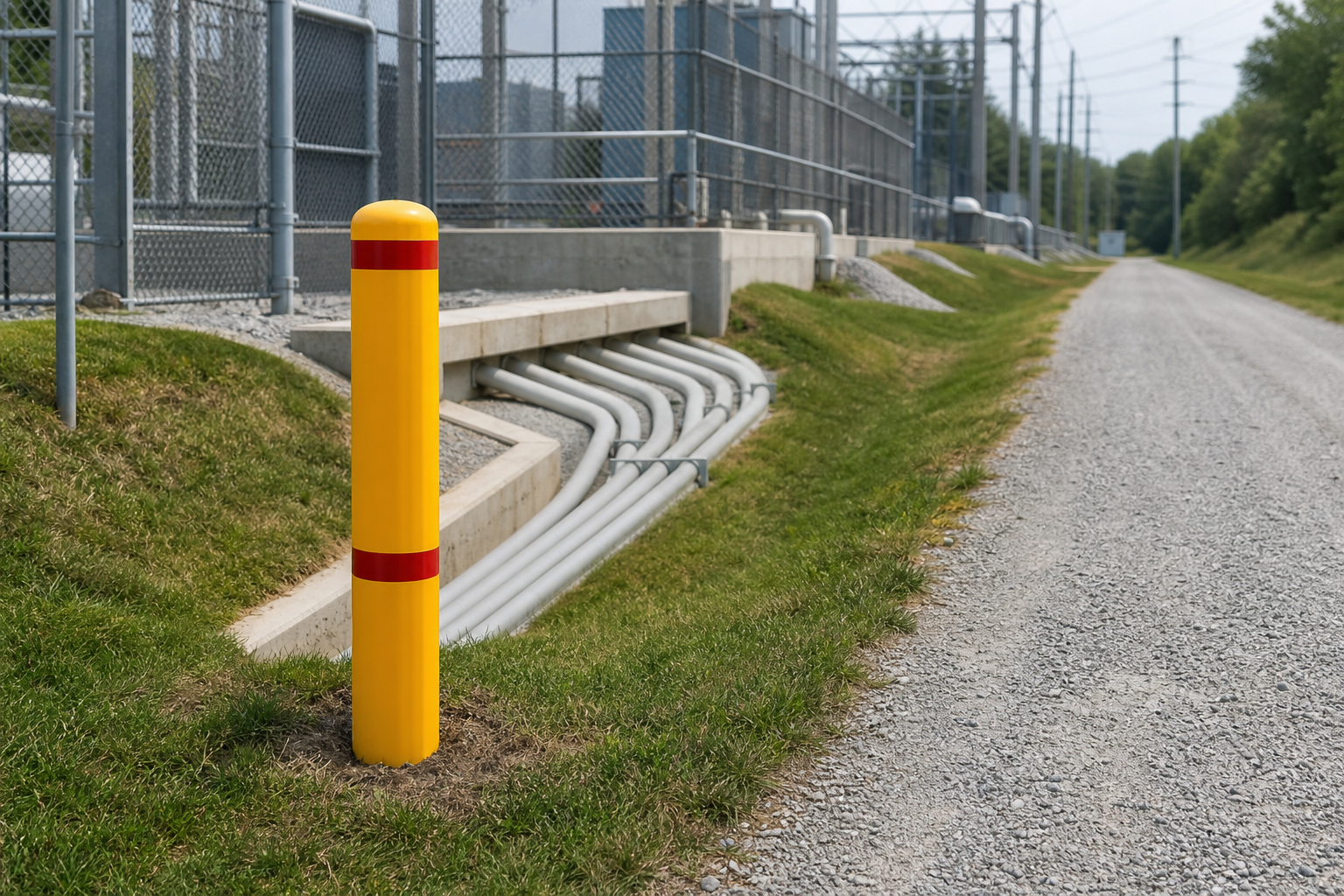
Underground cable warning markers are visible or detectable indicators that identify the presence and approximate route of buried cables or other utilities. They help facility teams, contractors, and maintenance crews recognize hidden infrastructure, but they do not replace 811, utility-owner coordination, locating, or safe excavation procedures.
The right system depends on what is buried, how it can be located, the surrounding environment, expected traffic, and the specifications set by the utility owner or jurisdiction. A surface post may provide a clear warning, while tracer wire, detectable tape, or an electronic marker may support future locating.
Key Takeaways
- Underground cable warning markers are essential for identifying buried utilities and ensuring safety during excavation.
- Different types of markers serve distinct purposes, such as visual identification or supporting future locating efforts.
- Choosing the right marker involves understanding the utility type, environmental conditions, and applicable regulations.
- Permanent markers should not be confused with temporary markings, which serve different roles in utility identification.
- Regular inspection and documentation of markers enhance safety and compliance in utility management.
What are underground cable warning markers?
Underground cable warning markers are part of a utility-identification system. They may include marker posts, surface warning signs, near-surface plates, concrete slabs, detectable warning tape, tracer wire, electronic markers, or labels inside vaults and chambers.
Their purpose is to make a hidden cable route easier to recognize before maintenance, construction, excavation, or emergency work begins. Government guidance describes route markers and warning signs as indicators of buried infrastructure, including markers at prominent crossings and other visible points along a route. PHMSA explains the role of pipeline markers and warning signs in identifying buried lines.
These products perform different jobs. A post or sign communicates a warning at the surface. A label inside a chamber identifies the cable or equipment at a known access point. A detectable component may help a locator trace a route that cannot be seen from above.
Permanent markers are not the same as temporary locate markings

Permanent identification and temporary locate markings should be treated as separate layers of information. A permanently installed post, sign, slab, or plate remains part of the site’s asset-identification system. Temporary markings are applied for a particular locate request, design survey, or excavation project and may be refreshed, altered, or removed as work progresses.
The FHWA describes temporary utility marking with APWA color-coded paint, stakes, lath, and survey flags. These markings help crews interpret current field information, but they are not a substitute for a durable marker plan or an accurate buried-asset record. FHWA’s utility-marking guidance provides context for this temporary field-marking role.
Before digging, follow the applicable call-before-you-dig process and wait for the required utility responses. A permanent marker can warn that a cable is nearby, but it cannot confirm excavation limits or prove that every underground facility has been identified.
Underground cable marker types compared
There is no single marker that fits every buried cable application. The following comparison shows the distinction between visual identification and locating support.
| Marker or system | Main function | Important limitation |
|---|---|---|
| Marker post | Provides a visible route or presence reference above grade. | May communicate only the printed information and is not automatically detectable. |
| Surface warning sign | Warns people about buried cables or restricted work near a route. | Visibility depends on placement, line of sight, condition, vegetation, and nearby equipment. |
| Concrete slab marker | Creates a durable surface reference where a robust permanent installation is appropriate. | Dimensions, placement, and loading requirements depend on project or owner specifications. |
| Near-surface plate | Offers visible identification where surface access and moderate exposure make it suitable. | May not suit heavy vehicles, impact, or frequent disturbance. |
| Detectable warning tape | Provides a subsurface warning layer that may be sensed during excavation or locating work. | It must be selected and installed for the utility and burial conditions. |
| Tracer wire | Creates a conductive path that can support locating of nonmetallic conduit or cable routes. | Continuity, access points, connections, and compatible equipment matter. |
| Electronic marker | Provides a locatable reference at a selected point, such as a crossing, bend, or access location. | It is a point reference, not necessarily a continuous route indication. |
| Chamber or vault label | Identifies cables, ducts, or equipment at a known access point. | It does not replace route markers along a long buried run. |
For a broader view of how surface and subsurface components work together, review these underground pipe markers and related marking-system options. The appropriate combination still depends on the utility owner’s requirements and site conditions.
Visual warning versus detectable identification
A visible marker and a detectable system answer different questions. A post or sign answers, “Is buried infrastructure present in this area?” A tracer wire, detectable tape, or electronic marker may help answer, “Where is the route or reference point when the cable cannot be seen?”
This distinction is especially important for nonmetallic conduit and cables. A conventional locator may not detect plastic conduit reliably unless the system includes a conductive path or another suitable locating method. FHWA guidance on cable and pipe locators explains why the detection approach must match the utility construction.
Do not assume that a warning post contains a locating target, that all tape is detectable, or that an electronic marker identifies the entire cable route. Confirm the marker’s stated function, compatibility, installation requirements, and maintenance needs before ordering.
How to choose underground cable warning markers
Before ordering, choose underground cable markers by answering these questions with the utility owner, engineer, or responsible EHS representative:
- What utility is being identified? Record whether the route contains power, telecommunications, fiber, control wiring, or another service.
- Is the cable or conduit metallic? Identify whether it can be traced directly or requires tracer wire, detectable tape, electronic markers, or another conductive element.
- Is the requirement visual, detectable, or both? A warning sign may communicate presence, while future maintenance may require a separate locating system.
- What are the site conditions? Consider UV exposure, moisture, chemicals, soil conditions, freeze-thaw cycles, heat, and cleaning practices.
- What physical exposure is expected? Check for vehicle traffic, snow removal, landscaping, excavation, impact, foot traffic, and equipment movement.
- How will people see and interpret it? Confirm line of sight, message clarity, contrast, mounting height, vegetation, lighting, and approach direction.
- What specifications apply? Obtain the utility owner’s standards and check relevant municipal, DOT, project, engineering, and jurisdictional requirements.
- How will the system be maintained? Decide who will inspect the marker, report damage, and keep replacement information current.
Installation and placement considerations
Installation should begin with information, not product selection. Request the required utility locates, obtain the relevant documentation, and coordinate with the utility owner or engineer. Confirm which line is being marked and whether the owner requires a specific marker type, message, color, spacing approach, or detectable component.
Next, assess site hazards and work controls. Protect workers and the public from traffic, excavation, energized systems, equipment movement, and other installation conditions. The marker should be visible from routes used by maintenance and construction teams without creating a new obstruction.
There is no universal spacing, depth, or embedding rule for every underground cable warning marker. Requirements may vary with the utility, terrain, crossings, changes in direction, access points, local standards, and owner specifications. Use approved project documentation rather than copying a spacing number from an unrelated application.
After installation, inspect the marker from the viewpoint of the people who need to use it. Confirm that the message is readable, the marker is secure, the route reference is logical, and any detectable element is connected or accessible as specified.
Inspection and documentation checklist
A marker is more useful when its physical location and technical purpose are recorded. Add the following to the site’s asset or maintenance records:
- Utility identity and service description.
- Marker type, message, material, and identifying number, if used.
- Installed location, route reference, crossing, bend, access point, or property boundary.
- Installation date, installer, work order, and applicable specification.
- Photographs showing the marker in context and close up.
- Whether the system includes detectable tape, tracer wire, or electronic markers.
- Connection, continuity, access, or testing information where required.
- Inspection frequency, damage reports, replacement details, and route changes.
During inspections, look for fading, cracking, corrosion, missing hardware, vegetation obstruction, impact damage, unauthorized relocation, and changes in traffic or construction conditions. Update the record whenever a marker is replaced or the utility route changes.
Durability and purchasing checks
Industrial marker and sign materials should match the environment rather than simply an indoor or outdoor catalog label. Ask about resistance to UV exposure, weather, moisture, chemicals, freezing conditions, abrasion, and expected impact. Confirm that the mounting method, adhesive, substrate, and hardware suit the installation surface.
VisionMarker describes its industrial labeling and identification products as designed for exposure to weather, UV rays, moisture, and chemical products. Its catalog includes piping identification, signs, labels and stickers, and fire protection products. The industrial product selection can help buyers review identification formats, but a specific item should be verified for buried cable marking and applicable project requirements.
Frequently asked questions
Are underground cable warning markers detectable by locating equipment?
Not necessarily. A visual post, sign, slab, or plate may only communicate that a utility is present. Detectable tape, tracer wire, and electronic markers are separate components that may support locating when properly selected and installed.
Do underground cable marker posts replace calling 811 before digging?
No. Marker posts provide visual information, but they do not replace the applicable call-before-you-dig process, utility-owner coordination, or site-specific locating. Before excavation, follow the required process for the work location and wait for utility responses. Call-before-you-dig guidance also advises contacting 811, waiting for responses, and using temporary markings before digging.
How are nonmetallic underground cables located?
Nonmetallic cable or conduit may need tracer wire, detectable tape, an electronic marker, or an active detection method that creates a conductive signal. The correct approach depends on the installed system and locating equipment. A visible warning sign alone does not make a nonmetallic route detectable.
Is there one universal spacing requirement for underground cable warning markers?
No. Spacing can depend on the utility owner, jurisdiction, route geometry, crossings, terrain, visibility, and project specifications. Treat published spacing as application-specific unless the responsible owner or authority confirms that it applies.
Conclusion
Underground cable warning markers are most effective when treated as one part of a coordinated utility-identification system. Choose visible markers to communicate presence and route information, add detectable components when future locating requires them, and keep temporary locate markings separate from permanent asset identification.
Before installation, confirm the utility type, construction, locating method, environmental exposure, traffic conditions, visibility, and applicable specifications. Then inspect the finished work and document its location, purpose, and detectable-system details so future crews have more than a marker to rely on.
For industrial labeling and identification products serving customers across the USA and Canada, visit VisionMarker to review available options and request pricing or product guidance.