Canada


Industrial signage is the standardized system of safety signs, labels, pipe markers, and floor markings that communicates hazards and procedures in workplaces. In the USA, effective programs align with OSHA rules and ANSI design formats to reduce incidents, speed decision-making, and strengthen safety culture across shifts.
By Dante de Felice • Last updated: July 6, 2026

Overview and Table of Contents
Use industrial signage to remove ambiguity, reinforce procedures, and direct safe actions. This complete guide explains what industrial signage is, why it matters, how programs work, types and materials, best practices, tools, and mini case studies—plus five fast upgrades you can deploy in days.
What you’ll get in this guide:
- Clear definition of industrial signage aligned to USA standards
- Five quick wins you can implement this week
- How a cross-functional signage program runs smoothly
- Major types: OSHA/ANSI signs, ASME A13.1 pipe markers, labels, floors, NFPA 170 symbols
- Material and placement choices that actually last
- Actionable best practices, tools, and real-world examples
For deep dives on hazard icons and placements, see our internal explainer on safety symbols and our marking systems guide. These reinforce the principles in this article and help maintain consistency at scale.
What Is Industrial Signage?
Industrial signage is a standardized visual language—signs, labels, pipe markers, and floor markings—that identifies hazards, routes, equipment, and procedures in workplaces. In USA facilities, programs align to OSHA 29 CFR 1910.145 and ANSI Z535 formats so people recognize severity and action within seconds.
Industrial signage turns policy into action at the point of work. Colors, shapes, and pictograms reduce interpretation time and prompt the correct behavior where it matters—next to valves, panels, doors, aisles, and emergency equipment.
- Scope: Hazard notices, PPE reminders, restricted access, energy isolation points, evacuation egress, and device locations.
- Standards: OSHA 29 CFR 1910.145 (signs and tags), ANSI Z535 (design/format), ASME A13.1 (pipe marking), NFPA 170 (fire safety symbols).
- Media: Rigid aluminum or polycarbonate signs, industrial vinyl labels and stickers, floor tapes/paints, inspection tags, and placards.
VisionMarker focuses on ANSI-certified, standards-aligned products spanning pipe markers, safety signs and posters, labels and stickers, and fire protection signage. Our catalog supports EHS managers and operations leaders who need durability in UV, moisture, and chemical exposure.
5 Ways to Boost Safety Fast Today
Target five quick wins: mark process piping to ASME A13.1, standardize OSHA/ANSI sign formats, separate forklifts and pedestrians with floor markings, place PPE reminders at point-of-use, and verify NFPA 170 fire symbols. These fixes address common gaps and deliver visible improvements in days.
- Mark process piping to ASME A13.1. Identify contents and flow direction on accessible sides at valves, tees, and penetrations. Consistent color bands reduce trace time during startups and make lockout steps easier to verify.
- Standardize OSHA/ANSI sign formats. Use consistent signal words and layouts so crews instantly recognize severity and action. Eliminate mismatched legacy signs that force people to re-learn in each area.
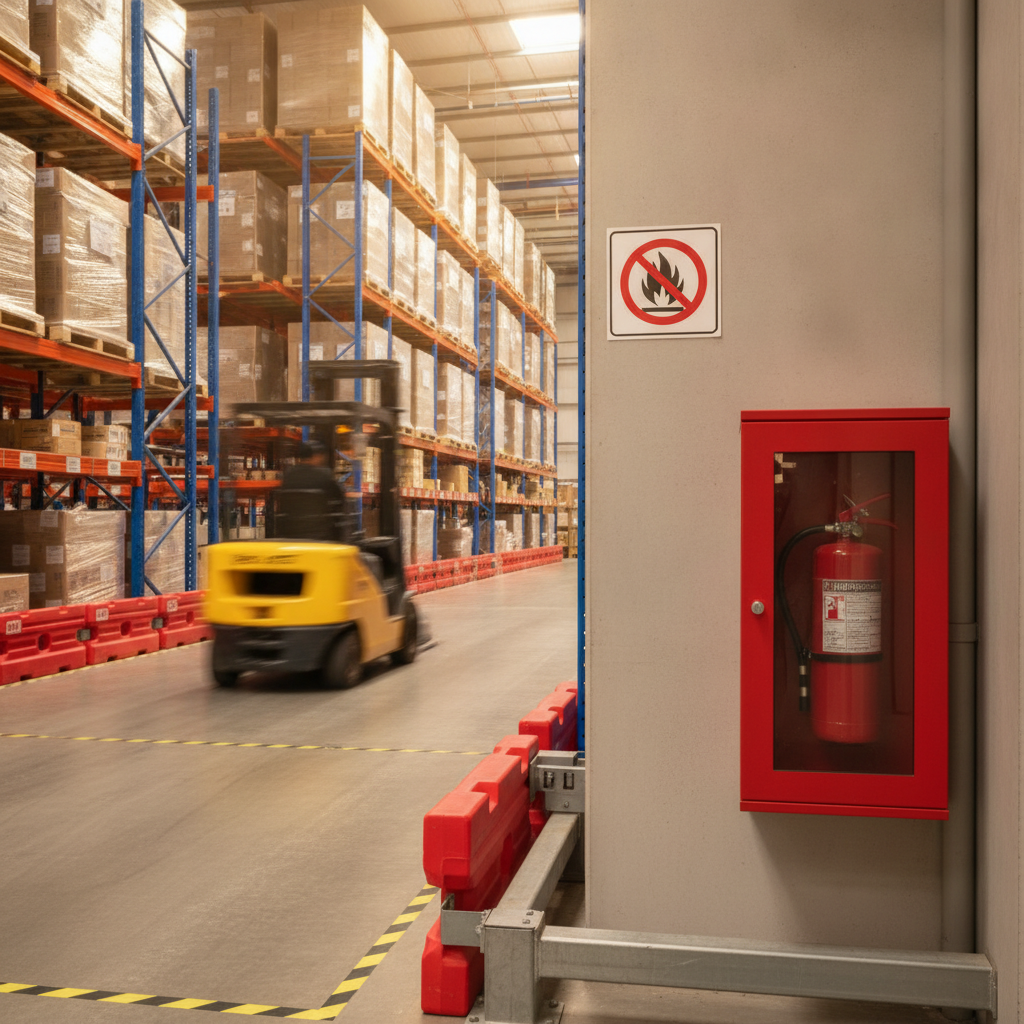
- Separate forklifts and pedestrians. Apply high-contrast floor lines, arrows, and keep-out zones at blind corners and docks. Add Keep Aisles Clear cues near staging areas to prevent creeping encroachment.
- Put PPE reminders where tasks begin. Install Eye Protection Required, Gloves Required, and similar labels at tool rooms, mixing benches, and lab entries so decisions happen before exposure.
- Audit fire protection visibility. Confirm extinguishers, pull stations, and hose cabinets have standardized NFPA 170 symbols, open approach paths, and no obstructions from common approach angles.
We’ve seen teams implement all five within a single improvement sprint. The gains show up quickly in fewer hesitations, smoother audits, and better compliance among new and rotating workers.
For a deeper look at hazard-specific warnings and formats, our warning sign guide breaks down severity levels and symbol selection, helping you avoid mixed styles across departments.
Why Industrial Signage Matters
Good industrial signage lowers incident risk, speeds training, and proves due diligence. Consistent colors, symbols, and placements reduce interpretation time under stress and help auditors trace how you identify, control, and communicate hazards across zones.
- Faster recognition: Symbols and color codes are understood quicker than text, especially in alarms, line stoppages, or low-visibility conditions.
- Behavioral consistency: One format across buildings reduces re-learning, crucial for contractors and rotating crews.
- Audit readiness: A standard library, documented placements, and inspection logs demonstrate a managed control, not an ad hoc poster collection.
Signage also complements electrical safety programs and maintenance practices. For broader safety context around electrical risk management frameworks, see this discussion of program alignment to national standards in an NFPA 70E-focused overview.
How an Industrial Signage Program Works
Map risks, choose standard formats, and assign upkeep. A cross-functional team audits zones, deploys signs and markers by priority, and maintains them on a defined inspection cadence so clarity survives moves, repainting, and process change.
Seven-step operating loop
- Risk mapping: Inventory hazards, high-traffic routes, energy sources, and emergency assets by zone.
- Standard selection: Adopt OSHA/ANSI for sign formats, ASME A13.1 for pipe markers, and NFPA 170 for fire symbols.
- Design and materials: Match substrates and adhesives to UV, moisture, chemicals, and impact zones.
- Placement rules: Define heights, sightlines, repeat intervals, and approach angles.
- Deployment: Stage by area; confirm readability from typical operator paths.
- Training: Fold meanings into onboarding and toolbox talks; post a symbol legend.
- Inspection: Run quarterly walks and event-based checks after moves or paint.
Ownership matters. Give EHS governance of the standard library, and empower area supervisors to request additions using a simple ticket or form. That balance keeps the system nimble without losing consistency.
Types of Industrial Signage (with Real-World Uses)
The core categories work together: OSHA/ANSI safety signs, ASME A13.1 pipe markers, labels and stickers for assets and chemicals, floor and aisle markings, and NFPA 170 fire protection symbols. Together, they create a consistent visual safety language.
OSHA/ANSI Safety Signs
Standardized formats use signal words and colors to indicate severity and action so workers interpret intent in a glance.
- Signal words: DANGER, WARNING, CAUTION, and NOTICE map to severity tiers and visual contrast.
- Common needs: Slippery When Wet, Entry Prohibited, Face Mask Required, Hand Protection Required.
- Where they go: Machine guarding zones, chemical splash areas, electrical rooms, mezzanine edges, and restricted doors.
Explore severity and symbol choices in our article on OSHA warning signs; it outlines how to align messages with the right header and color so intent is unmistakable.
ASME A13.1 Pipe Markers
Pipe markers identify contents, associated hazard class, and flow direction to reduce tracing time and misinterpretation during work and emergencies.
- Use cases: Steam and condensate, cooling water, compressed air, natural gas, acids, caustics, medical gases.
- Placement: Apply at regular intervals and at valves, tees, and wall/ceiling penetrations within normal lines of sight.
- Durability: Choose laminates and adhesives that handle washdowns, solvents, and heat cycling.
VisionMarker’s pipe identification products are engineered for UV, moisture, and chemical resistance to maintain legibility between inspection cycles.
Labels and Stickers
Labels support asset identification, inspection status, chemical information, and quick reminders at the exact decision point.
- Examples: PPE reminders, equipment start-up/shutdown steps, barcode IDs, chemical identifiers.
- Environments: Oils, solvents, washdowns, and UV exposure demand specialty films and overlaminates.
- Benefits: Rapid deployment and easy updates as processes change.
Browse categories like danger-format signs and street and safety signs to anchor your standard library in proven formats.
Floor and Aisle Markings
Floor visuals shape movement. They establish pedestrian lanes, forklift routes, keep-out zones, and machine footprints to reduce conflicts.
- Media: Caution stripes, footprints, arrows, high-contrast tapes, and epoxy paints matched to surface prep.
- Placement: Intersections, blind corners, dock edges, charging bays, and pinch points near staging racks.
- Tip: Verify color contrast under your area’s actual lighting before committing to a full rollout.
NFPA 170 Fire Protection Symbols
Uniform icons help people find fire equipment through smoke, glare, or crowding. Keep approach paths open and mount at consistent heights.
- Devices: Extinguishers, cabinets, pull stations, standpipes, fire department connections, and sprinklers.
- Checks: Visibility from approach distances, obstruction-free access, and consistent icon styles.
- Integration: Align with evacuation route maps and door hardware labeling.
For a program-level view of life-safety components working together, our fire signage guide shows how symbols, placements, and maintenance routines interact during drills.
Materials, Durability, and Placement
Match material to exposure: aluminum or polycarbonate for long-term rigid signs, industrial vinyls for labels and floors, and UV-stable inks/laminates. Place for sightline and distance with consistent heights, repeats, and approach angles tested under real lighting.
A resilient program starts with the right substrate and topcoat. UV, heat cycling, washdowns, and solvents all influence legibility over time. Use fasteners for rigid signs in impact zones and pressure-sensitive adhesives within recommended temperature windows for labels.
| Material | Best for | Strengths | Notes |
|---|---|---|---|
| Aluminum | Outdoor or long-term | Rigid, corrosion-resistant | Ideal for perimeters and gates |
| Polycarbonate | High-impact interiors | Excellent impact strength | Good near forklifts and carts |
| Rigid PVC | Indoor walls | Lightweight, stable | Economical for low-impact zones |
| Adhesive Vinyl | Labels & decals | Conforms to curves | Choose chemical-resistant laminates |
| Floor Tape/Epoxy | Aisles & zones | High visibility | Prep floors for adhesion and longevity |
When planning layouts, test glare and shadows at shift changes. Operator eye-height, typical approach paths, and background clutter determine whether a sign performs like a control—or blends into noise.
Best Practices (and Mistakes to Avoid)
Standardize formats, size for viewing distance, and maintain on a schedule. Avoid mixed styles, cluttered messages, and unverified placements. Treat signage as a managed safety control supported by training and inspections.
Pro tips for clarity
- One message per sign: Split complex instructions into adjacent, scannable units.
- Design for distance: Size graphics for where people stand and move; prioritize contrast over decoration.
- Consistency across sites: Use the same symbols and color logic to reduce re-learning between buildings.
- Verify in the field: Check glare, shadow, and approach angles under real lighting before rollout.
- Maintain relentlessly: Replace faded, torn, or obstructed items immediately and log the change.
Common pitfalls
- Mixed visual languages: Combining legacy and new styles forces interpretation and slows decisions.
- Text walls: Dense paragraphs near fast-moving work areas will be skipped. Use symbols and clear headers.
- Unowned standards: Without a library owner, formats drift and audits get harder.
For a quick refresher on consumer-facing visual principles that also apply to industrial wayfinding, this practical piece on improving in-store signage highlights contrast, clutter, and placement fundamentals.
Tools and Resources
Build a simple toolkit: a signage audit checklist, a standard symbol/color library (OSHA/ANSI, ASME A13.1, NFPA 170), a material guide by environment, and an inspection log with replacement triggers. Centralize templates so supervisors can self-serve while EHS governs.
- Audit checklist: Zone-by-zone inventory of hazards, routes, energy sources, and emergency assets.
- Standard library: Approved headers, colors, symbols, and sample layouts.
- Material guide: Substrate and laminate selection by exposure (UV, washdown, solvents).
- Inspection log: Quarterly cadence plus event-based checks after moves or repainting.
VisionMarker supports this workflow with ANSI-certified industrial signage across pipe markers, safety posters and signs, labels and stickers, and fire protection products—all engineered for UV, moisture, and chemical resistance.
Need a fast start? Request a standards-aligned signage assessment and prioritized rollout plan. Our team turns your audit into placements, materials, and a maintenance cadence you can run.
If you’re coordinating with electrical reliability teams, this industrial electrical overview provides a useful parallel for building managed, cross-functional safety programs.
Mini Case Studies and Examples
Targeted upgrades deliver fast, trackable gains. These short examples show how standard-aligned visuals reduce confusion, cut near-misses, and improve readiness in common USA facility scenarios.
- Utilities plant: Replaced ad hoc stickers with ASME A13.1 markers on steam and condensate. Technicians reported faster line tracing during startups and clearer lockout verifications.
- Distribution center: Added pedestrian lanes, forklift routes, and Keep Aisles Clear cues at dock doors. Near-misses at blind corners declined following a short refresher training.
- Chemical blending room: Introduced PPE-at-point-of-use labels at mix stations and eyewash signage. Supervisors saw stronger compliance among new hires and temporary staff.
- Commercial tower: Audited fire device visibility and upgraded icons to NFPA 170 sets. Evacuation drills moved more predictably with fewer bottlenecks at exits.
- Maintenance shop: Posted standardized NOTICE/CAUTION formats at battery charging bays and tool cribs. Crews referenced signage during shift handoffs, reducing guesswork.
Standardization made these gains possible. When symbols, colors, and placements repeat across zones, people learn once and apply everywhere—even under time pressure.
For hazard hierarchy and severity choices, revisit our deeper dive on OSHA warning formats and the broader hazard markings guide.
Key Takeaways and Next Steps
Start with the five fast wins, then formalize a standard library, placement rules, and inspection cadence. Choose durable, ANSI-certified media matched to your environment to keep clarity high—and your safety culture strong.
- Deploy the five quick wins in high-traffic zones first.
- Adopt OSHA/ANSI, ASME A13.1, and NFPA 170 as your baseline library.
- Right-size materials for UV, moisture, chemicals, and impact.
- Schedule quarterly inspections and event-based checks.
If your team needs a standards-aligned rollout mapped to your facility, contact VisionMarker. We support USA operations with ANSI-certified signs, ASME A13.1 pipe markers, labels and stickers, and NFPA-aligned fire protection signage—delivered with quick turnaround.
Frequently Asked Questions
Most questions focus on standards alignment, placement rules, and maintenance cadence. These concise answers help you plan and audit your program.
What standard should I use for pipe markers?
Use ASME A13.1 to identify contents, hazard classes, and flow direction. Place markers at intervals and at valves, tees, and wall penetrations so contents are recognizable from common approach angles and distances.
Do OSHA and ANSI signs use the same colors and words?
OSHA’s 29 CFR 1910.145 addresses signs and tags in general industry, while ANSI Z535 details signal words, colors, and layouts. Use them together so severity and action are understood at a glance across departments.
How often should I inspect signs and markers?
Quarterly visual inspections fit most facilities, with event-based checks after equipment moves, process changes, or repainting. Replace faded, damaged, or obstructed items immediately and log the update.
Where should PPE reminder signs go?
Place PPE reminders at decision points—entry doors to labs or shops, tool rooms, and mixing stations. Use consistent icons and colors so the cue is recognized instantly by both new and experienced workers.