Canada

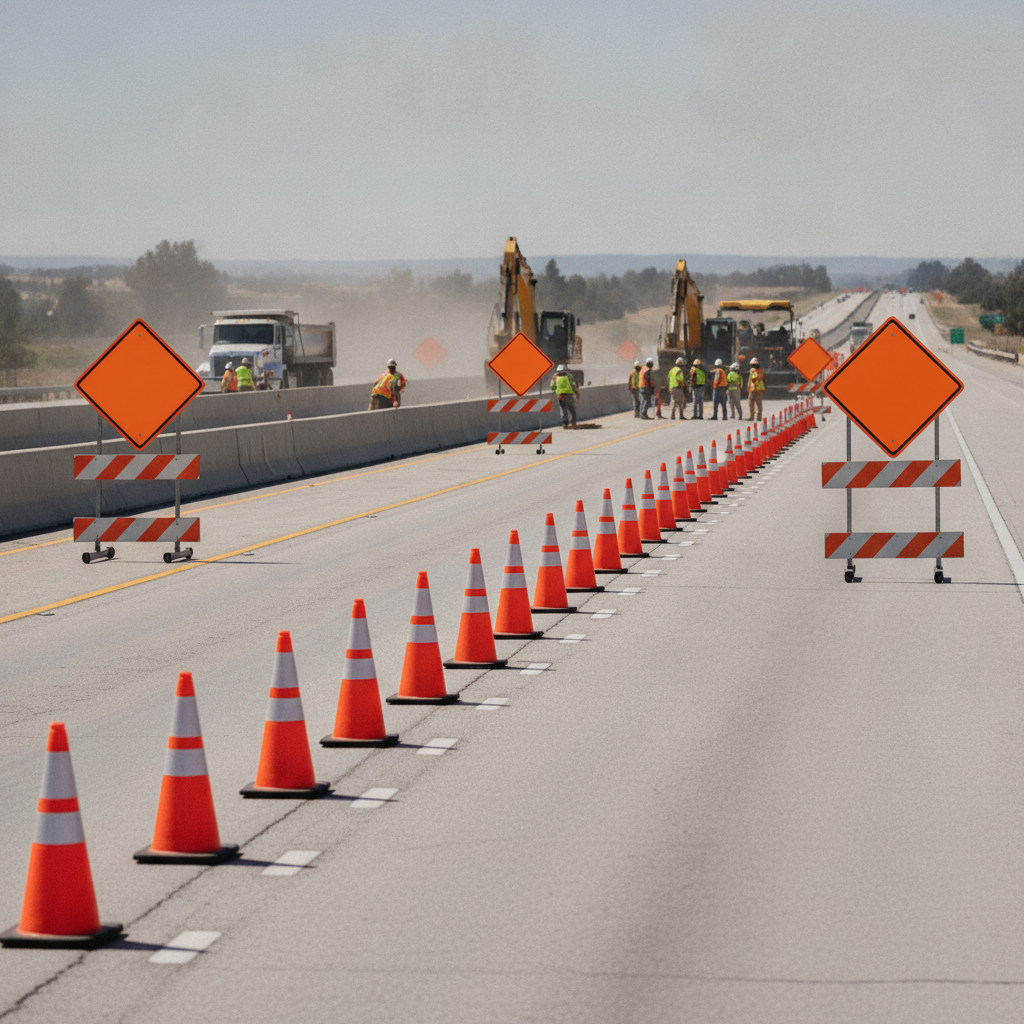
Work zone signs are temporary traffic control devices that warn and guide drivers and workers through road construction and maintenance areas in the USA. They use standardized shapes, colors, and reflectivity to communicate risk and direct safe movement. Done right, they reduce crashes, protect crews, and keep projects moving—day and night.
By Dante de Felice • Last updated: 2026-06-27
Overview and Table of Contents
This complete guide shows how to plan, select, place, and maintain work zone signs—centered on five essential components: sign faces, retroreflective materials, supports and hardware, placement and sequencing, and inspection and documentation. Use it to align field practice with standards and protect people in motion.
VisionMarker supports safety-critical operations across the USA with industrial signage built for harsh conditions and aligned to ANSI, NFPA, and ASME standards. In this guide you’ll learn how work zone signs fit into a full safety communication system and how to operationalize them on fast-moving jobs.
- What are work zone signs?
- Why work zone signs matter
- The 5 key parts of a compliant work zone sign system
- How work zone signage works on the ground
- Types of work zone signs and devices
- Best practices for safer work zones
- Tools, materials, and resources
- Practical examples and mini case studies
- Frequently Asked Questions
- Key takeaways and next steps
Quick Summary
Use work zone signs to deliver one clear message at a time, with high-contrast, retroreflective faces mounted at driver eye level and spaced for reaction time. Maintain a logical sequence: advance warning, transition, activity, and termination. Inspect daily and document changes as site conditions evolve.
Here’s what this guide covers at a glance, with tactical tips you can apply today.
- Core objective: Move people safely through temporary hazards with consistent, legible messages.
- Five-part system: Sign faces, reflectivity, supports, placement/sequence, inspection/documentation.
- Daily reality: Traffic volume, speed, sight distance, and weather drive real-world adjustments.
- Materials: UV-stable, chemical-resistant sign faces and hardware extend service life.
- Human factors: One message per sign; keep layouts simple; set heights and offsets for visibility.
Local considerations (USA)
- Follow nationally recognized standards and agency supplements applicable in the USA.
- Prioritize retroreflective sheeting visible in rain, fog, dusk, and full darkness.
- Account for seasonal daylight shifts and driver glare in summer and winter conditions.
What Are Work Zone Signs?
Work zone signs are temporary warning and regulatory devices used during road construction, utility work, and maintenance to notify drivers of changing conditions. They use standard shapes, colors, and symbols for instant recognition, and must remain legible in daylight and at night under vehicle headlights.
Think of work zone signs as a language for moving traffic through change. The symbols, colors, and shapes allow drivers to process instructions in fractions of a second. When the language is consistent—across states, contractors, and projects—drivers develop expectations that reduce surprise and support safer reactions.
How they differ from permanent signs
- Temporality: Deployed only when hazards or configurations exist; removed promptly afterward.
- Color and shape: Orange backgrounds for warnings, black legends for contrast; diamond or rectangular profiles dominate.
- Hardware: Portable stands, sandbag stabilization, and quick-attach hardware speed setup and teardown.
- Reflectivity: Emphasis on high-performance retroreflective sheeting for varied light and weather.
For facility and EHS teams coordinating near-road projects, work zone signs complement indoor and campus safety systems. VisionMarker’s broader catalog—such as warning sign categories and street and safety signs—helps unify messaging from site entrance to interior aisles.
Why Work Zone Signs Matter
Work zone signs reduce crash risk by setting expectations early, guiding speed choice, and directing safe path-of-travel. Clear, retroreflective messages give drivers time to see, understand, and act. The payoff is fewer conflicts, better throughput, and safer crews in changing conditions.
In high-speed contexts, fractions of a second matter. Visibility and message clarity affect perception-reaction times, which drive stopping distances and lane-change decisions. In our experience, the most resilient operations treat signage as a system rather than individual panels—sequencing messages so drivers never wonder “what’s next?”
- Safety impact: Logical sequences prevent last-second maneuvers near workers and equipment.
- Operational impact: Good signing maintains throughput, keeping detours and delays manageable.
- Compliance impact: Consistency with recognized standards reduces citation risk and improves audit outcomes.
Beyond the roadway, VisionMarker clients often integrate outdoor work zone control with indoor hazard communication. Teams pair diamond warning devices with facility signage like “PPE required” or “forklift traffic,” so the safety narrative stays coherent from perimeter to plant floor.
The 5 Key Parts of a Compliant Work Zone Sign System in 2026
A reliable work zone system rests on five parts: 1) sign faces and messages, 2) retroreflective materials and colors, 3) supports and hardware, 4) placement, spacing, and sequencing, and 5) inspection, maintenance, and documentation. Master these and you’ll manage visibility, comprehension, and control across changing conditions.
We organize this section around the five parts your field teams can control every shift. Each part includes selection tips, real-world examples, and a short checklist to apply before wheels roll.
Part 1: Sign faces and messages
- Message discipline: One message per sign—keep it short, with simple symbols or words.
- Core categories: Advance warnings (e.g., lane shifts), regulatory (e.g., reduced speed ahead), and guidance (e.g., detour arrows).
- Symbol support: Standardized icons help drivers recognize hazards faster, especially at speed.
- Context pairing: Pair outdoor warnings with indoor communication like ANSI Z535 sign guidance to reinforce consistent language.
Example: A utility crew staging a daytime shoulder closure can deploy a simple sequence—ROAD WORK AHEAD, RIGHT SHOULDER CLOSED, and END ROAD WORK. Each panel does one job. There’s no clutter and drivers don’t split attention scanning for extra meaning.
Part 2: Retroreflective materials and colors
- High-visibility sheeting: Choose microprismatic or other high-performance films for long-range detection at night and in rain.
- Color fidelity: Orange background, black legend for warnings; maintain contrast under headlights and glare.
- Durability: UV-stable films and inks resist fade; edge sealing and substrate selection extend life.
- Cleanliness: Dirt films and water spots can meaningfully reduce retroreflective return—clean before each shift.
In our field reviews, fading or grime often explains “invisible at night” complaints. A quick wipe and inspection before the cone truck departs often restores performance more than any other single action.
Part 3: Supports, stands, and hardware
- Stable bases: Use wind-rated portable stands with ballast; stabilize on uneven shoulders.
- Mounting: Quick-attach hardware keeps legends square and taut; avoid flapping roll-ups.
- Heights and offsets: Mount at driver eye band; offset from edge line for recovery space.
- Maintenance: Check springs, rivets, and latches; replace fatigued components before failure.
Example: Night paving with intermittent gusts. Crews switch to heavier bases and add sandbags to keep roll-ups upright. The reduced rework (no chasing down toppled signs) keeps the train moving and cuts exposure time on the shoulder.
Part 4: Placement, spacing, and sequencing
- Line-of-sight: Place signs where drivers can see them early—avoid vertical curves, foliage, or parked equipment blocking views.
- Readable gaps: Space messages so drivers can process one, act, then prepare for the next.
- Sequence logic: Advance warning → transition (tapers) → activity area → termination.
- Speed context: Higher approach speeds need longer advance notice and extended tapers.
Crews often benefit from a drive-through at operating speed before opening the lane. Small offsets and sign moves can dramatically improve sight lines and legibility in complex topography.
Part 5: Inspection, maintenance, and documentation
- Daily checks: Verify legends are clean, upright, and correctly sequenced; replace damaged faces.
- Shift logs: Record setup, changes, and removals; note weather, lighting, and any near-miss reports.
- Photo records: Capture start-of-shift conditions; photos speed incident review and training.
- Closeout: Remove or cover signs promptly to prevent “cry wolf” effects when work is done.
Documentation is your memory under pressure. When shift turnover happens fast, yesterday’s photos, notes, and diagrams anchor decisions and support continuous improvement.
| System Part | Main Goal | What To Verify | Common Pitfall |
|---|---|---|---|
| Sign faces | One clear message | Legibility and symbol clarity | Too many words or mixed messages |
| Reflectivity | Night and rain visibility | Clean, undamaged sheeting | Faded film or grime layer |
| Supports | Stay upright and square | Base stability and mount tightness | Under-ballasted stands in wind |
| Placement | Predictable driver actions | Sight lines and sequence timing | Blocked views near curves or equipment |
| Inspection | Catch issues early | Daily checks with photos | Forgetting removals at closeout |
How Work Zone Signage Works on the Ground
Field teams build a temporary traffic control sequence from the approach back: verify sight lines, place advance warnings, set tapers, define the activity area, and establish termination. Then they drive it, inspect at speed, document, and adjust for weather, lighting, and traffic.
Here’s a practical step-by-step workflow you can train to and audit. The details will vary by roadway type, speed, and work duration, but the control logic stays the same.
- Assess approach context: Note speed, lanes, curves, and obstructions; pick initial sign locations.
- Place advance warning: Start far enough upstream that drivers can decide and act without panic.
- Set transitions: Build tapers with cones or drums guiding the new path-of-travel.
- Define activity area: Protect workers and equipment with buffers and clear access points.
- Terminate cleanly: Provide an obvious “end of work” to restore normal expectations.
- Drive and adjust: Do a moving inspection at operating speed; tune offsets and heights.
- Document daily: Photos, notes, and diagrams capture what was actually in place.

| Setup Stage | Primary Action | Quality Check | Adjustment Cue |
|---|---|---|---|
| Advance Warning | Place first message | Visible, not blocked | Drivers braking too late |
| Transition | Build taper | Straight, uniform devices | Weaving near taper start |
| Activity Area | Protect crew zone | Buffers are respected | Encroachments or sudden stops |
| Termination | Restore normal flow | Clear “end work” message | Lingering slowdowns |
Types of Work Zone Signs and Devices
Most temporary traffic control plans combine orange diamond warnings, regulatory panels, channelizing devices (cones, drums, delineators), and lighting (beacons, arrow boards). Each device does a specific job—warn, guide, separate, or inform—so choose only what supports driver decisions.
Keep your device toolbox focused and familiar. Overloading the scene adds visual noise and slows comprehension. The right set depends on work duration, speed, and complexity.
Core devices and when to use them
- Diamond warning panels: Communicate lane shifts, workers, equipment crossings, or surface changes.
- Regulatory panels: Post temporary speed or lane-use controls when justified.
- Cones and drums: Build tapers and channelize traffic; add ballast for wind and wake turbulence.
- Delineators: Define edges on long work segments or low-speed detours.
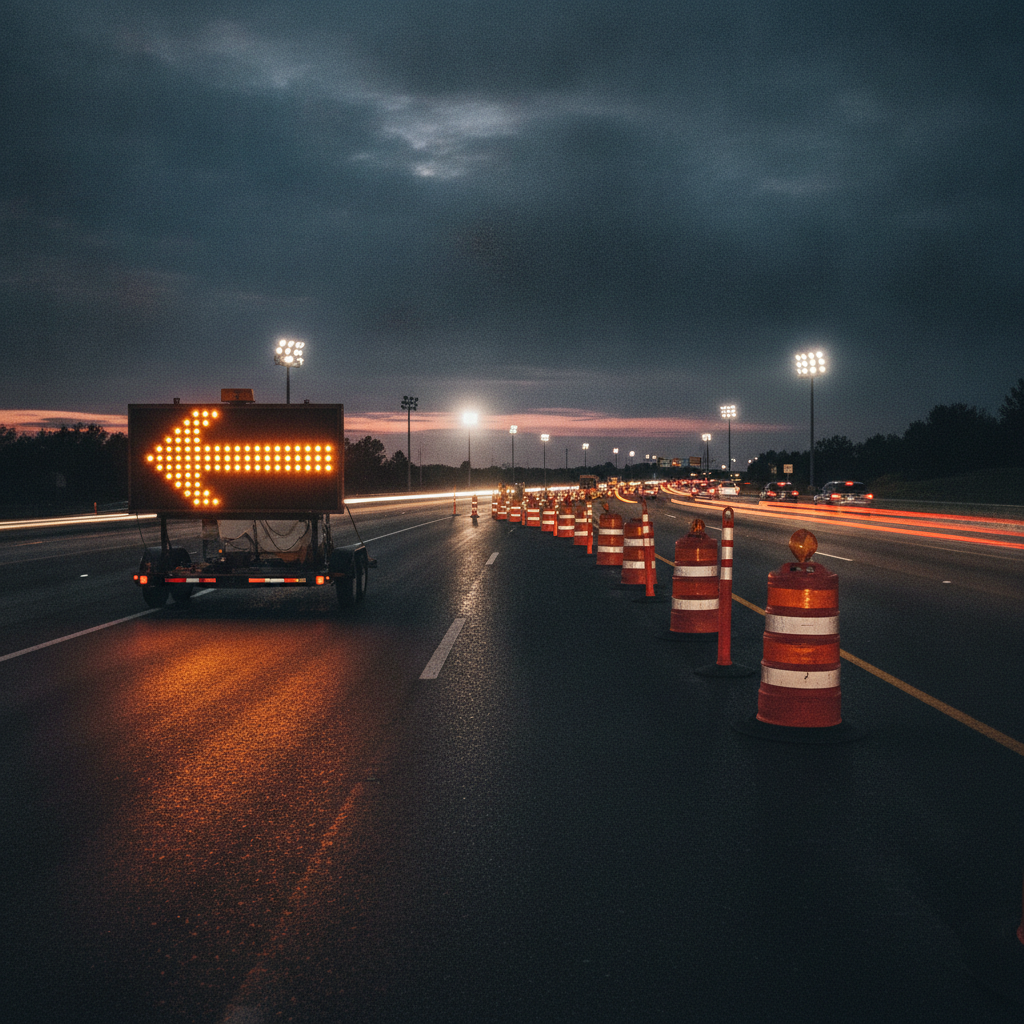
- Arrow boards: Reinforce merges or closures, especially at night and on multi-lane roads.
- Warning lights: Mark hazards or devices at night; avoid patterns that confuse drivers.
For broader safety communication, unify outdoor messages with facility systems. VisionMarker’s guidance on hazard markings and prohibited area signs helps you keep language consistent from highway shoulder to plant entrance.
Best Practices for Safer Work Zones
Design for human factors first: one message per sign, adequate reading time, and consistent sequencing. Keep devices upright and clean, remove unused signs, and document changes. Train crews to drive the setup at speed and fix sight-line issues before opening to traffic.
Strong crews operationalize a short list of rules religiously. Here’s the set we see separate high-performing operations from the rest.
- Clarity beats quantity: Add only devices that change decisions; remove anything redundant.
- Upright and square: A tilted panel is as hard to read as a dirty one; fix both.
- Housekeeping: Retire faded faces and frayed roll-ups; clean nightly during long runs.
- Consistency: Use the same sequence patterns across your program so drivers learn your “voice.”
- End work cleanly: “End Road Work” should be as visible as the first warning—closure clarity reduces residual slowdowns.
Looking for visual standards and symbol discipline across your facility? See our fire signage guide and our primer on ANSI Z535 sign design to keep warning formats uniform from roadway to workplace.
Tools, Materials, and Resources
Build your kit around durable, ANSI-aligned sign faces, high-performance retroreflective films, stable stands, and quick-attach hardware. Pair with channelizing devices, arrow boards, and cleaning supplies. Standardize checklists, inspection logs, and a camera for daily documentation.
VisionMarker’s product portfolio helps teams coordinate outdoor and indoor safety communication without mixed standards or mismatched color targets. EHS and operations leaders across the USA use our signage to bridge roadway control with plant-floor messaging.
Recommended components
- Signage: Orange warning faces with high-contrast legends; UV- and chemical-resistant construction.
- Reflectivity: Microprismatic sheeting for night, rain, and fog performance.
- Hardware: Wind-rated stands, sandbags, quick-attach brackets, and spare fasteners.
- Channelization: Cones, drums, delineators sized for roadway speed and duration.
- Lighting: Beacons and arrow boards for night operations and complex merges.
- Cleaning: Non-abrasive wipes and mild detergents to preserve retroreflective return.
Explore examples of industry gear such as high-visibility vests and PPE from the broader safety market (e.g., traffic safety vest examples) and general guides to signage selling (retail signage overview) for context on materials and visibility considerations. For construction-site safety concepts beyond traffic control, independent primers like this construction safety overview can help round out training topics.
Need a fast, standards-aligned solution?
VisionMarker provides ANSI-certified industrial signage with durable construction engineered for UV, moisture, and chemical resistance. Our team supports quick turnaround for safety-critical projects.
Practical Examples and Mini Case Studies
Effective programs pair clear outdoor warnings with consistent facility signage. Crews who standardize messages, reflectivity, and daily inspections report smoother traffic flow and fewer near-misses. The common thread: one disciplined, repeatable system from the first cone to the last “End Road Work.”
Utility shoulder closure (daylight, moderate speed)
- Objective: Protect a bucket truck and crew on a limited shoulder.
- Sequence: ROAD WORK AHEAD → RIGHT SHOULDER CLOSED → short taper with cones → END ROAD WORK.
- Outcome: Drivers anticipate the shoulder restriction and maintain lane position; no erratic braking.
- Reinforcement: Facility gates display PPE required and forklift traffic signs for consistency.
Night paving on multilane roadway
- Objective: Close one lane at a time while maintaining throughput.
- Sequence: Multiple advance warnings → arrow board on “merge left” → long, uniform taper with drums → END ROAD WORK.
- Outcome: Predictable merges reduce abrupt lane changes; fewer stops in the work area.
- Reinforcement: Indoors, teams use matching warning signage formats to sustain recognition patterns.
Warehouse campus detour (low-speed, long duration)
- Objective: Reroute traffic around a week-long utility excavation.
- Sequence: ROAD WORK AHEAD → DETOUR with arrows → DELINEATORS along new edge → END ROAD WORK at return point.
- Outcome: Consistent messages prevent cut-throughs; drivers stay on the intended path.
- Reinforcement: The facility’s ANSI Z535 signage keeps indoor warnings visually consistent.
Frequently Asked Questions
Plan from the approach back, use one message per sign, and inspect daily. Choose high-performance reflective faces, stable stands, and logical sequences. Remove signs when work ends. Document setups with photos to speed audits, training, and incident reviews.
What are the five essential parts of a work zone sign system?
Sign faces and messages, retroreflective materials and colors, supports and hardware, placement and sequencing, and inspection with documentation. Mastering these five keeps visibility high, messages clear, and setups consistent across changing field conditions.
How often should crews inspect temporary signs?
Inspect at the start of each shift and after major changes in weather, lighting, or traffic. Verify signs are clean, upright, legible, and properly sequenced. Document with quick photos and a short log so adjustments are traceable during reviews.
What’s the biggest mistake teams make with work zone signs?
Overloading drivers with too many messages. Keep one message per sign, remove anything not affecting a decision, and ensure the sequence unfolds predictably. Clean, upright, and well-placed signs prevent last-second reactions near workers.
How do indoor safety signs relate to road work zones?
Drivers and workers benefit from consistency. Using the same visual language outdoors and indoors—colors, symbols, and layout—reduces confusion. VisionMarker’s warning, fire protection, and hazard marking guides help unify that language across your site.
Key Takeaways and Next Steps
Treat work zone signs as a five-part system: clear faces, high-visibility reflectivity, stable supports, smart placement, and daily inspection. Keep messages simple, remove clutter, and document changes. Consistency across outdoor and indoor signage improves recognition, reduces risk, and speeds decisions.
- Standardize your kit: Use high-contrast, retroreflective faces and wind-stable stands.
- Sequence predictably: Advance warning, transition, activity, termination—every time.
- Audit daily: Clean, upright, legible; log changes with photos.
- Unify language: Align outdoor warnings with facility systems like warning signs.
If you’re building or upgrading a signage program, we can help. VisionMarker supplies ANSI-certified industrial signage and supports EHS, maintenance, and operations teams with fast, standards-aligned turnarounds—across the USA.